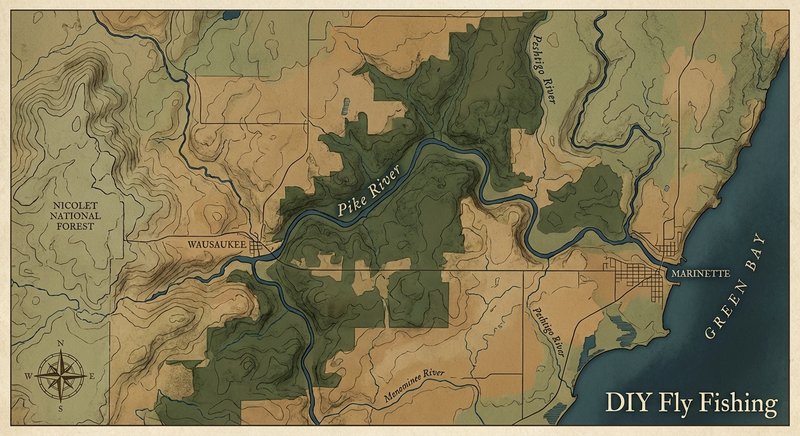
Pike River
Fly fishing in Wisconsin · Intermediate · Best seasons: Spring, Fall
Target Species
Steelhead, Brown Trout
About This Water
Northeast Wisconsin stream with steelhead runs. Lake Michigan tributary fishing.
Fishing Recommendations
The Pike River in Kenosha County, Wisconsin, is a unique gem among Lake Michigan tributaries. Unlike the massive, powerful rivers of Michigan or the rocky "steelhead alley" of Ohio/PA, the Pike is a small, intimate, and often moody stream. For the fly angler, it offers a "stealth-and-stalk" experience where you can catch trophy-sized migratory fish in water so narrow you could nearly jump across it.
Here is your guide to mastering the Pike River.
🎣 Location Overview
The Pike River flows through the southeastern corner of Wisconsin, emptying into Lake Michigan at Kenosha. It is characterized by its low gradient, muddy banks, and a mix of shale, gravel, and clay bottoms.
What makes it special is its intimacy. You aren't power-casting 60 feet of line here; you are flicking nymphs into deep undercut banks and navigating through tight corridors of overhanging brush. Because it is a small system, it is highly reactive to rain. It can go from a trickle to a chocolate-milk torrent in hours, but it "clears" (reaches a fishable green tint) faster than larger rivers.
🐟 Target Species & Behavior
The Pike is primarily a destination for Adreanous (migratory) species.
- Steelhead (Rainbow Trout): You will encounter both Chambers Creek (winter/spring spawners) and Skamania (summer/fall) strains. They are acrobatic and powerful. In this small water, a hooked steelhead is a chaotic event.
- Brown Trout: The Pike sees a massive run of Seeforellen and German Brown trout. These fish are often heavy-bodied and aggressive.
- Behavior: Because the water is shallow, these fish are extremely "spooky." They hold tight to structure—downed timber, undercut banks, and the deeper "dark" water of the bends. They rarely sit in the middle of a shallow riffle during daylight hours.
📅 Best Times to Fish
The Pike is strictly a seasonal fishery for fly anglers.
- Spring (March – April): This is the peak for Steelhead. As soon as the ice breaks and the water hits 38–42°F, fish begin moving. Look for "fresh" fish on the rise of the river and spawning fish on the gravel as it drops.
- Fall (October – December): This is the prime window for Lake Michigan Brown Trout and the start of the fall Steelhead run. The late October window, after a good rain has pushed fish past the harbor, is legendary.
- Conditions: The "magic" window is when the USGS gauge shows the river is receding after a rain and the water color turns from "chocolate" to "emerald green" (about 12–18 inches of visibility).
🪰 Recommended Flies & Techniques
Presentation on the Pike is about precision, not distance.
Top Fly Patterns
- Nymphs/Eggs:
- Estaz Eggs (Orange, Chartreuse, Peach) in sizes 10-14.
- Prince Nymphs and Pheasant Tails (weighted) in sizes 12-16.
- Nucleus Pellets or glow-bugs.
- Streamers:
- Woolly Buggers (Black or Olive) with lead eyes to get down fast.
- Egg-Sucking Leeches.
- Inductors:
- Small, subtle yarn indicators (large plastic bobbers will spook fish in this shallow water).
Effective Techniques
- High-Sticking / Tight-Line Nymphing: Given the narrowness, a traditional swing is often impossible. Use a long rod (9.5 or 10ft 7wt) to drop nymphs vertically into holes.
- The "Pike Flip": A short water-load cast to place your fly under overhanging branches on the opposite bank.
- Streamer Jigging: Instead of a traditional strip, jig a weighted bugger vertically near log jams.
💡 Pro Tips & Local Knowledge
- Stealth is Mandatory: If you walk up to the bank and see the fish, the fish has already seen you and likely won't strike. Wear earthy colors, stay low, and move slowly.
- Focus on the Parks: Petrifying Springs Park ("Pets") is the crown jewel of the Pike. It offers miles of public access with beautiful limestone bluffs and manicured banks that make casting slightly easier.
- The "Low Light" Rule: On the Pike, the fishing is 10x better at dawn and dusk. Once the sun hits the water, the fish tucked into the deepest shadows and become very difficult to entice.
- Check the Mouth: If the river is too low, the sandbar at the mouth (Kenosha Harbor) can sometimes close or become very shallow. If a storm opens the mouth, expect a fresh "push" of fish immediately.
⚠️ Important Information
- Access: Petrifying Springs Park is the most popular access point. Downstream, there are various pockets of public land near Kenosha, but be wary of private property boundaries—Wisconsin law generally allows you to fish as long as you "keep your feet wet" in the stream bed, but entry must be from public access.
- Regulations: This is a tributary of Lake Michigan. You need a Wisconsin Fishing License plus a Great Lakes Salmon & Trout Stamp.
- Gear Note: Use a 7-weight rod. A 5-weight is too light for a 12lb Brown Trout in heavy brush, and an 8-weight is often too clunky for the delicate presentations needed here. Use 8lb to 10lb fluorocarbon tippet; the fish are line-shy but the wood is unforgiving.
- Safety: The clay banks of the Pike are notoriously slippery ("Pike Snot"). Wading boots with aluminum bars or studs are highly recommended to avoid a slide into the drink.
Final Guide Advice: The Pike is a "reward for effort" river. You might walk two miles for one hookup, but that one fish will be a 30-inch chrome powerhouse in a stream no wider than a sidewalk. It’s an addictive challenge.
Bug Hatches & Matching Flies
| Hatch | Type | Peak months | Time of day | Hook sizes | Matching flies |
|---|---|---|---|---|---|
| Blue-Winged Olive Baetis spp. | mayfly | April, May, September, October | Afternoon | #18-22 | RS2 #18-22, BWO Sparkle Dun #18-20, Pheasant Tail #18-20 |
| Hendrickson Ephemerella subvaria | mayfly | May | Afternoon | #12-14 | Hendrickson Dark #12-14, Red Quill #14, Hendrickson Nymph #12-14 |
| Grannom Caddis Brachycentrus | caddis | May | Afternoon/Evening | #14-16 | Elk Hair Caddis (Olive) #14-16, Grannom Pupa #14-16, Deep Sparkle Pupa #14-16 |
| Giant Salmonfly Pteronarcys dorsata | stonefly | May, June | Morning/Evening | #4-8 | Pats Rubber Legs #6-8, Kaufmanns Stone #4-8, Stimulator (Orange) #8-10 |
| Sulfur Ephemerella invaria | mayfly | June | Evening | #14-18 | Sulfur Parachute #14-18, Sulfur Emerger #16-18, Sulfur Spinner #14-16 |
| Hex Hexagenia limbata | mayfly | June, July | Late Evening/Night | #4-8 | Hexagenia Dry #4-6, Hex Cripple #6, Wiggle Nymph (Tan) #6-8 |
| Light Cahill Stenacron interpunctatum | mayfly | June, July | Evening | #12-14 | Light Cahill Dry #12-14, Cream Usual #14, Gold Ribbed Hares Ear #12-14 |
| Trico Tricorythodes spp. | mayfly | August, September | Morning | #20-24 | Trico Spinner #20-24, Trico Parachute #22, Zebra Midge #20-22 |
| October Caddis Dicosmoecus | caddis | September, October | Afternoon/Evening | #8-12 | Orange Elk Hair Caddis #10-12, Stimulator (Orange) #8-10, October Caddis Pupa #10-12 |
| Grasshoppers Orthoptera | terrestrial | July, August, September | Afternoon | #8-12 | Dave's Hopper #8-12, Parachute Hopper #10-12, Morrish Hopper #8-10 |