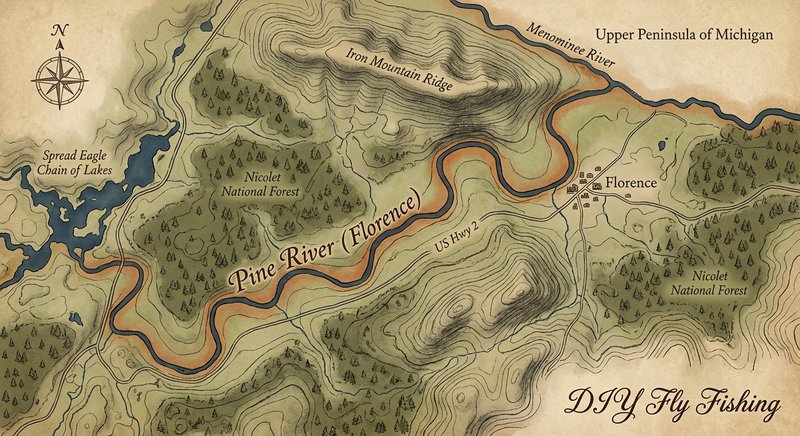
Pine River (Florence)
Fly fishing in Wisconsin · Intermediate · Best seasons: Summer, Fall
Target Species
Brook Trout, Brown Trout
About This Water
Northern Wisconsin stream with wild brook trout. Flows into the Menominee River.
Fishing Recommendations
The Pine River in Florence County, Wisconsin, is a crown jewel of the Northwoods. Designated as one of the state's "Wild Rivers," it offers an authentic wilderness experience that is increasingly rare. This isn't a manicured spring creek; it is a rugged, tannic, and timber-filled river that rewards stealth, precision, and a bit of "bushwhacking" spirit.
Here is your comprehensive guide to fly fishing the Pine River.
🎣 Location Overview
The Pine River flows through the glacial landscapes of Northeast Wisconsin. It is characterized by its tannic (tea-colored) water, which comes from the surrounding cedar swamps and hemlock forests. This acidity and color keep the water cooler than many other Midwestern freestone streams, though it remains sensitive to extreme summer heat.
Anglers love the Pine for its seclusion. Because it flows through the Nicolet National Forest, large stretches are inaccessible by road, requiring a hike or a canoe to reach the best water. The riverbed varies from fast-moving gravel riffles and boulder gardens to deep, slow-moving pools guarded by massive "sweepers" (downed trees).
🐟 Target Species & Behavior
- Brook Trout: These are the native residents. In the upper reaches and smaller tributaries (like the Popple River), Brookies are king. They are opportunistic feeders but highly skittish. They hold in the cold-water bubbles at the base of small falls and in the "skinny" water near the banks.
- Brown Trout: As the river gains volume and moves toward the Menominee River confluence, Brown Trout become the dominant predator. These fish are notorious for living deep under log jams. They are most active during low-light conditions and are known to smash large streamers or "dries" during major hatches.
- Behavior: Due to the dark water, fish here often rely on vibration and silhouette. They aren't as "picky" about fly size as Spring Creek trout, but they are much more sensitive to shadows and bank vibrations.
📅 Best Times to Fish
Summer (June – August)
- The Hex Hatch: Late June through early July features the legendary Hexagenia limbata (Giant Michigan Mayfly) hatch. This is the best chance to land a trophy Brown Trout on a dry fly.
- Terrestrial Season: Late July and August are prime for hoppers, ants, and beetles dropped from the overhanging forest canopy.
- Time of Day: Early morning (before 9:00 AM) and "The Magic Hour" (sunset to dusk) are the only times to fish during high summer to avoid stressing the fish in warmer water.
Fall (September – October)
- Pre-Spawn Aggression: This is arguably the best time for streamers. Brook Trout take on vivid orange hues, and Brown Trout become extremely territorial.
- Conditions: Cool, overcast days are perfect. A light rain often "turns on" the big fish.
- Note: Always check the WDNR season closure dates, as the inland trout season typically ends October 15th.
🪰 Recommended Flies & Techniques
Dry Flies
- The Classics: Parachute Adams (#12-16), Elk Hair Caddis (#14-18), and Royal Wulff.
- The "Big Meat": Hexagenia patterns (#4-6) for night fishing in July.
- Terrestrials: Black Foam Ants, Chernobyl Ants, and Dave’s Hoppers.
Nymphs
- The Pine Special: Gold-ribbed Hare’s Ear (#14-16) and Pheasant Tails.
- Attractors: Prince Nymphs and Rainbow Warriors work well in the tannic water due to their flash.
- Technique: Use a high-sticking or Euro-nymphing approach in the deeper runs near the Hwy 101 bridge.
Streamers
- Patterns: Woolly Buggers (Black or Olive), Muddler Minnows (representing sculpins), and Sparkle Minnows.
- Technique: "Pound the wood." Cast your streamer as close to downed logs as possible, give it two strips, and get ready.
💡 Pro Tips & Local Knowledge
- Respect the "Wood": The Pine is famous for downed timber. If you aren't losing a few flies to the trees, you aren't fishing in the right spots. Use a slightly heavier tippet (3X or 4X) than you would on a spring creek to pull fish away from the logs.
- Stealth is Mandatory: Because the water is dark, trout can't see you as easily from a distance, but they are very sensitive to wading vibrations. Move slowly and avoid "sloshing."
- The "Oxbow" Area: Look for the oxbows and bends south of Florence. These areas create deep scouring pools where the largest Browns reside.
- Canoe Access: For the ultimate experience, float the river from Chipmunk Rapids. It allows you to reach "virgin" water that shore anglers never see.
⚠️ Important Information
- Regulations: The Pine River has different regulations depending on the stretch. Much of it is Category Yellow or Green under Wisconsin’s trout tool. Always check the WDNR Trout Tool before heading out.
- Access: Key access points include the Hwy 101 Bridge, Chipmunk Rapids Campground, and the Pine River Falls area. Be prepared for steep banks and thick brush.
- Safety: This is true Northwoods wilderness. Cell service is spotty to non-existent. Carry a compass/GPS, bear spray (black bears are common), and plenty of bug repellent—the mosquitoes and "no-see-ums" can be brutal in June.
- Permit: You must have a valid Wisconsin Fishing License and an Inland Trout Stamp.
Guide’s Final Word: The Pine River doesn't give up its secrets easily. You will work for every fish, but standing in the middle of a Wild River with a 14-inch native Brookie in your net is a feeling that no crowded tailwater can replicate.
Bug Hatches & Matching Flies
| Hatch | Type | Peak months | Time of day | Hook sizes | Matching flies |
|---|---|---|---|---|---|
| Hendrickson Ephemerella subvaria | mayfly | May | Afternoon | #12-14 | Red Quill #12-14, Hendrickson Emerger #14, Pheasant Tail #12-14 |
| Grannom Caddis Brachycentrus | caddis | May | All Day | #14-16 | Elk Hair Caddis (Dark) #14-16, Deep Sparkle Pupa #14-16, Peacock Caddis #16 |
| Blue-Winged Olive Baetis spp. | mayfly | May, September, October | Mid-day/Afternoon | #18-22 | RS2 #20-22, Parachute BWO #18-22, WD-40 #20 |
| Giant Michigan Mayfly (Hex) Hexagenia limbata | mayfly | June, July | Dusk/Night | #6-10 | Hexagenia Spinner #6-8, Hex Nymph #8, Wiggle Hex #8 |
| Light Cahill Stenacron candadense | mayfly | June, July | Evening | #12-14 | Light Cahill #12-14, Gold Ribbed Hare's Ear #14 |
| Giant Golden Stonefly Acroneuria lycorias | stonefly | June | Evening | #8-12 | Golden Stone Nymph #8-10, Stimulator (Yellow) #10-12 |
| Trico Tricorythodes | mayfly | July, August, September | Early Morning | #20-24 | Trico Spinner #22-24, Zebra Midge #20-22 |
| Terrestrials Formicidae / Coleoptera | terrestrial | July, August | All Day | #12-18 | Black Foam Ant #16-18, Chernobyl Ant #12, Crowe Beetle #14-16 |