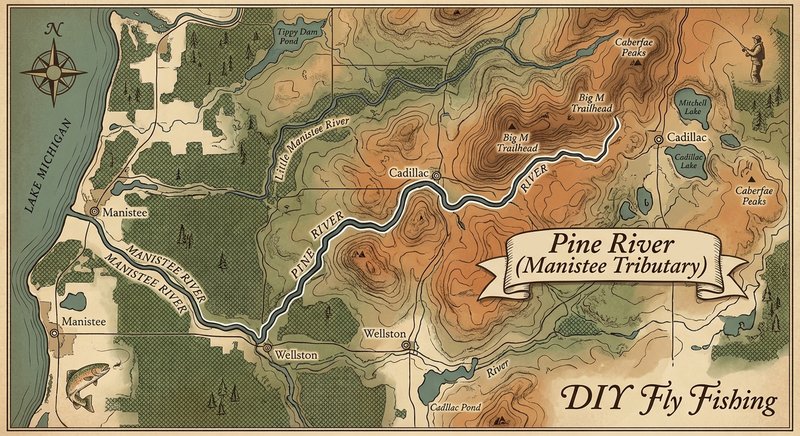
Pine River (Manistee Tributary)
Fly fishing in Michigan · Intermediate · Best seasons: Spring, Fall
Target Species
Brown Trout, Steelhead
About This Water
Fast-flowing stream popular with paddlers and anglers. Brown trout and steelhead runs.
Fishing Recommendations
The Pine River, a premier tributary of the Manistee River in Michigan’s Lower Peninsula, is a "Wild and Scenic" designated waterway. It is unique in Michigan for its high gradient—dropping significantly faster than its neighbors like the Au Sable or the Manistee—giving it a character more akin to a mountain stream than a typical Midwestern river.
Here is your comprehensive guide to fly fishing the Pine River.
🎣 Location Overview
The Pine River flows through the heart of the Huron-Manistee National Forest. It is a cold, quick-flowing, and incredibly clear river. What makes the Pine special is its ruggedness. Unlike the broad, easy-wading stretches of the main-stem Manistee, the Pine is tight, choked with "sweepers" (fallen trees), and features clay banks and deep holes.
Anglers love the Pine for its wildness. The resident brown trout are almost entirely stream-born (wild), and the river provides a sanctuary for those looking to escape the crowds often found on the bigger rivers. It is a technical river that rewards accuracy and stealth over long-distance casting.
🐟 Target Species & Behavior
Brown Trout (Resident)
The Pine is a "Blue Ribbon" trout stream. The resident browns are wary and highly structure-oriented. They live under the "wood"—the massive log jams that define this river.
- Behavior: During the day, they tuck deep into cover. They are opportunistic feeders but become highly predatory as they grow, switching to a diet of crayfish, sculpins, and smaller trout.
Steelhead (Migratory)
The Pine receives a solid run of Lake Michigan steelhead that push up through the Tippy Dam pond.
- Behavior: Steelhead in the Pine are often found in the deeper, darker pools during their move upstream. When spawning, they utilize the gravel runs (redds). They are incredibly powerful in the Pine's fast current, making them a significant challenge to land.
📅 Best Times to Fish
Spring (Late March – May)
- Focus: Steelhead and early-season Trout.
- Conditions: The steelhead run peaks in April. As the water warms into May, the Hendrickson mayfly hatch begins, providing the first major dry fly action of the year for resident browns.
Fall (September – November)
- Focus: Pre-spawn Brown Trout and "Fall Run" Steelhead.
- Conditions: This is the time for "Streamer Eaters." As brown trout prepare to spawn, they become hyper-aggressive. October also sees the arrival of the first push of fall steelhead following the salmon (though the Pine has fewer salmon than the main Manistee).
Prime Windows
- Time of Day: For trout, low light is essential. The Pine is very clear; midday sun sends big fish deep under logs. Fish the "grey light" of dawn and dusk.
- Weather: Overcast, drizzly days are "trophy days" on the Pine.
🪰 Recommended Flies & Techniques
Streamer Fishing (The Pine River Specialty)
The most productive way to find a trophy Brown is to "pound the wood."
- Technique: Use a sink-tip line and cast as close to the logs as possible. Give the fly immediate motion.
- Patterns: Kelly Galloup’s Dungeon (Olive or Black), Sparkle Minnows, and Zoo Cougars.
Nymphing (Steelhead & Trout)
- Technique: High-sticking or indicator nymphing through the deep runs and "buckets."
- Patterns:
- Steelhead: Hex Nymphs, Egg patterns (Oregon Cheese, Clown Egg), and Stoneflies.
- Trout: Prince Nymphs, Pheasant Tails, and Rubber-legged Stones.
Dry Fly Fishing
- Technique: Precision casting to rising fish in the "seams" between the fast current and the wood.
- Patterns: Hendricksons (May), Sulfurs (June), and the legendary Hexagenia limbata (late June/July). In late summer, Hoopers and Terrestrials are deadly near the grassy banks.
💡 Pro Tips & Local Knowledge
- The "Aluminum Hatch": The Pine is a very popular destination for paddlers (canoes and kayaks). From June through August, between 10:00 AM and 4:00 PM, the river can be crowded with boats. To find peace, fish the margins: Get on the water at sunrise and be off by 10, or start your "evening hatch" session after 5:00 PM.
- Wading Caution: The Pine has "clay slides" and soft sand pockets. The current is faster than it looks. A wading staff is highly recommended, and always wear a belt with your waders.
- The "Short Game": You will rarely need to cast more than 30 feet. Focus on "dinking" your streamers into small pockets of slow water behind logs. If you aren't losing a few flies to the trees, you aren't fishing deep enough into the cover.
⚠️ Important Information
Access Points
- Silver Creek: Good wading access.
- Dobson Bridge: A popular launch and wading spot.
- Peterson Bridge: Central location with good access above and below the bridge (US-31 area).
- Lowman’s Bridges: Great upper-river access.
Regulations & Permits
- License: A valid Michigan Fishing License is required.
- Watercraft Permits: If you plan to float the river (even in a personal raft/pontoon), the Pine is a Permit-Only river through the US Forest Service during the peak season (Memorial Day through Labor Day). These must be reserved in advance via Recreation.gov.
- Type 4 Water: Much of the Pine is classified as Type 4 water. This means it is open all year for catch and release, but check the Michigan DNR Fishing Guide for specific boundary lines and possession seasons.
Special Considerations
The Pine is a fragile ecosystem. Please practice Catch and Release for the wild resident brown trout to ensure this fishery remains a "Blue Ribbon" destination for generations to come.
Bug Hatches & Matching Flies
| Hatch | Type | Peak months | Time of day | Hook sizes | Matching flies |
|---|---|---|---|---|---|
| Blue-Winged Olive Baetis / Acerpenna | mayfly | April, May, September, October | Midday | #18-22 | RS2 #18-20, Parachute Adams #18-22, BWO Sparkle Dun #18-20 |
| Hendrickson Ephemerella subvaria | mayfly | May | Afternoon | #12-14 | Hendrickson Parachute #12-14, Red Quill Spinner #14, Pheasant Tail Nymph #12-14 |
| Sulphur Ephemerella invaria / dorothea | mayfly | May, June | Evening | #14-18 | Sulphur Parachute #16-18, Sulphur CDC Emerger #16-18 |
| Golden Stonefly Acroneuria michiganensis | stonefly | June, July | Morning/Evening | #6-10 | Pat's Rubber Leg #6-10, Golden Stimulator #8-10 |
| Brown Drake Ephemera simulans | mayfly | June | Late Evening | #10-12 | Brown Drake Spinner #10-12, Brown Drake Paradrake #10-12 |
| Giant Michigan Mayfly (Hex) Hexagenia limbata | mayfly | June, July | Night | #4-8 | Hexagenia Spinner #4-6, Bear's Hex #6 |
| Spotted Sedge Hydropsyche | caddis | May, June, July, August | Evening | #14-18 | Elk Hair Caddis #14-18, LaFontaine Sparkle Pupa #14-16, Holy Grail Caddis #14-16 |
| Slate Drake Isonychia bicolor | mayfly | June, July, August, September | Afternoon/Evening | #10-12 | Isonychia Parachute #10-12, Zug Bug #10-12 |
| Terrestrials (Grasshoppers/Ants) N/A | terrestrial | July, August, September | Midday | #8-16 | Dave's Hopper #8-12, Chernobyl Ant #10-14, Black Foam Ant #16 |
| Grannom Caddis Brachycentrus | caddis | April, May | Morning/Afternoon | #14-16 | Grannom Pupa #14-16, Peacock Caddis #14-16 |