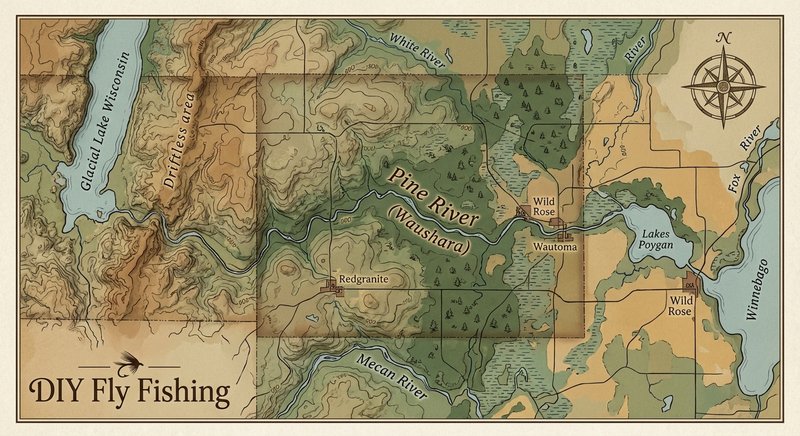
Pine River (Waushara)
Fly fishing in Wisconsin · Beginner · Best seasons: Spring, Summer, Fall
Target Species
Brook Trout, Brown Trout
About This Water
Central Wisconsin stream with wild brook and brown trout. Remote sections available.
Fishing Recommendations
The Pine River in Waushara County is a crown jewel of Central Wisconsin trout fishing. While the Driftless Area to the west gets much of the national press, the "Central Sands" region—and the Pine River specifically—offers a unique, spring-fed experience characterized by crystal-clear water, lush forests, and high trout densities.
As your guide, here is the deep dive into mastering the Pine.
🎣 Location Overview
The Pine River is a classic "sand-country" spring creek. Unlike the limestone-rubble streams of the Driftless, the Pine flows through glacial outwash sands. This results in incredibly stable water temperatures (cold in summer, rarely freezing in winter) and a stream bed characterized by shifting sand, gravel riffles, and an immense amount of woody debris.
What makes it special is its wild character. The Pine has excellent natural reproduction of both Brown and Brook trout. It is a "busy" river—not in terms of crowds, but in terms of structure. You’ll be casting around downed logs, overhanging alders, and deep undercut banks. It requires technical precision but rewards you with some of the prettiest wild fish in the Midwest.
🐟 Target Species & Behavior
- Brook Trout: Found primarily in the upper reaches (upstream of Wild Rose). They are stunning, vibrant fish that hold in the swifter, colder oxygenated ripples and near the heads of pools. They are opportunistic but very "spooky" in the clear water.
- Brown Trout: These dominate the middle and lower sections. They are the masters of the "wood." A Pine River brown trout is rarely found in the open; they tuck deep under log jams and wait for food to drift by.
- Feeding Behavior: Because the river is nutrient-rich, the fish are well-fed. They focus heavily on scuds (freshwater shrimp) and caddis larvae year-round. During summer, they become highly focused on the surface for terrestrial insects and the legendary Hexagenia hatch.
📅 Best Times to Fish
- Spring (Late April – May): This is the window for Blue Winged Olives (BWOs) and early Caddis. The water is high but clear. This is the best time for nymphing the deep holes before the vegetation gets too thick.
- Summer (June – August): The "Golden Era" on the Pine.
- The Hex: Late June through early July features the Hexagenia limbata (Giant Mayfly) hatch. This happens at dusk and into the night—this is your best chance at a 20-inch Brown.
- Terrestrials: August is prime for ants, beetles, and crickets dropped from the overhanging banks.
- Fall (September – October 15th): The Brookies and Browns are coloring up for the spawn. They become aggressive and territorial. Streamer fishing is most productive now.
- Time of Day: During the heat of summer, midday can be slow. Focus on the "edges of the day" (dawn and dusk). On cloudy, drizzly days, the fishing can stay "hot" all day long.
🪰 Recommended Flies & Techniques
Dry Flies
- The Classics: Elk Hair Caddis (size 14-18), Parachute Adams (16-20).
- The "Hex": Large foam-bodied Hex patterns or Michigan Nightingales (size 4-6) for the night hatch.
- Terrestrials: Fat Albert (size 10), Foam Beetles, and Cinnamon Ants.
- Technique: Use a "Reach Cast." Because the current is micro-managed by logs and bends, a standard cast will result in immediate drag. You need to land your fly with a mend already built into the line.
Nymphs & Scuds
- Wisconsin Staples: The Pink Squirrel (size 14-16) and the Gold-Ribbed Hare’s Ear.
- Scuds: Olive or Orange scuds (size 16-18) are essential. The Pine is crawling with them.
- Technique: "Tight-lining" or Euro-nymphing is difficult here due to the wood. Use a small, sensitive strike indicator and be prepared to lose flies. If you aren't bumping the wood, you aren't where the fish are.
Streamers
- Patterns: Woolly Buggers (Black or Olive), Muddler Minnows (simulating sculpins).
- Technique: The "Pound the Bank" method. Cast tight to the logs and strip aggressively.
💡 Pro Tips & Local Knowledge
- "Wood is Good": If you see a pile of downed trees that looks impossible to fish, figure out a way to get a fly near it. That is where the "Wall Hanger" Browns live.
- Stealth is Mandatory: The sand bottom doesn't crunch like gravel, but vibrations travel. Wear drab clothing (greens/browns) to blend into the alders. Avoid wading whenever possible; fish from the bank or the very edge of the water.
- The Downstream Drift: In very tight quarters, try "dapping" or letting a dry fly drift downstream of you on a long line to reach fish that would see you if you tried to cast from below them.
- Check the "Wild Rose" Area: The stretch near the state fish hatchery is excellent for numbers of fish, though they may be smaller on average.
⚠️ Important Information
- Access: Much of the Pine River is buffered by WDNR (Wisconsin Dept. of Natural Resources) fishing easements. Look for the "Public Fishing Area" signs at bridge crossings.
- Regulations: Waushara County trout regulations can vary by segment. As of current rules, much of the Pine is under "Category 4" or "Category 5" (Special regs). Always check the current WDNR Trout Tool (online map) before heading out, as some sections are Catch and Release only or have specific lure requirements (artificial only).
- Wading Safety: While mostly sandy, there are "muck holes" near the banks that can be waist-deep. Use a wading staff.
- Permits: You need a Wisconsin Fishing License AND an Inland Trout Stamp.
The Pine River is a rewarding, technical, and beautiful stream. Respect the private property between easements, pinched barbs for easy release of the wild fish, and enjoy one of the best spring creeks in the Midwest!
Bug Hatches & Matching Flies
| Hatch | Type | Peak months | Time of day | Hook sizes | Matching flies |
|---|---|---|---|---|---|
| Blue-Winged Olive Baetis | mayfly | April, May, September, October | Mid-day | #18-22 | RS2 #20-22, BWO Sparkle Dun #18-20, Pheasant Tail Nymph #18-22 |
| Hendrickson Ephemerella subvaria | mayfly | April, May | Afternoon | #12-14 | Hendrickson Sparkle Dun #12-14, Red Quill #12-14, Hendrickson Nymph #12-14 |
| Grannom Caddis Brachycentrus | caddis | May | Morning/Afternoon | #14-16 | Peacock Caddis #14-16, LaFontaine's Deep Pupa #14-16, Elk Hair Caddis (Olive) #14-16 |
| Sulphur Ephemerella invaria | mayfly | June | Evening | #14-16 | Sulphur Parachute #14-16, Sulphur Emerger #14-16, Pheasant Tail (Flashback) #14-16 |
| Light Cahill Stenacron interpunctatum | mayfly | June, July | Evening | #12-14 | Light Cahill #12-14, Cream Usual #12-14, Gold Ribbed Hare's Ear #12-14 |
| Hex Hexagenia limbata | mayfly | June, July | Night | #6-8 | Hexagenia Spinner #6-8, Wiggle Nymph (Hex) #6-8, Michigan Night Skater #6-8 |
| Trico Tricorythodes | mayfly | July, August, September | Early Morning | #20-24 | Trico Spinner (Poly Wing) #20-24, Griffith's Gnat #20-22, Trico Nymph #22-24 |
| Terrestrials Formicidae / Gryllidae | terrestrial | July, August, September | Afternoon | #12-18 | Cinnamon Ant #16-18, Black Foam Beetle #14-16, Dave's Hopper #12 |