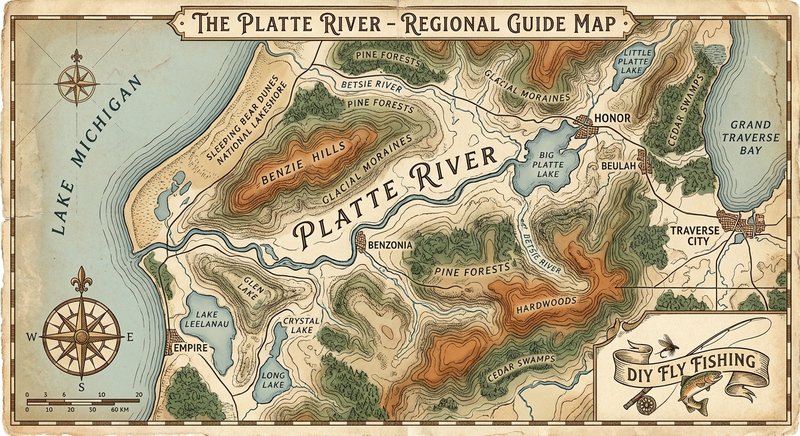
Platte River
Fly fishing in Michigan · Beginner · Best seasons: Spring, Fall
Target Species
Steelhead, Coho Salmon, Brown Trout
About This Water
Crystal clear waters near Sleeping Bear Dunes. Historic coho salmon restoration river.
Fishing Recommendations
The Platte River in Benzie County, Michigan, is a gem of the Midwest. While it is smaller and more intimate than the nearby Manistee or Muskegon rivers, it holds a legendary status as the "birthplace" of the Great Lakes salmon program. Known for its gin-clear water and sandy bottom, the Platte offers a unique visual fishing experience that can be both incredibly rewarding and technically challenging.
🎣 Location Overview
The Platte River is a quintessential Northern Michigan stream. It is divided into two distinct personalities: the Upper Platte (above the Platte River State Fish Hatchery) and the Lower Platte (from the hatchery down to Lake Michigan).
What makes the Platte special is its clarity. Unlike many Michigan rivers that carry a "tannin" (tea-colored) stain, the Platte is often crystal clear. This allows for incredible sight-fishing opportunities but demands stealth from the angler. The river flows through the Sleeping Bear Dunes National Lakeshore at its mouth, providing some of the most scenic backdrops in fly fishing.
🐟 Target Species & Behavior
Coho Salmon
The Platte is the premier Coho destination in Michigan.
- Behavior: Coho are more aggressive than Chinook (Kings). They are known for their "acrobatic" fights and willingness to chase a moving fly.
- Holding: They stack up in the deeper holes and under log jams in the lower river.
Steelhead
- Behavior: You’ll find both fall-run (following the salmon to eat eggs) and spring-run (spawning) fish.
- Holding: Look for them in the "seams" of the current and on the gravel transitions at the head of pools.
Brown Trout
- Behavior: The river has a healthy population of resident Browns. They are opportunistic but wary.
- Feeding: They feed on heavy hatches of Hendricksons, Sulfurs, and Hexagenia in the summer, but switch to eggs and fry in the spring and fall.
📅 Best Times to Fish
Fall (September – November)
- Late September/Early October: This is the peak for Coho Salmon. The river can be crowded, but the fishing is electric.
- November: The "Guide's Favorite" time. The crowds thin out, and the big, chrome Steelhead move in to feast on loose salmon eggs.
Spring (March – May)
- Late March/April: The primary run for Spring Steelhead. As the water warms to the 40°F–50°F range, fish become very active on the gravel.
Best Conditions
- Time of Day: Low light is your best friend. In the Platte’s clear water, fish are "spooky." Start at the crack of dawn or fish until the final minutes of dusk.
- Weather: Overcast, "gloomy" days are better than bluebird skies. A light rain can often trigger a fresh push of fish from Lake Michigan.
🪰 Recommended Flies & Techniques
Techniques
- Indicator Nymphing: The most effective way to target Steelhead and Salmon here. Use a long, fluorocarbon leader (9–12 feet) to account for the clear water.
- Stripping Streamers: Specifically for Coho. A fast, erratic retrieve can trigger an instinctual strike.
- Swinging Spey: The lower reaches near the mouth offer room to swing small intruders or leeches for fresh-run fish.
Top Fly Patterns
- Eggs: Nuke Eggs, Scuds, and Glo-Bugs in "Oregon Cheese," Chartreuse, and Pale Pink. (Size 8–12).
- Nymphs: Hexagenia nymphs, Prince Nymphs, and Stoneflies (Size 8–14).
- Streamers: For Coho, use Flashy Buggers (Blue/Silver or Pink/White). For Steelhead, use Egg-Sucking Leeches in purple or black.
- Beads: 8mm and 10mm beads in "Mottled Cream" or "Dead Orange" are standard local equipment.
💡 Pro Tips & Local Knowledge
- The Stealth Factor: Because the water is so clear, avoid "wading through the kitchen." Stay on the banks as much as possible and move slowly. If you see the fish, they have likely already seen you.
- The Weir Factor: Be aware of the Lower Platte River Weir. This is a fish-counting station managed by the DNR. It can temporarily block fish passage, so check local reports to see if the "gates are open."
- Longer Rods: A 9'6" or 10' fly rod (7-weight for Steelhead, 8-weight for Salmon) helps with line control and keeping your fly line off the water to avoid spooking fish.
- Focus on the "Tail-outs": While everyone crowds the deep holes, active Steelhead often sit in the shallower "tail-outs" (the end of the pool where the water accelerates) during low light.
⚠️ Important Information
- Regulations: The Platte has specific "Type" designations (Type 4 for much of the lower river). This means it is open year-round for trout and salmon, but always check the current Michigan DNR Fishing Guide as boundaries near the hatchery and the weir have seasonal closures.
- Access Point:
- The Mouth: Platte River Point (Sleeping Bear Dunes) for "surf" casting.
- M-22 Bridge: A popular spot for launching or wading.
- Riverside Canoe Livery: Good access, but busy with paddlers in early September.
- Wading Safety: The bottom is mostly sand, which is easy wading, but watch out for "suck holes" and submerged timber which can shift after heavy rains.
- Park Pass: If fishing within the Sleeping Bear Dunes National Lakeshore boundaries, you will need a National Park pass.
Guide’s Final Word: The Platte is a "finesse" river. Scale down your tippet to 2X or 3X fluorocarbon, keep a low profile, and enjoy the sight of a 10lb Steelhead charging through water so clear it looks like air.
Bug Hatches & Matching Flies
| Hatch | Type | Peak months | Time of day | Hook sizes | Matching flies |
|---|---|---|---|---|---|
| Blue-Winged Olive (BWO) Baetis spp. | mayfly | April, May, September, October | Midday | #18-22 | Adams Parachute #18-22, Pheasant Tail #18-20, RS2 #20-22 |
| Hendrickson Ephemerella subvaria | mayfly | May | Afternoon | #12-14 | Red Quill #12-14, Hendrickson Nymph #12-14, Quill Gordon #12 |
| Grannom Caddis Brachycentrus | caddis | April, May | Morning/Afternoon | #14-16 | Elk Hair Caddis (Olive) #14-16, Pupa-Peep #14-16, Deep Sparkle Pupa #14-16 |
| Sulfur / Pale Evening Dun Ephemerella invaria/dorothea | mayfly | June, July | Evening | #14-18 | Sulfur Parachute #14-18, Sulfur Spinner #16-18, Rabbit Foot Emerger #16 |
| Giant Michigan Mayfly (Hex) Hexagenia limbata | mayfly | June, July | Night | #4-8 | Hexagenia Spinner #4-6, Hex Parasol #6-8, Wiggle Hex Nymph #6-8 |
| Slate Drake Isonychia bicolor | mayfly | July, August, September | Afternoon/Evening | #10-12 | Iso Parachute #10-12, Prince Nymph #10-12, Zug Bug #10-14 |
| Cinnamon Caddis Hydropsyche | caddis | June, July, August | Evening | #14-18 | Elk Hair Caddis (Tan) #14-18, Holy Grail #14-16, Iris Caddis #16 |
| Terrestrials (Ants/Beetles) Formicidae / Coleoptera | terrestrial | July, August, September | All Day | #12-18 | Cinnamon Ant #14-18, Foam Beetle #12-16, Chernobyl Ant #8-12 |