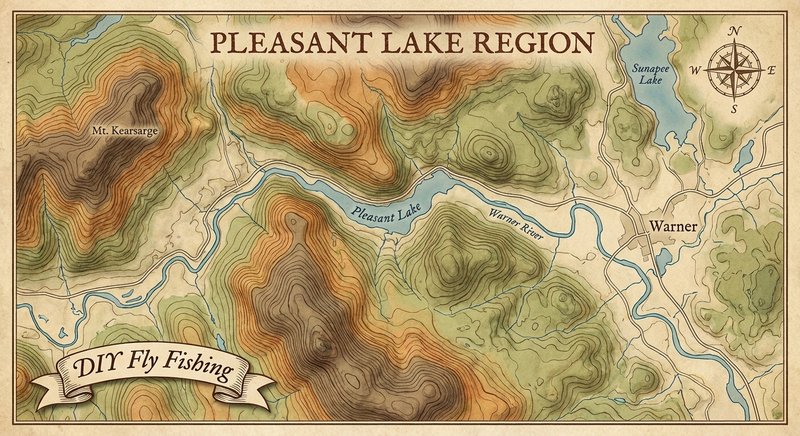
Pleasant Lake
Fly fishing in New Hampshire · Beginner · Best seasons: Spring, Summer, Fall
Target Species
Smallmouth Bass, Largemouth Bass, Pickerel
About This Water
Merrimack County lake with bass and panfish. New London area.
Fishing Recommendations
Welcome to one of the gems of the Dartmouth-Lake Sunapee region. As your guide, I can tell you that Pleasant Lake in New London/Elkins, New Hampshire, is a unique fishery. Unlike many "bass ponds" in New England that are shallow and murky, Pleasant Lake is exceptionally clear (oligotrophic), deep, and surrounded by the stunning backdrop of Mount Kearsarge.
Because the water is so clear, this is a "technical" bass fishery where presentation and stealth are just as important as fly choice.
🎣 Location Overview
Pleasant Lake covers approximately 600 acres with a maximum depth of about 100 feet. It is primarily known for its cold-water species (Landlocked Salmon and Lake Trout), but for the fly angler targeting Smallmouth and Largemouth Bass, it offers a "big water" experience in a manageable size.
The lake is characterized by dramatic drop-offs, boulder-strewn shorelines, and crystalline water. You can often see the bottom in 15–20 feet of water. This clarity makes it a spectacular place for sight-fishing, but it also means the fish are wary. The eastern end near the village of Elkins is shallower and weedier, while the western and central portions feature rocky points and steep ledges.
🐟 Target Species & Behavior
Smallmouth Bass (The Main Event)
Smallmouths are the dominant warm-water predator here. They love the rocky structure and the steep transitions from shallow shelves to deep water.
- Behavior: They are highly mobile. In the spring, they move to the sandy/rocky shallows to spawn. In the summer, they retreat to the "drops" (15–25 feet) but will cruise the shallows during low-light hours.
- Forage: Their diet consists heavily of crayfish and juvenile yellow perch, but they are also opportunistic hunters of the lake’s landlocked smelt population.
Largemouth Bass
Largemouths are less common than smallmouths but grow to impressive sizes here.
- Behavior: Look for them in the "micro-habitats": lily pad edges in the bays, under the many private docks, and around fallen timber near the Elkins boat ramp.
- Forage: Frogs, dragonflies, and bluegill.
Chain Pickerel
The "water wolves" of Pleasant Lake.
- Behavior: They haunt the weed edges and the transition zones where the sand meets the vegetation. They are aggressive and will often strike a fly right at the boat.
- Note: Bring wire tippet or heavy fluorocarbon (20lb+), as their teeth will make short work of a standard bass leader.
📅 Best Times to Fish
- Spring (May – Mid-June): This is the prime window. As the water hits 55–60°F, Smallmouth move to the shallows. You can sight-fish for cruisers. This is the best time for topwater action.
- Summer (July – August): The "Dog Days." Due to the high recreational boat traffic and water clarity, you must fish the "Golden Hours"—dawn and dusk. Once the sun is high, the fish move deep, and you'll need sinking lines.
- Fall (September – October): As the water cools, bass become aggressive again, feeding heavily before winter. Focus on the remaining green weed beds and rocky points.
- Optimal Conditions: Overcast, "fishy" days are best here. Because the water is so clear, a bright bluebird sky makes the fish move deep and stay tight to cover.
🪰 Recommended Flies & Techniques
For Smallmouth Bass
- Flies: Clouser Minnows (Olive/White or Blue/White to mimic smelt), Meat Whistles (Brown/Orange for crayfish), and Murdich Minnows.
- Technique: Use an Intermediate Sinking Line. Cast toward the shore and strip the fly back over the drop-off. Smallmouth often follow the fly from the shallows and strike right as the fly "escapes" into deeper water.
For Largemouth & Topwater
- Flies: BoogleBugs (Poppers), Dahlberg Divers, and Deer Hair Frogs.
- Technique: Target the docks and the shaded pockets under overhanging trees. On Pleasant Lake, a "quiet" landing is better than a loud splash because of the clarity.
For Pickerel
- Flies: Large, flashy streamers like the Mickey Finn or any pattern with plenty of Krystal Flash.
- Technique: A fast, erratic strip-strip-pause retrieve.
💡 Pro Tips & Local Knowledge
- The "Stealth" Factor: Because you can see the fish, they can see you. Use a long leader (9–12 feet) tapered to 10lb or 12lb fluorocarbon. Fluorocarbon is essential here because it is nearly invisible underwater.
- Focus on the Islands: There are several small islands and rock piles. The submerged saddles between these islands and the main shore are Smallmouth highways.
- The Elkins Channel: The area where the water flows toward the outlet in Elkins often holds the largest concentration of pickerel and largemouths due to the higher density of lily pads and weeds.
- Watch the Thermocline: In mid-summer, Smallmouth will often suspend. If you aren't getting hits on the bottom, try a "count down" method with a sinking tip to find the depth where they are holding.
⚠️ Important Information
- Access: The primary public access is the State Boat Access in Elkins (off Route 11). It is a well-maintained ramp with parking, but it fills up very early on weekends.
- Regulations:
- A valid New Hampshire Fishing License is required.
- Pleasant Lake is managed for multiple species. Be aware that Landlocked Salmon regulations apply (no lead sinkers, specific length limits). If you accidentally hook a Salmon or Lake Trout while bass fishing, keep it in the water and release it immediately.
- Invasive Species: NH is very strict about "Clean, Drain, Dry." Ensure your boat, trailer, and wading boots are free of weeds (milfoil) before entering.
- Navigation: Watch for the "No Wake" zones near the shore and the bridge. The lake has some hidden boulders just below the surface near the islands—navigate with care if you are using a motor.
Guide’s Final Word: Pleasant Lake is a "quality over quantity" destination. You might have to work harder for your fish than at other lakes, but the Smallmouths here are notoriously hard-fighting and the scenery is unbeatable. Tight lines!
Bug Hatches & Matching Flies
| Hatch | Type | Peak months | Time of day | Hook sizes | Matching flies |
|---|---|---|---|---|---|
| Hexagenia (Giant Mayfly) Hexagenia limbata | mayfly | June, July | Dusk/Evening | #6-10 | Hexagenia Cripple #6-8, Paradun Hex #6-10, Hexagenia Nymph #8 |
| Speckled Spinner (Callibaetis) Callibaetis | mayfly | June, August, September | Late Morning | #12-16 | Callibaetis Spinner #14-16, Wiggle Nymph #12-14, Parachute Adams #12-16 |
| Chironomids (Midges) Chironomidae | midge | May, June, September | All Day | #18-24 | Zebra Midge #18-22, Chironobunny #18-20, Griffith's Gnat #20-24 |
| Cinnamon Sedge Hydropsyche | caddis | July, August | Evening | #14-18 | Elk Hair Caddis (Tan) #14-16, LaFontaine's Deep Sparkle Pupa #14-18 |
| Flying Black Ants Camponotus pensylvanicus | terrestrial | August, September | Afternoon | #12-16 | Chernobyl Ant #12-14, Black Fur Ant #14-16 |
| White Miller Caenis | mayfly | July, August | Early Morning | #20-24 | Caenis Spinner #22-24, Trico Female #20-22 |
| Spotted Sedge Hydropsyche slossonae | caddis | June, July | Evening | #12-14 | Stimulator (Orange/Tan) #12-14, Caddis Larva #12 |
| Beetles Coleoptera | terrestrial | July, August | Mid-day | #12-16 | Foam Beetle #14-16, Crowe Beetle #12-14 |