Plover River
Fly fishing in Wisconsin · Beginner · Best seasons: Spring, Summer, Fall
Target Species
Brook Trout, Brown Trout
About This Water
Central Wisconsin stream with brook and brown trout. Good public access throughout.
Fishing Recommendations
The Plover River in Central Wisconsin is a hidden gem for fly anglers who appreciate technical, spring-fed water and the challenge of fishing around heavy structure. While it doesn't always get the national press of the Namekagon or the Driftless Area, the Plover offers some of the finest Brook and Brown trout fishing in the state, particularly for those who aren't afraid to get their flies tight to "the wood."
🎣 Location Overview
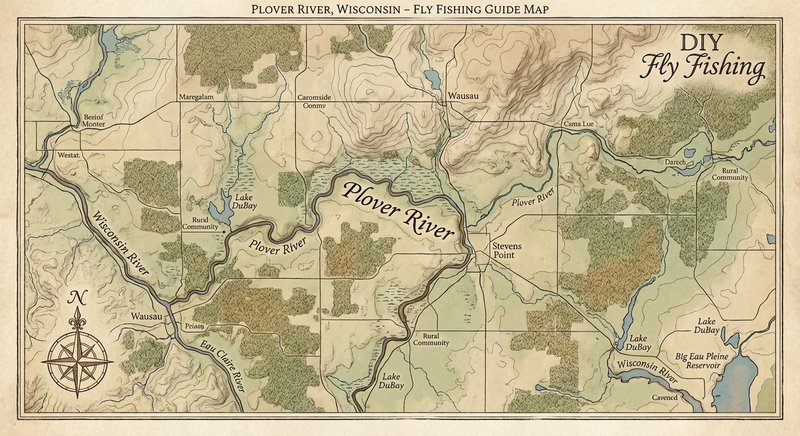
The Plover River originates in the rolling hills of eastern Marathon County and flows south toward the Wisconsin River. It is characterized by its crystal-clear water, sandy and gravel bottoms, and an abundance of woody debris.
What makes the Plover special is its dual personality. The upper reaches (near Hatley and the Ice Age Trail) are narrow, cold, and dominated by wild Brook Trout. As you move downstream toward Jordan Pond and Stevens Point, the river widens, the water warms slightly, and the Brown Trout become the dominant predators. It is a quintessential Midwestern stream that rewards stealth and precise casting over long-distance bombing.
🐟 Target Species & Behavior
Brook Trout
Native to these waters, the Brookies are found primarily in the colder, upper sections (upstream of Hwy 153). They are vibrant, opportunistic, and favor "pocket water."
- Behavior: They hold in the coldest plumes of water, often right where a spring enters the main stem.
- Feeding: They love small dries and terrestrials but are easily spooked by heavy wading.
Brown Trout
The Browns dominate the middle stretches. These are often "wild-born" or long-term residents that have grown wary.
- Behavior: Browns in the Plover are "structure-oriented." If there is a fallen cedar or an undercut bank, a Brown is under it. They are notorious for darting out, slashing at a fly, and retreating instantly.
- Feeding: They are highly piscivorous (fish-eaters) as they get larger, making them prime targets for streamers.
📅 Best Times to Fish
- Spring (May - June): This is the "Golden Window." The water temperatures are perfect, and the major hatches (Hendricksons and Sulfurs) occur.
- Summer (July - August): Focus on the early mornings or the "magic hour" before dark. Terrestrial fishing (grasshoppers/ants) is at its peak during the heat of the day.
- Fall (September - October): As the Brook and Brown trout prepare to spawn, they become highly aggressive and territorial. This is the best time for trophy Browns.
- Prime Conditions: Overcast, drizzly days are best for the Plover. The lack of shadows makes the fish feel secure enough to leave their woody fortresses.
🪰 Recommended Flies & Techniques
Top Fly Patterns
- Dry Flies:
- Elk Hair Caddis (Size 14-18): A staple for the constant caddis activity.
- Sulfur Sparkle Dun (Size 16-18): Essential for June evenings.
- Hippie Stomper or Foam Beetles: Perfect for high-summer bank slapping.
- Nymphs:
- Gold-Ribbed Hare’s Ear (Size 14-16): Mimics almost anything in the drift.
- Ray Charles or Scud patterns (Size 16-18): The Plover has a high crustacean count.
- Streamers:
- Woolly Bugger (Olive or Black, Size 8-10): The most reliable search pattern.
- Muddler Minnow: Excellent for mimicking the small sculpins found in the gravelly runs.
Presentation Tips
- The "Bow-and-Arrow" Cast: In the upper sections, the brush is thick. You will need this cast to get under overhanging alders.
- Short-Line Nymphing: Because of the wood, long drifts are nearly impossible. High-sticking through small gaps in the logs is the most effective way to find fish.
- Tight to the Wood: If your fly isn't within 2 inches of a log jam, you aren't in the strike zone.
💡 Pro Tips & Local Knowledge
- The "Hwy 153 to Bevent" Stretch: This is arguably the most productive water for a mix of both species. Access is good, and the water has a perfect mix of riffles and deep pools.
- Stealth is Mandatory: The Plover is clear and relatively shallow. If you can see the fish, they have likely already seen you. Wear earthy tones (camo or olive) and move upstream slowly.
- Watch for "The Hex": In late June/early July, there is a modest Hexagenia limbata hatch in the slower, siltier sections. It’s not as famous as the Michigan hatches, but it brings the largest Browns to the surface at night.
- Log Jam Logic: In the Plover, the fish are rarely in the middle of the stream. They are under the banks or under the logs. If you aren't losing a few flies to the trees, you aren't fishing the right spots.
⚠️ Important Information
- Regulations: The Plover River has different regulations depending on the county and section. Some are Category Yellow (8-inch limit) and some are Category Green. Always check the current Wisconsin DNR Trout Tool before heading out.
- Access: Much of the Plover flows through private land, but Wisconsin law allows you to fish as long as you "keep your feet wet." Use public bridge crossings (Esker Rd, Hwy 153, Bevent Dr) to enter, and stay within the high-water marks.
- Gear Recommendation: A 7.5-foot to 8.5-foot 4-weight rod is ideal. A 9-foot rod is often too long for the tight canopy of the upper river.
- Permits: You must have a valid Wisconsin Fishing License and an Inland Trout Stamp.
Guide’s Final Word: The Plover is a "lunch pail" river. It doesn't give up its trophies easily, but for the angler who can cast accurately in tight quarters and doesn't mind a bit of a hike, it is one of the most rewarding trout streams in the Midwest.
Bug Hatches & Matching Flies
| Hatch | Type | Peak months | Time of day | Hook sizes | Matching flies |
|---|---|---|---|---|---|
| Blue-Winged Olive Baetis / Pseudocloeon | mayfly | April, May, September, October | Mid-day/Afternoon | #18-22 | RS2 #20-22, Parachute BWO #18-22, BWO Emerger #18-20 |
| Hendrickson Ephemerella subvaria | mayfly | April, May | Afternoon | #12-14 | Red Quill #12-14, Hendrickson Nymph #12-14, Pheasant Tail #14 |
| Grannom Caddis Brachycentrus | caddis | May | Morning/Afternoon | #14-16 | Elk Hair Caddis (Olive) #14-16, LaFontaine's Deep Sparkle Pupa #14-16, Peacock Caddis #16 |
| Sulfur Ephemerella invaria / dorothea | mayfly | June | Evening | #14-18 | Sulfur Parachute #14-18, Sulfur CDC Emerger #16-18, Gold Ribbed Hare's Ear #14-16 |
| Light Cahill Stenacron interpunctatum | mayfly | June, July | Evening | #14-16 | Light Cahill #14-16, Light Cahill Emerger #14-16 |
| Slate Drake Isonychia bicolor | mayfly | June, August, September | Late Afternoon | #10-12 | Iso Parachute #10-12, Isonychia Nymph #10-12, Prince Nymph #10-14 |
| Trico Tricorythodes | mayfly | July, August, September | Morning | #20-24 | Trico Spinner #20-24, Griffith's Gnat #20-22 |
| Terrestrials Formicidae / Orthoptera | terrestrial | July, August, September | Mid-day/Afternoon | #10-16 | Cinnamon Ant #14-18, Foam Beetle #14-16, Dave's Hopper #10-12 |