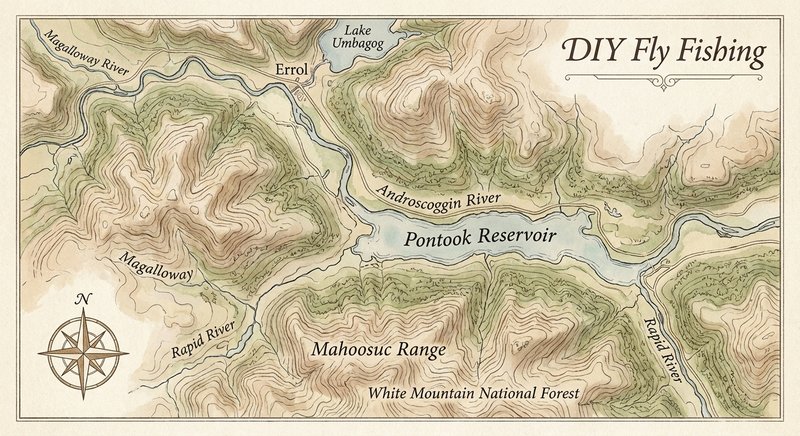
Pontook Reservoir
Fly fishing in New Hampshire · Beginner · Best seasons: Spring, Summer, Fall
Target Species
Brown Trout, Rainbow Trout, Smallmouth Bass
About This Water
Coos County reservoir with trout. Androscoggin River impoundment.
Fishing Recommendations
Welcome to the North Country. As your guide, I can tell you that Pontook Reservoir is one of the most unique fisheries in New Hampshire. Located on the Androscoggin River in Dummer, NH, it is essentially a wide, shallow "bulge" in the river created by the Pontook Dam. It offers a fascinating "hybrid" experience where cold-water trout and warm-water bass coexist in a wilderness setting.
🎣 Location Overview
Pontook Reservoir is a 3.5-mile stretch of the Androscoggin River that feels more like a massive, slow-moving marsh or lake than a traditional river. It is famous for its submerged timber—a remnant of the North Country’s logging history. Thousands of old logs and stumps litter the bottom, providing world-class structure for fish.
What makes it special is the diversity of water. You have the heavy, oxygenated "inlet" water at the north end (Twelve Mile Bridge), the slow, meandering "lake" section in the middle, and the tailwater environment below the dam. It is a scenic, wild place where you are just as likely to see a moose as you are another angler.
🐟 Target Species & Behavior
- Brown & Rainbow Trout: These are often "holdovers" from state stocking programs. In Pontook, trout behave like "cruisers." They move from the main river channel into the shallower flats during the morning and evening to feed on insect hatches. They love the cooler, moving water near the Twelve Mile Bridge inlet.
- Smallmouth Bass: Pontook is a Smallmouth factory. These fish are structure-oriented. They hold tight to the submerged stumps and log piles. Unlike river smallmouth that fight the current, these fish grow fat and "heavy" by sitting in the slack water and ambushing prey.
- Northern Pike: While not in your primary list, be warned: Pontook has a healthy population of Pike. If you feel a sudden, violent strike that snaps your 5x tippet instantly, you’ve found one.
📅 Best Times to Fish
- Spring (Late May – June): This is the "Golden Window." The water is cool enough for trout to be active throughout the reservoir. The Caddis hatches during this time are legendary, often called "The Mother’s Day Hatch" (though usually peaking in late May here).
- Summer (July – August): Focus on Smallmouth Bass during the day. For trout, you must fish the "magic hours"—dawn and dusk. During the heat of the day, trout retreat to the deeper river channels or the aerated water near the dam and inlet.
- Fall (September – October): The best time for Trophy Browns. As temperatures drop, Brown Trout become aggressive and territorial ahead of the spawn. The foliage is spectacular, and the bass are feeding heavily to bulk up for winter.
🪰 Recommended Flies & Techniques
For Trout
- Dry Flies:
- Elk Hair Caddis (Size 12-16): The staple. Fish it with a "twitch" to mimic the fluttering insects.
- Adams/Parachute Adams (Size 14-18): Excellent for the general mayfly hatches.
- Nymphing:
- Pheasant Tail & Hare’s Ear (Size 14-16): Standard patterns that work well in the deeper channels.
- Prince Nymph: The extra flash helps in the slightly "tannic" (tea-colored) water of the Androscoggin.
- Technique: Use a 9ft 5wt rod. In the slower sections, a "dry-dropper" rig is incredibly effective.
For Smallmouth Bass
- Streamers:
- Woolly Buggers (Black or Olive, Size 4-8): Mimics crayfish and leeches.
- Clouser Minnows: Best for fishing the edges of the old river channel.
- Topwater:
- Poppers & Stealth Bombers: There is nothing like a Smallmouth smashing a popper off a stump at sunset.
- Technique: Use a 6wt or 7wt rod. Cast as close to the visible wood/stumps as possible. Strip-pause-strip. Most strikes happen on the pause.
💡 Pro Tips & Local Knowledge
- The "Twelve Mile Bridge" Area: This is the northern entrance where the river enters the reservoir. It is the most consistent spot for trout because of the constant current and oxygen.
- Avoid the "Prop-Wrecker": If you are using a boat, be extremely careful. Pontook is a maze of submerged logs just inches below the surface. A kayak or canoe is the superior way to fish this water, allowing you to stealthily glide over the timber where big fish hide.
- Watch the Flows: Pontook is a hydro-regulated reservoir. Check the Brookfield Renewable flow sites. If the dam is releasing heavily, the "Tailwater" section below the dam becomes a premier spot for swinging streamers for big rainbows.
- Tannic Water: The water has a brownish tint from the forest. Use flies with a bit of flash (bead heads, krystal flash) to help the fish track your offering.
⚠️ Important Information
- Access: There is a great boat launch/parking area off Route 16 in Dummer. It offers easy access for kayaks and wading near the dam.
- Regulations: Pontook is managed under General Fishing Rules by NH Fish & Game, but the Androscoggin River sections immediately above and below have different rules (some are "Fly Fishing Only" or "Catch and Release"). Always double-check the current NH Freshwater Fishing Digest.
- Safety: The bottom is very silty and full of "timber trips." If you are wading, a wading staff is not optional—it is a necessity. Also, keep an eye out for black bears and moose, especially in the early morning.
Guide’s Final Word: Pontook is a "thinking man's" water. You have to read the wood and the current channels. Don't be afraid to switch from a dry fly for trout to a big streamer for bass—that versatility is exactly what makes this reservoir a North Country gem. Tight lines!
Bug Hatches & Matching Flies
| Hatch | Type | Peak months | Time of day | Hook sizes | Matching flies |
|---|---|---|---|---|---|
| Blue-Winged Olive Baetis / Acerpenna | mayfly | May, September, October | Mid-day/Overcast | #18-22 | BWO Sparkle Dun #18-20, RS2 #20-22, Pheasant Tail #18-22 |
| Hendrickson Ephemerella subvaria | mayfly | May | Afternoon | #12-14 | Red Quill #12-14, Hendrickson Cripple #14, Hare's Ear #12-14 |
| Grannom Caddis Brachycentrus | caddis | May | Morning/Evening | #14-16 | Elk Hair Caddis (Olive) #14-16, LaFontaine's Deep Sparkle Pupa #14-16, Peacock Caddis #16 |
| Eastern Pale Evening Dun (Sulfur) Ephemerella invaria / dorothea | mayfly | June, July | Evening | #14-18 | Sulfur Parachute #16-18, Sulfur Emerger #16, Sulfur Spinner #14-18 |
| March Brown Maccaffertium vicarium | mayfly | June | Afternoon | #10-12 | March Brown Dun #10-12, March Brown Nymph #10-12, Gold Ribbed Hare's Ear #10-12 |
| Spotted Sedge Hydropsyche | caddis | June, July, August | Evening | #14-16 | Tan Elk Hair Caddis #14-16, Hydropsyche Larva #14-16, Iris Caddis #16 |
| Trico Tricorythodes | mayfly | August, September | Early Morning | #22-26 | Trico Spinner #22-24, Trico Dun #22, Zebra Midge #20-22 |
| Golden Stonefly Acroneuria | stonefly | June, July | Night/Evening | #6-10 | Golden Stone Nymph #8-10, Pat's Rubber Legs #8-10, Stimulator (Yellow) #8-12 |
| Flying Ants Formicidae | terrestrial | August, September | Afternoon | #14-18 | Flying Ant (Black) #14-18, Cinnamon Ant #16-18, Chernobyl Ant #10-12 |