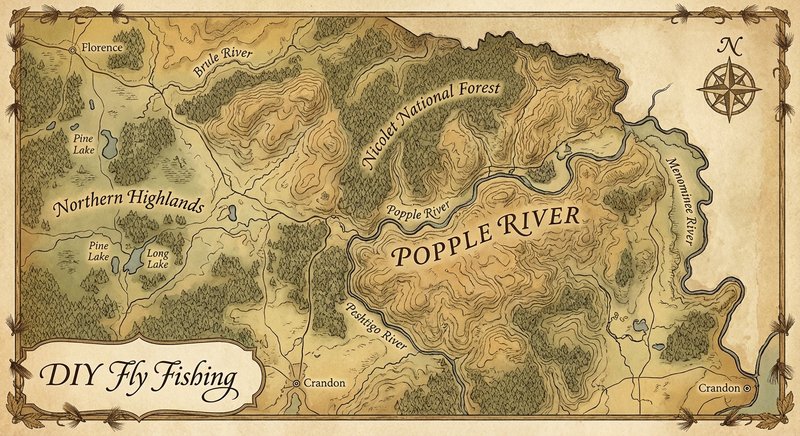
Popple River
Fly fishing in Wisconsin · Intermediate · Best seasons: Summer, Fall
Target Species
Brook Trout, Smallmouth Bass
About This Water
Northern Wisconsin wild river with brook trout. Remote wilderness fishing.
Fishing Recommendations
Welcome to the wild north woods. As your guide, I can tell you that the Popple River in Florence and Forest Counties is one of Wisconsin’s best-kept secrets. Designated as one of the state's "Wild Rivers," it offers a rugged, remote experience that feels more like the interior of Canada than the Midwest.
Here is your comprehensive guide to fly fishing the Popple River.
🎣 Location Overview
The Popple River is a pristine, tannin-stained waterway characterized by its "Wild River" status, meaning it is largely undeveloped and free-flowing. It is a river of two faces: the upper sections and tributaries are cool enough to support wild Brook Trout, while the lower sections—filled with boulders, deep pools, and dramatic waterfalls—are a haven for aggressive Smallmouth Bass.
What makes it special is the solitude. The river is rocky, often difficult to wade, and shrouded in dense forest. Anglers love it because it rewards those willing to hike and bushwhack with hard-fighting fish that rarely see a fly.
🐟 Target Species & Behavior
Brook Trout (Upper River & Tributaries)
- Behavior: These are native, wild fish. They are opportunistic but extremely spooky due to the clarity and shallow nature of the upper reaches.
- Holding Spots: Look for "undercut" banks, shaded pockets under overhanging alders, and the heads of deep, tea-colored pools.
- Feeding: They key in on terrestrial insects (ants/beetles) in late summer and small stoneflies or mayflies in the spring and fall.
Smallmouth Bass (Middle & Lower River)
- Behavior: The Popple’s smallmouth are "river bronzebacks"—lean, muscular, and exceptionally aggressive.
- Holding Spots: Focus on the "tail-outs" of rapids, behind large boulders (mid-stream eddies), and in the deep foam-covered pools below waterfalls like Washburn or Jennings Falls.
- Feeding: They are apex predators here, feeding heavily on crayfish, hellgrammites, and baitfish (shiners and dace).
📅 Best Times to Fish
Summer (June – August)
- Target: Smallmouth Bass are the stars here. As the water warms, their metabolism spikes.
- Best Time of Day: Early morning and "magic hour" (the last two hours of daylight) for topwater action.
- Conditions: Low, clear water is common. Stealth is required.
Fall (September – October)
- Target: Brook Trout (before the season closes) and trophy Smallmouth.
- Best Time of Day: Mid-day as the sun warms the water slightly.
- Conditions: The "Pre-spawn" for Brookies brings out their vibrant orange colors and aggressive territorial behavior. Smallmouth begin feeding heavily on baitfish to bulk up for winter.
🪰 Recommended Flies & Techniques
For Brook Trout
- Dry Flies: Royal Wulff (size 14-16), Elk Hair Caddis (size 16), and Parachute Adams.
- Terrestrials: Black Foam Ants or Beetles (size 14-18) are deadly in August.
- Nymphs: Gold-ribbed Hare’s Ear or Pheasant Tail (size 16-18) dropped 18 inches below a dry fly (Dropper Rig).
For Smallmouth Bass
- Streamers: Woolly Buggers (Black or Olive, size 4-8), Murdich Minnows, and Near Nuff Crayfish.
- Topwater: Boogle Bugs or small Poppers in yellow or chartreuse.
- Technique: Use a "swing and strip" method. Cast across the current, let the fly swing into an eddy, and give it short, erratic strips.
💡 Pro Tips & Local Knowledge
- Chase the Waterfalls: The stretches around Big Bull Falls and Washburn Falls are high-gradient and oxygen-rich. Smallmouth stack up in the plunge pools.
- The "Tannin" Factor: The water is the color of strong tea. Bright flies (chartreuse, white, or flashy gold) often perform better than natural tones because they provide better contrast in the dark water.
- Wading Safety: The Popple is notorious for slippery, "bowling ball" rocks. Studded wading boots and a staff are non-negotiable here.
- Tributary Hunting: If the main stem of the Popple feels too warm in mid-July, hike up into the smaller feeder creeks (like the South Branch). You’ll find cooler water and active Brookies.
⚠️ Important Information
Access Information
- Access is primarily via forest roads and bridge crossings.
- Key access points include the Hwy 101 bridge, Woods Creek Road, and the Morgan Lake Road area.
- Much of the river is surrounded by the Nicolet National Forest, providing excellent public access, but be prepared for "primitive" hiking trails.
Regulations & Permits
- License: A valid Wisconsin Fishing License and an Inland Trout Stamp are required.
- Seasons: General trout season typically runs from the first Saturday in May to October 15th. Smallmouth Bass have different harvest regulations, but most fly anglers practice Catch and Release to preserve these slow-growing northern populations.
- Wild River Status: Motorized vehicles are restricted near the banks; respect the "Wild River" buffer zones to keep the area pristine.
Special Considerations
- Bugs: In Summer, the mosquitoes and biting flies (deer flies/black flies) can be brutal. Bring heavy-duty repellent or a head net.
- Cell Service: Expect zero cell service once you leave the main highway. Carry a physical map or a GPS satellite communicator.
Bug Hatches & Matching Flies
| Hatch | Type | Peak months | Time of day | Hook sizes | Matching flies |
|---|---|---|---|---|---|
| Hendrickson Ephemerella subvaria | mayfly | May | Afternoon | #12-14 | Red Quill #12-14, Hendrickson Emerger #12-14, Pheasant Tail #12-14 |
| Blue-Winged Olive Baetis | mayfly | April, May, September, October | Late Morning/Afternoon | #18-22 | BWO Sparkle Dun #18-20, RS2 #20-22, Barr's BWO Emerger #18-22 |
| American Grannom Brachycentrus | caddis | May | Morning/Evening | #14-16 | Elk Hair Caddis (Olive) #14-16, LaFontaine's Deep Sparkle Pupa #14-16, Peacock Caddis #16 |
| Sulfur / Pale Evening Dun Ephemerella invaria | mayfly | June | Evening | #14-18 | Sulfur Parachute #14-18, Sulfur Emerger #16-18, Golden Ribbed Hare's Ear #14-16 |
| Light Cahill Stenacron / Stenonema | mayfly | June, July | Evening | #12-14 | Light Cahill #12-14, Gold Ribbed Hare's Ear #12-14 |
| Golden Stonefly Acroneuria | stonefly | June, July | Evening/Night | #6-10 | Kaufmann's Stone (Golden) #8-10, Golden Stimulator #8-12 |
| Giant Mayfly (Hex) Hexagenia limbata | mayfly | June, July | Night | #4-8 | Hexagenia Spinner #4-6, Hexagenia Nymph #6-8 |
| Ants and Beetles Formicidae / Coleoptera | terrestrial | July, August, September | Afternoon | #12-18 | Black Foam Ant #14-18, Chernobyl Ant #10-12, Crowe Beetle #14-16 |