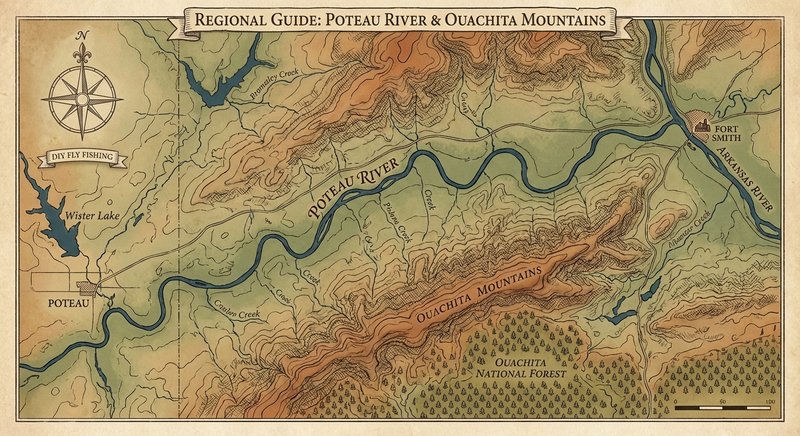
Poteau River
Fly fishing in Arkansas · Beginner · Best seasons: Spring, Summer, Fall
Target Species
Largemouth Bass, Spotted Bass, Catfish
About This Water
West-central Arkansas stream with bass fishing. Flows into Wister Lake.
Fishing Recommendations
The Poteau River is a unique gem in the Arkansas fly fishing portfolio. While many anglers flock to the state for its world-famous tailwater trout, the Poteau offers a gritty, rewarding warm-water experience. Flowing from the Ouachita National Forest through western Arkansas and into Oklahoma, it is one of the few rivers in the United States that flows primarily north.
For the fly angler, the Poteau is a "working man’s river"—it’s murky, structure-heavy, and rewards those who can cast with precision into tight cover.
🎣 Location Overview
The Poteau River changes character significantly as it flows. The upper reaches near Waldron are smaller and more wading-friendly, while the lower sections toward Fort Smith become deep, slow-moving, and "swampy."
What makes it special is the sheer volume of woody debris and rocky ledges. This isn't a river for delicate dry fly presentations; it’s a place for heavy 7-weight rods, weedless flies, and "combat fishing." The water is generally stained or turbid, meaning fish rely heavily on their lateral lines to detect movement, making it a playground for noisy topwater bugs and vibrating streamers.
🐟 Target Species & Behavior
Largemouth Bass
These are the kings of the Poteau’s backwaters. They hold tight to fallen timber, cypress knees, and lily pads. They are ambush predators, waiting for a fly to "twitch" off a log.
- Feed on: Bluegill, crawfish, shad, and frogs.
Spotted Bass (Kentucky Bass)
Found more frequently in the mid-sections where there is a bit more current and rocky bottoms. They are more aggressive than largemouths and tend to school more often.
- Feed on: Primarily crawfish and small minnows.
Catfish (Channel & Flathead)
While traditionally a bait-fishing target, the Poteau’s catfish can be caught on a fly, especially during the "locust falls" or when they are actively prowling shallow flats at night.
- Feed on: High-protein sources. To catch them on a fly, you need heavy, bottom-hugging patterns that mimic dying baitfish or large crawfish.
📅 Best Times to Fish
- Spring (April – June): This is the prime window. As the water warms to 60°F, bass move into the shallows to spawn. This is your best chance at a trophy Largemouth.
- Summer (July – August): The bite moves to the "low light" hours. Target the river at dawn or dusk with topwater flies. During the heat of the day, fish move to deeper holes or under heavy overhead cover.
- Fall (September – November): As the water cools, bass become hyper-aggressive, feeding up for winter. This is the best time for "searching" with large streamers.
- Prime Window: Early morning (first light) until about 10:00 AM. If the sky is overcast, the bite can stay hot all day.
🪰 Recommended Flies & Techniques
Top Patterns
- Topwater: BoogleBugs (Poppers) in "Electric Yellow" or "Black Stealth." Frogs like the Umpqua Swimming Frog.
- Streamers: Clouser Minnows (Chartreuse/White) are essential. For stained water, use Black and Purple Woolly Buggers with plenty of flash.
- Crawfish: Near Nuff Craw or Whitlock’s Near Nuff Sculpin. Use patterns with orange or rusty brown tones.
Techniques
- The "Log Flip": Cast your fly literally onto a partially submerged log, then gently twitch it into the water. Bass often sit directly under the wood, and the "plop" triggers an instant strike.
- The Slow Strip: For catfish and deep-dwelling bass, use a sink-tip line. Cast upstream, let the fly hit the bottom, and use very slow, 2-inch strips to mimic a crawfish crawling over rocks.
- Weedless is Mandatory: If your flies aren't tied with a weed guard, you will spend more time untangling from brush than fishing.
💡 Pro Tips & Local Knowledge
- The Color Rule: The Poteau is rarely "crystal clear." Use Dark Colors (Black, Navy, Dark Green) on overcast days or in very murky water—this creates a stronger silhouette for the fish to see. Use Bright Colors (Chartreuse, White) on sunny days.
- Target the Eddies: Where the river bends, the current carves out deep pockets. Spend extra time working the "seam" between the fast water and the still water.
- Canoe/Kayak is King: While there are wading spots near bridge crossings, the best way to fish the Poteau is by drifting it. A kayak allows you to reach the "hidden" blowdowns that shore anglers can't get to.
- Catfish Secret: If you see catfish rising (they often "gulp" air or feed on the surface during certain insect hatches), throw a large, black foam cicada or a heavy Woolly Bugger directly into the ring of the rise.
⚠️ Important Information
- Access: Key access points include the Poteau River WMA and various bridge crossings near Waldron and Hon, AR. Be respectful of private property boundaries, which are common along the riverbanks.
- Regulations: An Arkansas Fishing License is required. Check the Arkansas Game and Fish Commission (AGFC) handbook for specific size and creel limits, as they can change season to season.
- Safety:
- Snakes: Cottonmouths are common on the Poteau. Watch where you step and where you reach to unhook a fly from a branch.
- Mud: The banks are notoriously "slick" clay. Wear boots with good traction.
- Hydration: The humidity in the Arkansas river valley during summer is intense. Bring more water than you think you need.
The Poteau River isn't about high-fashion gear or technical dry fly matching; it's about grit, heavy tippet (12lb–20lb), and the thrill of a 5-pound bass exploding on a popper in the shadows of an Arkansas slough. Tight lines!
Bug Hatches & Matching Flies
| Hatch | Type | Peak months | Time of day | Hook sizes | Matching flies |
|---|---|---|---|---|---|
| Giant Mayfly (Hex) Hexagenia limbata | mayfly | June, July | Evening/Night | #6-10 | Hexagenia Spinner #6-8, Burrowing Mayfly Nymph #8-10 |
| Tan Caddis Hydropsyche | caddis | May, September | Evening | #14-18 | Elk Hair Caddis (Tan) #14-16, Gold Ribbed Hare's Ear #14-18 |
| Blue-Winged Olive (BWO) Baetis | mayfly | March, April, October, November | Afternoon | #18-22 | BWO Parachute #18-20, Pheasant Tail #18-22 |
| Common Grasshopper Melanoplus | terrestrial | July, August, September | Afternoon | #8-12 | Dave's Hopper #8-12, Morrish Hopper #10-12 |
| Blue Damselfly Enallagma | terrestrial | June, July, August | All Day | #10-14 | Adult Damselfly #10-12, Marabou Damselfly Nymph #12-14 |
| Trico Tricorythodes | mayfly | August, September | Morning | #20-24 | Trico Spinner #20-22, Zebra Midge #20-24 |
| Midges Chironomidae | midge | January, February, December | Morning/Afternoon | #18-26 | Griffith's Gnat #18-22, Black Zebra Midge #20-24 |
| White Curse (Caenis) Caenis | mayfly | July, August | Evening/Morning | #22-26 | Caenis Spinner #24-26, Cream Midge #22-24 |
| Cicada Neotibicen | terrestrial | July, August | Afternoon | #4-8 | Black/Orange Foam Cicada #6-8 |