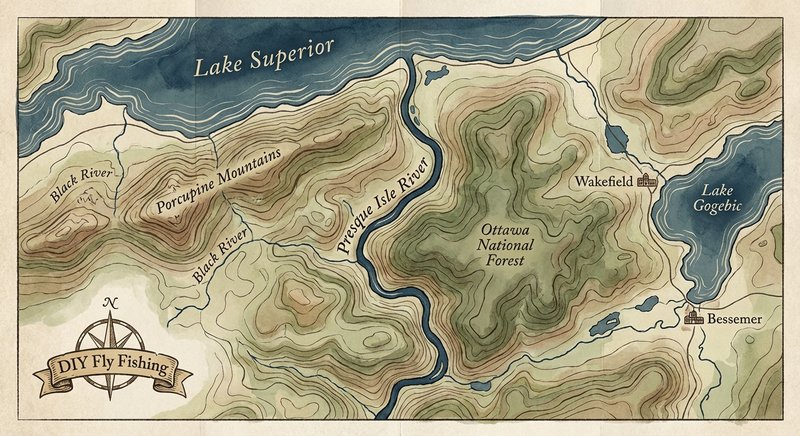
Presque Isle River
Fly fishing in Michigan · Intermediate · Best seasons: Spring, Summer, Fall
Target Species
Brook Trout, Steelhead, Brown Trout
About This Water
Western Upper Peninsula river with beautiful waterfalls. Brook trout and steelhead.
Fishing Recommendations
The Presque Isle River, located in the rugged western end of Michigan’s Upper Peninsula, is one of the most wild and scenic rivers in the Midwest. Flowing through the heart of the Porcupine Mountains Wilderness State Park, it is a river of dramatic contrasts—transitioning from quiet, meandering beaver meadows to violent, spectacular waterfalls before emptying into Lake Superior.
For the fly angler, the Presque Isle offers a "choose your own adventure" experience: intimate brook trout stalking in the headwaters or testing your mettle against Lake Superior steelhead near the mouth.
🎣 Location Overview
The Presque Isle is defined by its tannic, tea-colored water and its spectacular geology. The riverbed is primarily composed of slippery shale and ancient volcanic rock.
What makes it special is its isolation. Much of the best fishing requires hiking into the "Porkies." The lower section is famous for its massive waterfalls (Manabezho, Manido, and Nawadaha), which serve as natural barriers. While the very mouth of the river is accessible to lake-run fish, the miles of river above the falls are a sanctuary for wild, native salmonids. It is a "high-gradient" river in many spots, meaning you’ll be fishing pockets, plunge pools, and rapid runs.
🐟 Target Species & Behavior
- Brook Trout (Native): These are the crown jewels of the Presque Isle. They are found throughout the main stem and branches. They are opportunistic feeders but wary. In the tannic water, they often hold tight to undercut banks and submerged timber.
- Steelhead: Found primarily in the lower mile of the river below the first major waterfall (Manabezho Falls). These are wild Lake Superior fish—hard-fighting and chrome-bright.
- Brown Trout: While less numerous than brookies, larger wild browns inhabit the deeper, slower pools in the middle reaches of the river, often becoming active during low-light conditions or heavy hatches.
📅 Best Times to Fish
- Spring (Late April – June):
- Steelhead: April and early May are prime for lake-run fish near the mouth.
- Trout: Late May brings the first major hatches (Hendricksons). Water levels are usually high, so heavy nymphs and streamers are necessary.
- Summer (July – August):
- This is the prime window for Brook Trout. As the water warms, fish congregate near cold-water springs and at the heads of oxygenated riffles. Terrestrial fishing (ants/beetles) is world-class during this time.
- Fall (September – October):
- The "Color Run": Brook trout take on brilliant spawning colors.
- Salmon/Steelhead: Early fall brings Pink or Coho Salmon, followed by the fall run of Steelhead into the lower river.
🪰 Recommended Flies & Techniques
For Brook & Brown Trout
- Dry Flies:
- Patterns: Elk Hair Caddis (Size 14-16), Parachute Adams (12-16), Royal Wulff.
- Terrestrials: Black Foam Ants, Chernobyl Ants, and Dave’s Hopper.
- Nymphs:
- Patterns: Gold-ribbed Hare’s Ear, Prince Nymph, and Pheasant Tails (Size 12-16).
- Technique: High-stick nymphing through the deep pockets between boulders.
- Streamers:
- Patterns: Black or Olive Woolly Buggers, Muddler Minnows.
- Technique: Stripping across current seams or "swinging" through deep bends.
For Steelhead (Lower River)
- Patterns: Egg patterns (Glo-bugs), Hex nymphs, and large Black Stoneflies.
- Technique: Indicator nymphing is most effective in the turbulent water near the mouth.
💡 Pro Tips & Local Knowledge
- The "Tannic" Strategy: Because the water is dark (root-beer colored), fish have slightly lower visibility. Use larger profiles and darker colors (Black, Purple, Dark Olive). A black woolly bugger is often more visible to a trout in these waters than a light-colored one.
- Focus on the Branches: The South and East Branches of the Presque Isle offer more "classic" trout water that is easier to wade than the main stem near the waterfalls.
- Stealth over Distance: You rarely need to cast 50 feet here. Short, accurate casts and managing your line to avoid drag in the complex currents are the keys to success.
- The "Splat" Factor: When fishing terrestrials in August, don't be afraid to let the fly hit the water with a "splat." It mimics a grasshopper falling off the bank and triggers an aggressive reaction from brookies.
⚠️ Important Information
- Access: Most fishing is accessed via the Porcupine Mountains Wilderness State Park. A Michigan Recreation Passport is required for vehicle entry.
- Safety: Wading is treacherous. The shale rock is incredibly slick—felt soles (where legal) or studded rubber soles and a wading staff are non-negotiable.
- Regulations: The Presque Isle has various designations (Type 1, Type 4, etc.) depending on the section. Always check the current Michigan DNR Fishing Guide for size limits and tackle restrictions.
- Wilderness Ethics: This is bear country. Carry bear spray if hiking deep into the backcountry, and always practice "Leave No Trace" principles. Cell service is non-existent once you leave the main road.
Guide’s Final Word: The Presque Isle isn't about catching the biggest fish in Michigan; it's about catching the most beautiful fish in the most beautiful place. Bring your camera, watch your footing, and enjoy the solitude.
Bug Hatches & Matching Flies
| Hatch | Type | Peak months | Time of day | Hook sizes | Matching flies |
|---|---|---|---|---|---|
| Hendrickson Ephemerella subvaria | mayfly | May | Afternoon | #12-14 | Red Quill #12-14, Hendrickson Emerger #12-14, Pheasant Tail #12-14 |
| Grannom Caddis Brachycentrus | caddis | May | Morning/Afternoon | #14-16 | Elk Hair Caddis (Dark) #14-16, Deep Sparkle Pupa #14-16, Holy Grail #14-16 |
| Blue Winged Olive Baetis | mayfly | May, September, October | Afternoon | #18-22 | BWO Sparkle Dun #18-22, RS2 #20-22, Barr's BWO Emerger #18-20 |
| Brown Drake Ephemera simulans | mayfly | June | Evening | #10-12 | Brown Drake Paradigm #10-12, Brown Drake Cripple #10-12, Gold Ribbed Hare's Ear #10-12 |
| Sulphur Ephemerella invaria | mayfly | June, July | Evening | #14-16 | Sulphur Parachute #14-16, Sulphur Spinner #14-16, Sulphur Emerger #14-16 |
| Giant Black Stonefly Pteronarcys dorsata | stonefly | May, June | Morning/Evening | #4-8 | Pat's Rubber Leg #4-8, Chubby Chernobyl #6-10, Black Stimulator #8-10 |
| Light Cahill Stenonema ithaca | mayfly | June, July | Evening | #12-14 | Light Cahill #12-14, Cahill Spinner #12-14, Light Cahill Emerger #12-14 |
| Terrestrials Formicidae/Coleoptera | terrestrial | July, August, September | All Day | #12-18 | Black Foam Ant #14-18, Joan Wulff’s Flying Ant #16, Beetle Bailey #12-16 |
| Golden Stonefly Acroneuria | stonefly | June, July | Afternoon/Evening | #8-12 | Golden Stone Nymph #8-12, Yellow Stimulator #8-12, Golden Stone Cripple #10 |