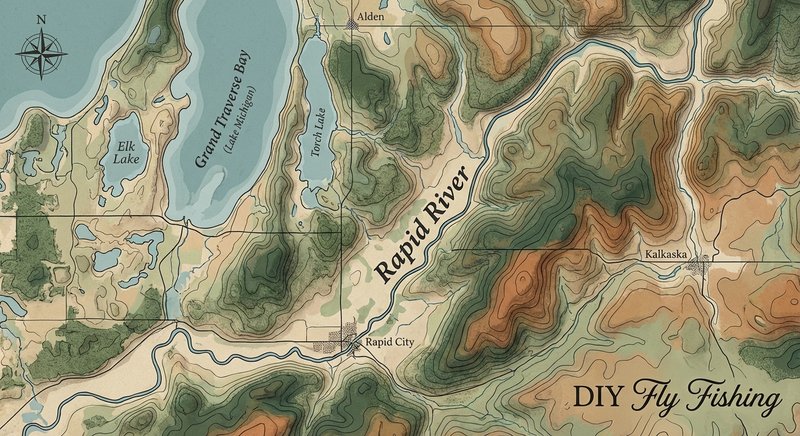
Rapid River
Fly fishing in Michigan · Intermediate · Best seasons: Spring, Fall
Target Species
Steelhead, Brown Trout, Salmon
About This Water
Upper Peninsula stream flowing into Little Bay de Noc. Good trout and salmon fishing.
Fishing Recommendations
The Rapid River, located in Michigan’s Upper Peninsula (Delta County), is a hidden gem for anglers who prefer intimate, technical water over the sprawling crowds of the Lower Peninsula’s bigger rivers. Flowing into the Little Bay de Noc, this river is a quintessential UP stream: tannic-stained, rocky, and heavily influenced by the seasonal migrations of Lake Michigan’s salmonids.
Here is your comprehensive guide to fly fishing the Rapid River.
🎣 Location Overview
The Rapid River is famous for its limestone and shale bedrock, which creates a series of ledges, small drops, and deep pocket water. Unlike the sandy bottoms of many Lower Michigan rivers, the Rapid is rugged and can be slippery.
What makes it special is its "Flashy" nature. Because of the bedrock, the river rises and falls quickly after rain. It is a smaller, more manageable river for the wading angler, offering a sense of solitude that is hard to find on the Pere Marquette or the Muskegon. The tea-colored (tannic) water provides excellent cover for fish, making them less spooky than in crystal-clear streams, but it also requires high-visibility patterns or high-contrast flies.
🐟 Target Species & Behavior
Steelhead (Spring)
These are the "chrome" powerhouse fish. They enter the river to spawn. They tend to hold in the deeper "slots" behind limestone ledges before moving onto gravel runs to spawn. They are aggressive but can be temperamental depending on water temperature.
Salmon (Fall - Chinook & Coho)
The "Kings" (Chinook) arrive first, followed by Coho. They are big, powerful, and territorial. In the Rapid, they utilize the deep holes and the undercut banks. While they aren't actively feeding, they strike out of aggression or instinct.
Brown Trout (Year-round/Fall)
The Rapid holds a decent population of resident Brown Trout, but the real prizes are the "lake-run" Browns that follow the salmon in the fall to gorge on eggs. These fish are predatory and smart, often hiding in the most difficult-to-reach wood debris.
📅 Best Times to Fish
- Spring (Late March – Early May): This is the prime window for Steelhead. The peak usually occurs in mid-April when water temps hit the 42°F to 50°F range.
- Fall (September – October):
- September: Chinook Salmon begin their run.
- October: The peak for Coho Salmon and the best time for "Egg-eating" Brown Trout.
- Best Time of Day: Low-light conditions are superior. Early morning (first light) and the hour before dusk are prime. On overcast days, the fishing can remain "hot" all day due to the tannic water.
- The "Magic" Condition: Look for a falling barometer and a receding water level after a rain event. "Tea-colored but clearing" is the ideal water clarity.
🪰 Recommended Flies & Techniques
Steelhead (Spring)
- Technique: Nymphing under an indicator or "ticking" the bottom with a chuck-and-duck rig.
- Flies:
- Eggs: Estaz Eggs (Orange, Chartreuse), Nuclear Eggs.
- Nymphs: Stonefly nymphs (black or golden, size 6-10), Hexagenia nymphs.
- Swing: Black or Blue/White Intruders (if water flow allows).
Salmon & Brown Trout (Fall)
- Technique: Streamer stripping for aggression or dead-drifting eggs behind spawning beds for Browns.
- Flies:
- Streamers: Woolly Buggers (Black/Olive), Egg-Leeches, and large articulated patterns like the "Galloup’s Dungeon" in white or black.
- Eggs: Glo-bugs and beads (8mm - 10mm) in "Oregon Cheese" or "Mottled Roe" colors.
💡 Pro Tips & Local Knowledge
- Mind the Ledges: The limestone bedrock creates "steps." Fish will often hold right at the base of a drop-off. Instead of casting into the middle of a pool, focus your drift so the fly "tumbles" over the ledge into the deeper pocket.
- The "Pink" Factor: In even-numbered years, the Rapid River gets a run of Pink Salmon. They are smaller but extremely fun on a 5-weight rod and will hit small pink nymphs and streamers aggressively.
- Wading Safety: The shale and limestone are incredibly slick. Cleated wading boots are mandatory. A wading staff is highly recommended, as one wrong step on a mossy ledge can result in a swim.
- Stealth Matters: Because the river is smaller, heavy footsteps on the bank can vibrate through the bedrock and spook fish. Approach pools quietly from downstream.
⚠️ Important Information
Access
- Rapid River Falls Park: Located just off US-41. This provides excellent public access to the "Falls" area, which is a natural barrier and holding point for migratory fish.
- Forest Road Access: There are several spots where Hiawatha National Forest lands touch the river. Check a Delorme Atlas or a digital mapping app (like OnX) to ensure you are on public land.
Regulations & Permits
- License: A Michigan All-Species Fishing License is required.
- Type 4 Water: Most of the Rapid River is classified as Type 4. This means you can fish it year-round for all species, but strictly follow the possession seasons for Steelhead and Salmon.
- Check the Guide: Always consult the current Michigan DNR Fishing Guide for specific bag limits and tackle restrictions, as rules can change annually.
Special Considerations
- Cell Service: Spotty at best. Download your maps for offline use before heading out.
- Black Flies/Mosquitoes: In the spring and early summer, the UP is famous for its biting insects. Bring heavy-duty repellent or a head net.
- Respect the Resource: Practice Catch and Release on resident trout to preserve the fishery. If keeping a salmon or steelhead, ensure it is a legal, fair-hooked fish.
Bug Hatches & Matching Flies
| Hatch | Type | Peak months | Time of day | Hook sizes | Matching flies |
|---|---|---|---|---|---|
| Hendrickson Ephemerella subvaria | mayfly | May | Afternoon | #12-14 | Red Quill #12-14, Hendrickson Emerger #14, Pheasant Tail #12-14 |
| Grannom Caddis Brachycentrus | caddis | May | All Day | #14-16 | Elk Hair Caddis (Olive) #14-16, LaFontaine's Deep Sparkle Pupa #14-16, Peacock Caddis #16 |
| Sulphur Ephemerella invaria | mayfly | June | Evening | #14-16 | Sulphur Parachute #14-16, Sulphur Emerger #16, Mercer's Missing Link #14-16 |
| Brown Drake Ephemera simulans | mayfly | June | Dusk | #10-12 | Brown Drake Spinner #10-12, A.P. Drake Nymph #10-12, Extended Body Drake #10 |
| Hex Hexagenia limbata | mayfly | June, July | Night | #4-8 | Hex Parasol #6-8, Roberts Yellow Drake #6-8, Hex Nymph #4-8 |
| Blue Winged Olive Baetis | mayfly | May, September, October | Midday | #18-22 | BWO Sparkle Dun #18-20, RS2 (Gray or Olive) #20-22, WD-40 #18-22 |
| Golden Stonefly Acroneuria | stonefly | June, July | Afternoon | #8-12 | Kaufmann's Stone #8-10, Golden Chubby Chernobyl #10-12, Stimulator (Yellow) #8-12 |
| Terrestrials Formicidae/Coleoptera | terrestrial | July, August, September | Midday | #12-18 | Cinnamon Ant #14-18, Foam Beetle #12-16, Dave's Hopper #10-12 |