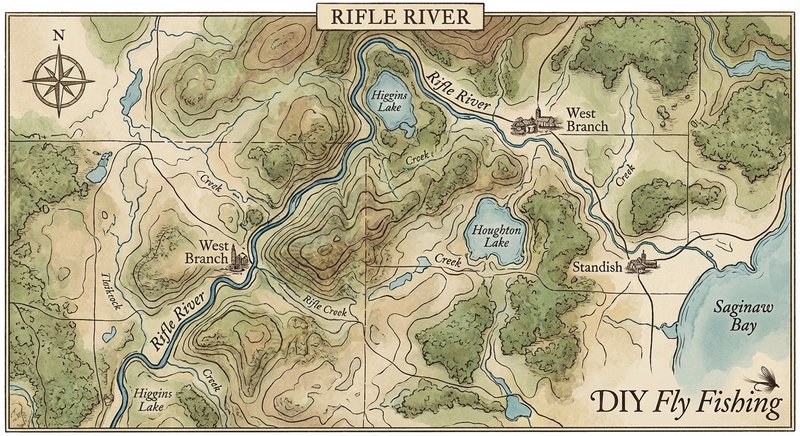
Rifle River
Fly fishing in Michigan · Beginner · Best seasons: Spring, Summer, Fall
Target Species
Brook Trout, Brown Trout
About This Water
Northeast Michigan stream with wild brook trout and stocked brown trout. Scenic fishing.
Fishing Recommendations
The Rifle River, located in the northeastern Lower Peninsula of Michigan, is often overshadowed by its famous neighbors, the Au Sable and the Manistee. However, for the discerning fly angler, the "Rifle" offers a more rugged, intimate, and often less-crowded experience. It is a river of dual personalities: a cold-water trout sanctuary in its upper reaches and a warm-water playground as it flows toward Saginaw Bay.
Here is your guide to mastering the trout waters of the Rifle River.
🎣 Location Overview
The Rifle River begins in the glacial moraines of Ogemaw County. The upper section—specifically from the headwaters down to around the town of Selkirk—is the primary destination for trout anglers.
What makes the Rifle special is its high gradient for a Michigan river. While many MI rivers are slow and meandering, the Rifle has a "bubbly" character with riffles, runs, and plenty of gravel. The river bottom is a mix of sand and cobble, framed by dense cedar swamps and hardwood forests. It feels wilder and more "north woods" than the manicured banks of the mainstream Au Sable.
🐟 Target Species & Behavior
The Rifle is a classic cold-water fishery in its upper stretches, supported by both natural reproduction and supplemental stocking.
- Brook Trout: Found primarily in the furthest upstream reaches and cold-water tributaries (like Houghton Creek). They are opportunistic feeders, often holding in the soft water behind rocks or in tiny pockets along the banks.
- Brown Trout: These are the kings of the Rifle. They are notoriously "woody" fish—meaning they live and die by submerged timber. They are ambush predators that stay tight to cover during the day and move into the shallow riffles at night to feed.
- Behavioral Note: Because the Rifle is a smaller system than the Manistee, the fish can be exceptionally spooky. A stealthy approach and a long leader are often required.
📅 Best Times to Fish
Spring (Late April – June)
This is the prime window. As the water warms into the 50s, the major insect hatches begin.
- May: Look for Hendrickson hatches.
- June: The "month of moths" and Mayflies. This is when the best dry fly action occurs.
Summer (July – August)
The main stem can get warm in the afternoons.
- Time of Day: Fish the "trico" hatches at dawn or terrestrials (grasshoppers/ants) during the day.
- The Hex: Late June and early July see the legendary Hexagenia limbata hatch. This is night fishing at its finest—targeting the largest Browns in the river under the cover of darkness.
Fall (September – October)
As water temperatures drop, Brown trout become aggressive and territorial ahead of their spawn.
- Strategy: This is the best time for "streamer eating." Big, articulated patterns can move trophy fish during overcast days.
🪰 Recommended Flies & Techniques
Dry Flies
- Adams (Standard & Parachute): #12-18. The universal Michigan fly.
- Roberts Yellow Drake: #12-14. A local Michigan classic that works wonders during the summer.
- Elk Hair Caddis: #14-16. Tan or Olive.
- Hex Patterns: #4-6 (Deer hair versions for buoyancy) for late-night summer monsters.
Nymphs
- Pheasant Tail: #14-18.
- Gold-Ribbed Hare’s Ear: #12-16.
- Prince Nymph: #12-14.
- Technique: Use a "trout spey" or a light indicator rig. Focus on the transition zones where a riffle drops into a deeper pool.
Streamers
- Woolly Bugger: Olive or Black, #6-10.
- Muddler Minnow: #4-8 (Excellent for mimicking sculpins or grasshoppers).
- Galloup-style Streamers: For the fall, try smaller versions of the Sex Dungeon in white or olive.
💡 Pro Tips & Local Knowledge
- The "Aluminum Hatch": In the summer, the Rifle is very popular with tubers and canoeists. To have a peaceful experience, you must be off the water by 10:30 AM or start your fishing after 7:00 PM.
- Focus on the Tributaries: If the main stem of the Rifle is running warm or crowded, head to Houghton Creek or Prior Creek. These are smaller, colder, and hold excellent populations of wild Brook and Brown trout.
- Cast to the Wood: If your fly isn't within two inches of a sunken log, you aren't in the strike zone for the big Browns. Be prepared to lose some flies to the "wooden trout."
- Stealth is Key: The water is often crystal clear. Wear drab clothing (earth tones), keep a low profile, and avoid splashing while wading.
⚠️ Important Information
- Access: The Rifle River Recreation Area (managed by the DNR) offers miles of public access and is the best place for a visiting angler to start. There are also several road-crossing access points along Sage Lake Road and Selkirk Road.
- Regulations: The Rifle is subject to Michigan DNR Trout Regulations. Most of the upper river is Type 1 (Open last Saturday in April – Sept 30; 5 fish limit; 7" minimum size). However, always check the current MI DNR Fishing Guide for specific reach-based changes.
- Wading Safety: While generally easy to wade, the Rifle has "holes" created by scouring current around log jams. Use a wading staff and be cautious of unstable sandy banks.
- Permits: A valid Michigan Fishing License is required. If fishing within the Recreation Area, a "Recreation Passport" (vehicle permit) is also required.
Tight lines on the Rifle—it's a gem of the North that rewards those who appreciate the wilder side of Michigan fly fishing!
Bug Hatches & Matching Flies
| Hatch | Type | Peak months | Time of day | Hook sizes | Matching flies |
|---|---|---|---|---|---|
| Hendrickson Ephemerella subvaria | mayfly | April, May | Afternoon | #12-14 | Red Quill #12-14, Hendrickson Emerger #12-14, Pheasant Tail #12-14 |
| Sulphurs Ephemerella invaria | mayfly | May, June | Evening | #14-18 | Sparkle Dun #14-16, Sulphur Parachute #14-18, Mercer's Poxyback Sulphur #14-16 |
| Brown Drake Ephemera simulans | mayfly | June | Evening/Dusk | #10-12 | Brown Drake Cripple #10-12, Standard Brown Drake #10-12, Harrop's Hair Wing Drake #10 |
| Giant Michigan Mayfly (Hex) Hexagenia limbata | mayfly | June, July | Night | #4-8 | Hexagenia Spinner #4-6, Robert's Yellow Drake #6-8, Hex Wigglers #6-8 |
| Blue Winged Olive (BWO) Baetis spp. | mayfly | April, May, September, October | Mid-day/Afternoon | #18-22 | RS2 #20-22, BWO Parachute #18-22, Cdc Baetis Dun #20 |
| Grannom Caddis Brachycentrus | caddis | April, May | Morning/Afternoon | #14-16 | Elk Hair Caddis (Olive) #14-16, Peacock Caddis #16, Deep Sparkle Pupa #14-16 |
| Slate Drake (Isonychia) Isonychia bicolor | mayfly | June, August, September | Late Afternoon | #10-12 | Iso Parachute #10-12, Isonychia Nymph #10-12, Zug Bug #10-12 |
| Trico Tricorythodes | mayfly | July, August, September | Morning | #22-26 | Trico Spinner #22-24, Griffith's Gnat #20-24, Sunken Trico Spinner #22 |
| Grasshoppers Orthoptera | terrestrial | July, August, September | Afternoon | #8-12 | Dave's Hopper #8-12, Parachute Hopper #10-12, Joe's Hopper #8-12 |