Rogue River
Fly fishing in Michigan · Beginner · Best seasons: Spring, Fall, Winter
Target Species
Steelhead, Brown Trout, Salmon
About This Water
Popular West Michigan steelhead destination. Urban fishery near Grand Rapids with good access.
Fishing Recommendations
The Rogue River in West Michigan is one of the state’s most storied "small water" gems. While it doesn't have the massive scale of the nearby Muskegon or Manistee, its intimate size, diverse water types, and proximity to Grand Rapids make it a favorite for technical anglers.
Here is your comprehensive guide to fly fishing the Rogue.
🎣 Location Overview
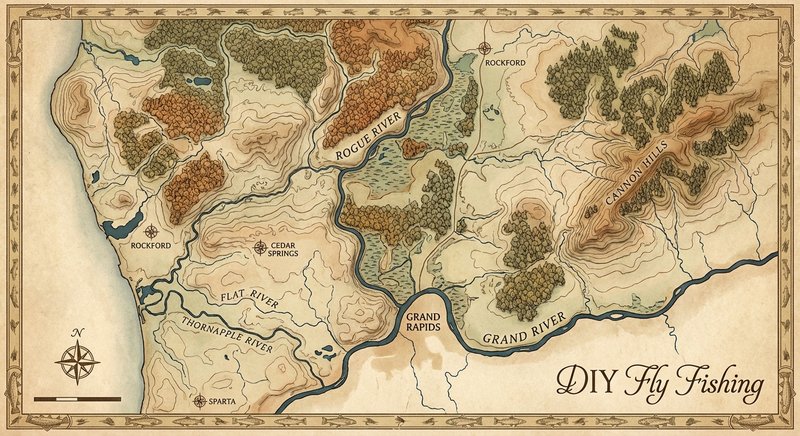
The Rogue River is a primary tributary to the Grand River, flowing through the picturesque town of Rockford. It is often characterized as two different rivers: the upper section (above Rockford) is a classic, spring-fed cold-water trout stream, while the lower section (below the Rockford Dam) is a playground for lake-run migratory species from Lake Michigan.
What makes the Rogue special is its accessibility and intimacy. You can wade almost the entire river. It features a classic mix of gravel runs, deep sweeping bends, and plenty of woody debris (log jams) that provide excellent cover. Because it is smaller than other Michigan rivers, the Rogue requires a stealthier approach, making it a "thinking person’s" fishery.
🐟 Target Species & Behavior
Steelhead (Lake-run Rainbow Trout)
The "crown jewel" of the Rogue. These fish enter from Lake Michigan via the Grand River.
- Behavior: They are energetic and acrobatic. In the Rogue’s smaller water, they can be very "spooky."
- Holding: Look for them in "seams" where fast water meets slow water, and behind gravel transitions in the spring.
Brown Trout (Resident)
The Rogue is a designated "Blue Ribbon" trout stream in its upper reaches.
- Behavior: Resident browns are wary and highly nocturnal. They love the undercut banks and heavy timber.
- Feeding: They key in on heavy insect hatches (Mayflies/Caddis) in early summer and switch to small fish/crayfish (streamers) in the fall.
Salmon (Chinook & Coho)
Massive Kings (Chinook) and more aggressive Cohos push up in the fall.
- Behavior: They are on a mission to spawn. They stack up heavily in the deep holes below the Rockford Dam.
- Feeding: They aren't actively feeding but strike out of territorial aggression or instinct.
📅 Best Times to Fish
- Spring (March – early May): This is Prime Steelhead Season. As the snow melts and the water hits 40–45°F, the main run begins. April is the peak for fish on the gravel.
- Fall (September – November):
- September/October: The Salmon run.
- Late October/November: The "Fall Steelhead" push. These are the hardest-fighting fish of the year, entering the river to feast on salmon eggs.
- Winter (December – February): A "low and slow" game. Steelhead will over-winter in the deeper holes. Focus on the warmest part of the day (12 PM – 3 PM) when the water temperature might rise a degree or two.
🪰 Recommended Flies & Techniques
Steelhead Techniques
- Indicator Nymphing: The most productive method. Use a 9ft 7wt or 8wt rod.
- Flies: Glo-Bugs (eggs) in Oregon Cheese or Chartreuse, Nuke Eggs, and Stonefly nymphs (size 6-10) in black or golden.
- Swinging (Trout Spey): On the lower sections, swinging small intruders or leeches on a light Spey rod is incredibly fun.
Brown Trout Techniques
- Streamer Stripping: Use a 6wt rod with a sink-tip line.
- Flies: Kelly Galloup’s Dungeon, Sculpzilla, or a classic Black Woolly Bugger.
- Dry Fly: During June, the Hexagenia limbata (Hex) hatch occurs at dusk, bringing the largest browns to the surface.
Salmon Techniques
- Chuck and Duck: A local Michigan tradition involving heavy slinky weights to get flies down fast in high water (check regulations on weight distance from the hook).
- Flies: Large Estaz Eggs, Comets, and Woolly Buggers.
💡 Pro Tips & Local Knowledge
- The "Dam" Crowd: The area immediately below the Rockford Dam gets very crowded during the Salmon run. For a better experience, hike downstream toward Childsdale Avenue or Packer Hollow. The fish have to pass through there anyway, and they are often less stressed.
- Stealth is Mandatory: Because the Rogue is clear and relatively shallow, wearing bright colors or splashing around will shut the fishing down. Approach holes from downstream and stay low.
- Lighten Your Tippet: While the Muskegon allows for heavy 12lb leaders, the Rogue often requires dropping down to 8lb or even 6lb Fluorocarbon to get bites from pressured Steelhead.
- Wood is Good: In the Rogue, if you aren't losing a few flies to log jams, you aren't fishing where the big Browns live. Cast tight to the timber.
⚠️ Important Information
- Access Points:
- Peppler Park (Rockford): Direct access below the dam.
- Childsdale Ave: Good wading access and a small parking area.
- Jericho Ave / 10 Mile Rd: Access for the upper "trout" sections.
- Regulations: The Rogue has specific sections. Some are Type 4 (open year-round for certain species), while others have stricter trout season dates. Always check the Michigan DNR Fishing Guide before heading out.
- License: A valid Michigan All-Species Fishing License is required for Steelhead and Salmon.
- Wading Safety: The Rogue has many hidden "holes" and drop-offs near log jams. A wading staff is highly recommended, especially during the higher flows of spring.
Guide’s Final Word: The Rogue is a rewarding river that favors the patient angler. Don't be afraid to walk a mile away from the parking lot—the further you get from the bridges, the better the fishing gets.
Bug Hatches & Matching Flies
| Hatch | Type | Peak months | Time of day | Hook sizes | Matching flies |
|---|---|---|---|---|---|
| Blue Winged Olive Baetis | mayfly | April, May, September, October | Late Morning/Afternoon | #18-22 | RS2 #18-22, BWO Sparkle Dun #18-20, Parachute Adams #20-22 |
| Hendrickson Ephemerella subvaria | mayfly | April, May | Afternoon | #12-14 | Red Quill #12-14, Hendrickson Emerger #12-14, Pheasant Tail Nymph #12-14 |
| Grannom Caddis Brachycentrus | caddis | May | All Day | #14-16 | Peacock Caddis #14-16, LaFontaine's Deep Sparkle Pupa #14-16, Elk Hair Caddis (Olive) #14-16 |
| Sulphur Ephemerella invaria | mayfly | May, June | Evening | #14-18 | Sulphur Parachute #16-18, CDC Sulphur Emerger #16-18, Sulphur Spinner #14-18 |
| Brown Drake Ephemera simulans | mayfly | May, June | Dusk/Night | #10-12 | Brown Drake Para-Wulff #10-12, Brown Drake Nymph #10-12, Roberts Yellow Drake #12 |
| Cinnamon Caddis Hydropsyche | caddis | June, July, August | Evening | #14-18 | Elk Hair Caddis (Tan) #14-18, Holy Grail Caddis #16, X-Caddis #14-16 |
| Isonychia Isonychia bicolor | mayfly | July, August, September | Late Afternoon/Evening | #10-12 | Iso Parachute #10-12, Zug Bug #10-12, Prince Nymph #10-14 |
| Trico Tricorythodes | mayfly | July, August, September | Early Morning | #20-24 | Trico Spinner #22-24, Griffith's Gnat #20-24, Trico Dun #22-24 |
| Terrestrials Various | terrestrial | July, August, September | All Day | #10-18 | Black Foam Ant #16-18, Dave's Hopper #10-12, Cinnamon Flying Ant #14-16 |