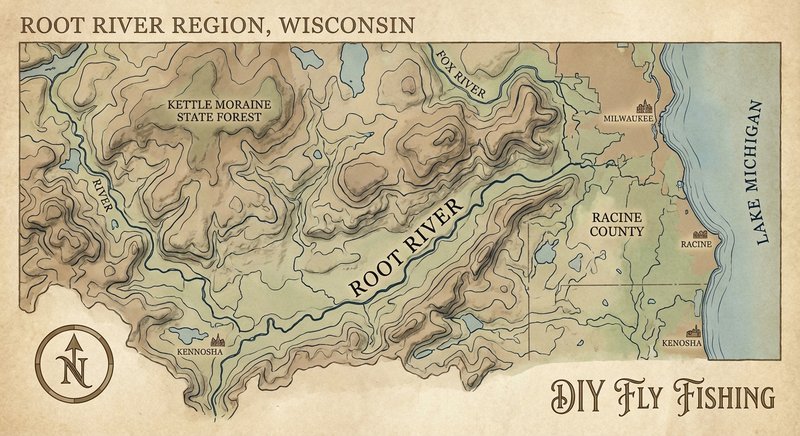
Root River
Fly fishing in Wisconsin · Intermediate · Best seasons: Spring, Fall
Target Species
Steelhead, Chinook Salmon, Brown Trout
About This Water
Southeast Wisconsin stream with steelhead and salmon runs. Urban accessible.
Fishing Recommendations
The Root River in Racine, Wisconsin, is one of the premier Lake Michigan tributaries in the Midwest. Flowing through the heart of Racine and dumping into Lake Michigan, it is a designated "Anadromous Fishery," meaning it hosts massive migrations of lake-run salmonids that enter the river to spawn.
As your guide, here is everything you need to know to find success on the Root.
🎣 Location Overview
The Root River is a quintessential "Great Lakes tributary" experience. Unlike the clear, freestone rivers of the West, the Root is often characterized by murky, sediment-heavy water and a mix of shale ledges, gravel runs, and deep muddy pools.
What makes it special is the Root River Steelhead Facility (The Weir). This DNR-operated station collects eggs and milt for the state’s hatchery system. Because fish are stopped here, the stretch below the weir often holds staggering densities of fish. Anglers love the Root because it offers "big game" fishing in an accessible, urban-suburban environment.
🐟 Target Species & Behavior
- Chinook (King) Salmon: These are the "freight trains" of the river. They enter the system in early fall to spawn and die. They are aggressive early in the run but become territorial and "dark" as the season progresses.
- Steelhead (Rainbow Trout): The Root sees two main strains: Skamania (summer/early fall) and Chambers Creek/Ganaraska (late fall/spring). Steelhead are the acrobats of the river, often holding in faster oxygenated water or behind spawning salmon.
- Brown Trout: Large Seeforellen and German Brown trout follow the salmon in the fall to gorge on eggs. They are often the most "catchable" fish for fly anglers as they are actively feeding rather than just reacting.
Behavior Note: These fish aren't usually eating for nutrition; they are reacting to territorial triggers or instinctive feeding responses (especially the trout and steelhead).
📅 Best Times to Fish
- Fall (September – November):
- September: The Chinook begin their run. Look for "Skamania" steelhead mixed in.
- October: Peak for Chinook and the arrival of Coho salmon and Brown Trout.
- November: The best time for Lake-run Browns and the beginning of the late-fall Steelhead run.
- Spring (March – April):
- This is prime time for the main Steelhead migration. As the ice thaws and water temps hit the 40s, fish move toward the weir in huge numbers.
- Prime Windows: Low light is your friend. Early morning (first light) is the "golden hour" before the fish get spooked by wading pressure. High-water events (after a rain) are crucial; the rising water triggers fish to move upstream.
🪰 Recommended Flies & Techniques
Top Fly Patterns
- Egg Patterns (The Bread & Butter): Glow Bugs, Sucker Spawn, and Estaz Eggs in chartreuse, Oregon cheese, and clown colors.
- Nymphs: Size 8-12 Stoneflies (black or gold), Prince Nymphs, and San Juan Worms (especially in muddy water).
- Streamers: Woolly Buggers (black or white), Egg-Sucking Leeches, and Rabbit Strip flies.
- Specialty: Hexagenia nymphs or small "Comets" for weary fish.
Techniques
- Indicator Nymphing: The most effective method. Use a heavy fluorocarbon leader (8lb - 10lb) and enough split shot to get the fly to the "bottom bounce." Your fly should tick the rocks.
- Chuck and Duck: Used in deeper, faster water where traditional fly lines are too buoyant. This involves using a thin running line and heavy weights to get the fly down instantly.
- Swinging Streamers: Effective in the lower river for aggressive, fresh-run fish. Use a sink-tip line and swing leeches across the current.
💡 Pro Tips & Local Knowledge
- The "Weir Effect": If the DNR is processing fish at the weir, it can stir up the water and get fish downstream moving. Check the Root River Report online before you head out; it’s updated twice a week.
- Find the "Seams": You don't always need to be in the deepest hole. Steelhead often hold in the "seam"—the line where fast water meets slow water.
- Pressure Management: The Root gets crowded, especially at Colonial Park. If the crowds are thick, hike downstream toward Island Park. Fish will often hold in the nondescript "flat water" between the major holes to escape the pressure.
- The "Soft Take": Even a 20lb salmon can take a fly with a very subtle "tick." If your indicator stops or hesitates for a micro-second, SET THE HOOK.
⚠️ Important Information
- Access Points:
- Colonial Park: The most popular spot, just below the weir.
- Island Park: Good mid-river access with more room to spread out.
- Lincoln Park: Deep holes and slower water.
- Regulations:
- You need a Wisconsin Fishing License AND a Great Lakes Salmon/Trout Stamp.
- Snagging is strictly illegal. The fly must be hooked in the mouth.
- Check current season dates, as some stretches have specific night-closure rules to prevent poaching.
- Gear: Use a 7-weight to 9-weight rod. A 5-weight will get snapped like a toothpick by a fresh Chinook. High-quality wading boots with felt or studs are highly recommended, as the clay and shale can be incredibly slippery.
Guide’s Final Word: The Root River is a "grinder" fishery. You might go four hours without a bump and then hook three fish in ten minutes. Stay persistent, keep your fly on the bottom, and enjoy the rush when that chrome Steelhead finally hits!
Bug Hatches & Matching Flies
| Hatch | Type | Peak months | Time of day | Hook sizes | Matching flies |
|---|---|---|---|---|---|
| Blue-Winged Olive Baetis | mayfly | March, April, September, October | Midday | #18-22 | RS2 #18-22, Parachute Adams #18-22, Pheasant Tail #18-20 |
| Midges Chironomidae | midge | January, February, March, April | Late Morning to Afternoon | #20-26 | Zebra Midge #18-22, Griffith's Gnat #20-24, Top Secret Midge #20-24 |
| Little Black Stonefly Capniidae | stonefly | February, March | Midday | #14-18 | Early Brown/Black Stone #14-16, Little Black Sloan #16-18 |
| Spotted Sedge Hydropsyche | caddis | May, June, July | Evening | #14-18 | Elk Hair Caddis #14-18, LaFontaine's Deep Sparkle Pupa #14-16, Hydropsyche Larva #12-14 |
| Sulphur Ephemerella invaria | mayfly | May, June | Evening | #14-16 | Sulphur Parachute #14-16, Comparadun #14-16 |
| Trico Tricorythodes | mayfly | July, August, September | Early Morning | #20-24 | Trico Spinner #20-24, Sunken Trico Spinner #22 |
| Terrestrials Formicidae/Coleoptera | terrestrial | July, August, September | All Day | #12-18 | Cinnamon Ant #16-18, Black Foam Beetle #14-16, Dave's Hopper #10-12 |
| Golden Stonefly Acronesuria | stonefly | June, July | Evening | #8-12 | Pats Rubber Legs #8-12, Golden Stone Nymph #10-12 |