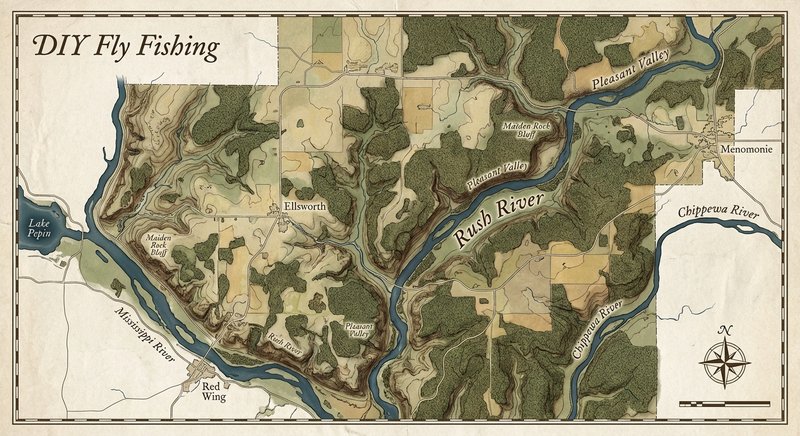
Rush River
Fly fishing in Wisconsin · Intermediate · Best seasons: Spring, Summer, Fall
Target Species
Brown Trout
About This Water
Driftless spring creek with wild brown trout. Technical fishing in beautiful valley.
Fishing Recommendations
The Rush River is widely considered the crown jewel of the Wisconsin "Driftless Area." Flowing through Pierce and St. Croix counties before emptying into Lake Pepin (the Mississippi River), the Rush is a classic limestone spring creek. It is larger than many of its neighbors, offering a "big water" feel with a prolific biomass that supports some of the highest trout counts—and some of the largest wild browns—in the Midwest.
🎣 Location Overview
The Rush River is a fertile, spring-fed stream characterized by its cold, nutrient-rich water. Unlike the smaller, tighter creeks in the region, the Rush offers room to cast, with a mix of sprawling meadow sections, limestone rimrock cliffs, and deep, timber-filled pools.
What makes it special is its resilience and productivity. The limestone influence keeps the water alkaline and cold, which is perfect for insect life. While it is a "Driftless" stream, it has a higher gradient in certain stretches, creating a beautiful sequence of riffles, runs, and deep, slow bends. It can be temperamental after a heavy rain—turning "chocolate milk" faster than the neighboring Kinnickinnic—but when it’s on, the fishing is world-class.
🐟 Target Species & Behavior
The Wild Brown Trout is the king of the Rush. While you may find an occasional escapee Rainbow or a stray Brookie in the upper tributaries, this is a Brown Trout fishery through and through.
- Size: Most fish are in the 10–14 inch range, but the Rush is famous for its "trophy" potential. Browns over 20 inches are caught every season by those who know where to look.
- Holding Water: These fish are structure-oriented. Look for them under "LUNKER" structures (man-made wooden overhangs), undercut banks, and nestled deep in the root balls of fallen trees.
- Feeding: They are highly opportunistic. Younger fish rise readily to hatches, while the larger "monsters" transition to a diet of sculpins, crayfish, and even smaller trout as they age.
📅 Best Times to Fish
Spring (March – May)
This is "Grannom" and "BWO" season. The early season (starting in early March) can be cold, but the midge hatches are consistent. By May, the Sulphur hatch begins, providing some of the best dry-fly action of the year.
Summer (June – August)
The Rush stays cold thanks to spring feeders, but the trout become "light sensitive."
- Morning: The Trico hatch is legendary. Tiny white-winged flies fall in clouds; you'll need 6X or 7X tippet and nerves of steel.
- Afternoon: This is terrestrial time. Look for "Hopper-Dropper" opportunities along the high-grass meadow banks.
Fall (September – October)
As the water cools, Brown Trout become aggressive and territorial ahead of the spawn. This is the best time to throw large streamers to trigger a "hunger" or "aggression" strike from a trophy fish.
Optimal Times: Early morning (dawn till 10 AM) and "the magic hour" (the last 90 minutes of daylight).
🪰 Recommended Flies & Techniques
Nymphing (The Bread and Butter)
The Rush is a "bug factory." If you aren't seeing rises, go deep.
- Patterns: Pink Squirrels (a Driftless staple), Zebra Midges (size 18-22), Scuds (gray or orange, size 14-18), and Pheasant Tails.
- Technique: Tactical European Nymphing (tight-line) is incredibly effective in the riffles. For the deeper pools, use a small, sensitive strike indicator.
Dry Fly (The Passion)
- Patterns: Sparkle Duns (BWO/Sulphur), Elk Hair Caddis (Tan/Olive), and the Hippo Hopper or foam ants for summer.
- Technique: Reach casts and pile casts are essential. The Rush has complex currents; a "drag-free drift" is the difference between a strike and a spooked fish.
Streamers (The Trophy Hunter)
- Patterns: Black or Olive Slump Busters, Woolly Buggers, and Sculpin-imitations.
- Technique: "Pound the banks." Cast tight to the wood or undercut banks and use erratic strips.
💡 Pro Tips & Local Knowledge
- The Turbidity Rule: The Rush can get muddy. If the water has 6–12 inches of visibility (a "milky" green), don't go home—this is prime streamer time. The fish feel safe and will move out of their deep holes to hunt. Use a large, black streamer.
- Stealth is Paramount: Because the water is often clear and the banks can be high, trout will see your silhouette from a distance. Stay low, wear earthy colors (drab greens/browns), and avoid splashing.
- The "Lower" Rush: Most people fish near Martell or El Paso. If you want bigger fish and fewer crowds, explore the lower reaches toward Maiden Rock, but be prepared for tougher wading and more "big water" conditions.
- Check the USGS Gauge: Always check the "Rush River at Maiden Rock" gauge online. If it’s spiking, the river will be dangerous and unfishable.
⚠️ Important Information
- Access: Wisconsin has excellent "Fishing Easement" programs. Look for the DNR "Public Fishing Area" signs at bridge crossings. Respect private property where easements do not exist.
- Regulations: The Rush has different regulations depending on the stretch. Much of it is Category 4 or 5 (check the WI DNR Trout Tool for specific bag limits and length requirements). Many serious anglers practice 100% Catch and Release here to preserve the trophy genetics.
- Permits: You need a Wisconsin Fishing License and an Inland Trout Stamp. These can be purchased online or at local bait shops in Ellsworth.
- Wading: The bottom is a mix of gravel and slippery limestone. Felt soles (where legal) or studded rubber soles and a wading staff are highly recommended.
Guide’s Final Word: The Rush River is a rewarding but demanding mistress. Spend your time observing the water before your first cast. Look for the "bubble line"—where the bubbles go, the food goes, and where the food goes, the Browns are waiting.
Bug Hatches & Matching Flies
| Hatch | Type | Peak months | Time of day | Hook sizes | Matching flies |
|---|---|---|---|---|---|
| Blue Winged Olives Baetis spp. | mayfly | April, May, September, October | Late Morning/Afternoon | #18-22 | RS2 #18-22, Parachute Adams #18-22, Pheasant Tail Nymph #18-20 |
| Grannom Caddis Brachycentrus | caddis | April, May | Afternoon/Evening | #14-16 | Elk Hair Caddis (Olive/Tan) #14-16, LaFontaine's Deep Sparkle Pupa #14-16, Peacock Soft Hackle #14-16 |
| Sulfurs Ephemerella invaria/dorothea | mayfly | May, June | Late Afternoon/Evening | #14-18 | Sulfur Parachute #14-18, Sulfur Emerger #14-16, Frenchie #14-16 |
| Tricos Tricorythodes | mayfly | July, August, September | Early Morning | #20-24 | Trico Spinner #20-24, Zebra Midge #20-22, Griffith's Gnat #20-22 |
| Light Cahill Stenacron interpunctatum | mayfly | June, July | Evening/Dusk | #12-14 | Light Cahill Dry #12-14, Hare's Ear Nymph #12-14, Light Cahill Wet Fly #14 |
| Terrestrials (Ants, Beetles, Hoppers) N/A | terrestrial | July, August, September | Late Morning/Afternoon | #8-18 | Fat Albert #8-12, Black Foam Ant #14-18, Crowe Beetle #12-16 |
| Craneflies Tipulidae | terrestrial | August, September | Morning/Afternoon | #10-14 | Daddy Long Legs #10-12, Crane Fly Larva #10-12 |
| Winter Midges Chironomidae | midge | January, February, March | Midday | #18-24 | Zebra Midge (Red/Black) #18-22, Morgan's Midge #20-22, WD-40 #20-22 |