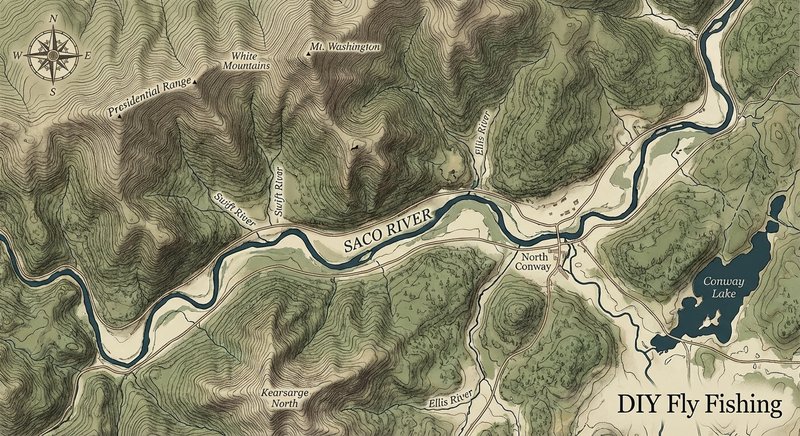
Saco River
Fly fishing in New Hampshire · Beginner · Best seasons: Spring, Summer, Fall
Target Species
Brook Trout, Brown Trout, Rainbow Trout
About This Water
White Mountain river with brook and brown trout. Popular recreation corridor.
Fishing Recommendations
The Saco River in New Hampshire is a quintessential New England freestone river. Rising from the rugged heights of Crawford Notch in the White Mountains, it transforms from a tumbling mountain brook into a classic wide trout stream as it winds toward the Maine border. For the fly angler, it offers a stunning backdrop of granite peaks and some of the most diverse trout water in the Northeast.
🎣 Location Overview
The Saco is a river of two characters. The Upper Saco (above Bartlett) is high-gradient, cold, and bouldery—perfect for those who love "blue lining" for wild fish. As it reaches Bartlett and North Conway, the river widens, featuring classic riffles, deep holding pools, and long glides.
What makes the Saco special is its clarity and accessibility. Much of the river parallels Route 302, yet it maintains a wilderness feel. It is a "pocket water" paradise in its upper reaches and a technical dry-fly fishery in its middle stretches. While it is a popular recreational river for tubers in the summer, the dedicated angler who knows when and where to go will find exceptional solitude and productive water.
🐟 Target Species & Behavior
- Brook Trout: The crown jewel of the White Mountains. In the headwaters and tributaries (like the Ellis River), you’ll find wild, vibrant brookies. They are opportunistic but wary, holding in highly oxygenated bubbles and behind large boulders.
- Rainbow Trout: Heavily stocked by NH Fish & Game in the Bartlett and Conway stretches. They tend to congregate in the faster riffles and at the heads of pools. They are aggressive feeders on caddis and stonefly nymphs.
- Brown Trout: The Saco holds some surprisingly large "holdover" browns. These fish are elusive and usually found in the deeper, slower "gorge" sections or tucked under undercut banks and fallen timber. They are primarily nocturnal or low-light feeders.
📅 Best Times to Fish
- Spring (Late May – June): This is the prime window. Once the "snow dump" runoff subsides, the water warms enough to trigger massive insect activity. June is the month for major hatches.
- Summer (July – August): Focus on the early mornings (sunrise to 10 AM) and late evenings. The river can get warm in the Conway area, so move upstream toward Crawford Notch or fish cold-water tributaries to protect the fish. Pro tip: Avoid the North Conway stretches between 11 AM and 4 PM to stay clear of the "aluminum hatch" (canoes and tubers).
- Fall (September – mid-October): My favorite time. The Brookies and Browns take on brilliant spawning colors and become aggressive. The foliage is world-class, and the crowds disappear.
🪰 Recommended Flies & Techniques
Dry Flies
- Elk Hair Caddis (#12-18): The most important fly on the Saco. Use tan or olive.
- Ausable Wulff (#12-14): High visibility for the choppy pocket water.
- Stimulators (#8-12): Great for mimicking large stoneflies or as a "hopper-dropper" lead fly.
- Blue Winged Olive (#18-22): Essential for overcast, drizzly days.
Nymphs
- Pheasant Tail (#14-18): The gold standard for the Saco’s Mayfly population.
- Prince Nymph (#12-16): Works exceptionally well for the stocked Rainbows.
- Pat’s Rubber Legs (#8-12): Vital in the spring to mimic the large Golden Stoneflies.
Streamers
- Woolly Bugger (Black or Olive): Dead-drift them through deep holes or swing them through tail-outs.
- Muddler Minnow: Excellent for mimicking sculpins and grasshoppers near the banks.
Techniques
- High-Sticking/Euro Nymphing: Because the Saco is so rocky, traditional long-line nymphing often leads to snags. Short-line nymphing through the "pockets" behind rocks is deadly here.
- The "Dry-Dropper": In the summer, a buoyant dry fly with a small Pheasant Tail dropped 18 inches below is the most efficient way to cover the river.
💡 Pro Tips & Local Knowledge
- Fish the "Cracks": The Saco has many flat ledge rock formations. Fish don't just sit behind boulders; they sit in the narrow cracks in the bedrock where the current is slower.
- Go High for Cold Water: If the water temp in North Conway hits 68°F, stop fishing there. Drive 15 minutes north to the Hart’s Location area. The water stays significantly colder due to the higher elevation and mountain shadows.
- Stealth is Key: The Saco is incredibly clear. If you can see the fish, they have likely already seen you. Wear earthy colors, keep a low profile, and use longer leaders (9–12 feet) in the slower pools.
- The "Secret" Tributaries: Don't overlook the Ellis River or the Rocky Branch. These are technically separate rivers but flow into the Saco system and offer incredible small-stream fly fishing when the main stem is high.
⚠️ Important Information
- Regulations: New Hampshire fishing licenses are required. Most of the Saco is open to general regulations, but always check the NH Fish & Game website for current "Fly Fishing Only" or "Catch and Release" zones, which can change seasonally.
- Access: Public access is excellent. Look for pull-offs along Route 302. Notable spots include the First Bridge in North Conway and the various White Mountain National Forest trailheads.
- Safety: The rocks in the Saco are notoriously slippery. Studded wading boots and a wading staff are highly recommended.
- Etiquette: This is a popular destination. If you see another angler in a pool, give them plenty of space (at least two pool-lengths) or move to the next pull-off.
Guide’s Final Word: The Saco isn't about giant trophy fish (though they exist); it’s about the experience of fishing one of the most beautiful landscapes in America. Slow down, observe the hatches, and enjoy the crisp mountain air. Tight lines!
Bug Hatches & Matching Flies
| Hatch | Type | Peak months | Time of day | Hook sizes | Matching flies |
|---|---|---|---|---|---|
| Hendrickson Ephemerella subvaria | mayfly | May | Afternoon | #12-14 | Red Quill #12-14, Hendrickson Nymph #12-14, Pheasant Tail #12-14 |
| Blue-Winged Olive Baetis spp. | mayfly | April, May, September, October | Midday/Afternoon | #18-22 | RS2 #18-22, Parachute BWO #18-22, Barr's BWO Emerger #20 |
| Grannom Caddis Brachycentrus | caddis | May | Morning/Afternoon | #14-16 | Elk Hair Caddis (Dark) #14-16, Deep Sparkle Pupa #14-16, Holy Grail #14-16 |
| Sulphur Ephemerella dorothea | mayfly | June, July | Evening | #16-18 | Sulphur Parachute #16-18, CDC Sulphur Emerger #16-18, Sulphur Spinner #16-18 |
| Eastern Green Drake Ephemera guttulata | mayfly | June | Dusk | #8-10 | Green Drake Cripple #8-10, Coffin Fly #8-10, Green Drake Nymph #8-10 |
| Light Cahill Stenacron interpunctatum | mayfly | June, July, August | Evening | #12-14 | Light Cahill Dry #12-14, Cream Usual #14, Gold Ribbed Hare's Ear #12-14 |
| Golden Stonefly Acroneuria lycorias | stonefly | June, July | Morning/Evening | #8-12 | Golden Stone Nymph #8-12, Stimulator (Yellow) #10-12, Pats Rubber Legs #8-12 |
| Cinnamon Caddis Hydropsyche | caddis | June, July, August | Evening | #14-18 | Tan Elk Hair Caddis #14-18, Z-Lon Caddis #16, LaFontaine Sparkle Pupa #16 |
| Trico Tricorythodes | mayfly | July, August, September | Morning | #22-26 | Trico Spinner #22-24, Griffith's Gnat #22-24 |
| Terrestrials (Ants/Beetles) Formicidae / Coleoptera | terrestrial | July, August, September | All Day | #12-18 | Black Foam Ant #16-18, Chernobyl Ant #12, Crowe Beetle #14-16 |