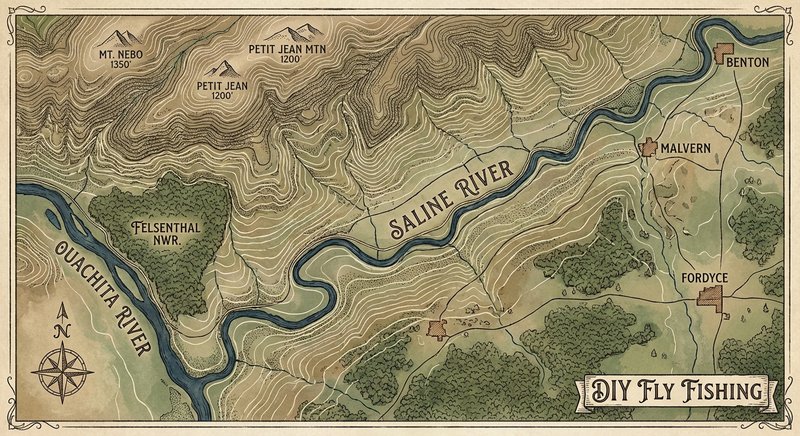
Saline River
Fly fishing in Arkansas · Beginner · Best seasons: Spring, Summer, Fall
Target Species
Smallmouth Bass, Largemouth Bass, Catfish
About This Water
South-central Arkansas stream with bass and catfish. Scenic float fishing.
Fishing Recommendations
The Saline River is one of Arkansas’s hidden gems. Unlike many of the state's famous tailwaters, the Saline is the last major free-flowing river in the entire Ouachita Mountain region. Because it is undammed, it retains a wild, natural character that changes dramatically from its rocky upper forks to its cypress-studded lower reaches.
For a fly angler, the Saline offers an intimate, scenic experience away from the crowds of the White or Little Red Rivers.
🎣 Location Overview
The Saline River is unique because it transitions through two distinct ecosystems. The Upper Saline (the North, Middle, and South Forks near Benton) is characterized by clear water, gravel bars, and rapid-and-pool sequences. This is classic "Ouachita Mountain" water.
As you move south of Benton toward Sheridan and eventually into the Felsenthal National Wildlife Refuge, the river slows down, deepens, and becomes a classic "Coastal Plain" river, lined with ancient cypress trees and tupelo gums. Anglers love the Saline because it offers a "choose your own adventure" style of fishing—you can wade-fish for acrobatic Smallmouth in the morning and float through swampy backwaters for massive Largemouth in the afternoon.
🐟 Target Species & Behavior
- Smallmouth Bass: These are the stars of the Upper Saline. They are leaner and meaner than their lake-dwelling cousins. They hold in the "head of the pool" where oxygenated water comes off a riffle, or behind large root balls and boulders. They feed heavily on crawfish and hellgrammites.
- Largemouth Bass: Dominant in the middle and lower stretches. They prefer the slower, deeper water and are almost always found tight to structure—specifically cypress knees, fallen timber, and lily pads. They are ambush predators looking for sunfish, frogs, and large minnows.
- Catfish (Channel and Flathead): While often overlooked by fly anglers, the Saline has a healthy population. On a fly rod, you’ll find them in deep holes during the heat of the day. They are surprisingly aggressive and will take a heavy, dark streamer swung deep and slow through a pool.
📅 Best Times to Fish
- Spring (March – May): This is the prime window for big fish. As water temperatures hit 55–60°F, bass become aggressive. Pre-spawn (April) is the best time for trophy Smallmouth. Note: Watch the river gauges; spring rains can blow this river out quickly.
- Summer (June – August): Best for consistent action. The water clears up and levels drop, making it perfect for wading. This is topwater season. Focus on early mornings and late evenings to avoid the Arkansas humidity and the midday "lull."
- Fall (September – November): My personal favorite. The water cools, the bugs return, and the bass feed heavily before winter. The clarity is usually at its peak, and the "Smallie" bite in the upper forks is world-round.
- Prime Windows: Low-light periods (dawn/dusk) are essential for topwater, but midday can be productive for Smallmouth if you fish deep with crawfish patterns.
🪰 Recommended Flies & Techniques
Top Patterns
- Topwater: BoogleBugs (Poppers) in yellow or white, Stealth Bombers (Size 4-6) in Chartreuse or Black, and Murdich Minnows (fished on the surface).
- Sub-Surface: Clouser Minnows (Chartreuse/White or Olive/White), Near Nuff Craws (Brown or Orange), and Woolly Buggers (Black or Olive with some flash).
- The "Secret Weapon": Hellgrammite patterns. The Saline is loaded with them. A heavy, black rubber-legged nymph or a specialized Hellgrammite fly drifted through riffles is deadly.
Techniques
- The "Pop and Pause": When using poppers, the pause is more important than the pop. Let the rings disappear before moving the fly again. Bass often strike when the fly is dead still.
- Streamer Stripping: For Smallmouth, use an erratic "strip-strip-pause" motion to mimic a wounded shiner.
- Crayfish Dead-Drift: In the upper rocky sections, fish a crayfish pattern under an indicator or bounce it along the bottom like a nymph.
💡 Pro Tips & Local Knowledge
- The "Fork" Logic: If the main stem below Benton is too muddy from rain, head up to the North Fork. It typically clears the fastest and has the highest gradient (more oxygen).
- Stay Stealthy: Because the water is often very clear and shallow in the summer, these fish are spooky. Long casts and light footprints are required. Wear natural colors (tan/camo) rather than bright white shirts.
- Target the "Seams": Don't just cast into the middle of the river. Look for the "seam" where fast water meets slow water. Saline Smallmouth sit right on that line waiting for food to be delivered.
- The "Cypress Knee" Trick: In the lower river, don't just cast near a cypress tree. You need to get your fly within 2 inches of the bark. Largemouth in the Saline rarely chase bait far; you have to put it in their living room.
⚠️ Important Information
- Access: Much of the riverbank is private property. The best way to fish the Saline is by kayak or canoe. Popular put-ins include the Hwy 5 bridge, Peeler Bend, and Lyle Park in Benton. For the lower river, look at the access points near Sheridan (Hwy 270).
- Regulations: An Arkansas Fishing License is required. Be sure to check the AGFC (Arkansas Game and Fish Commission) regulations for specific creel limits on Smallmouth Bass, as they have specific "Quality Management" zones on certain forks where catch-and-release is encouraged or limits are highly restricted.
- Safety: This is a wild river. Always check the USGS Gauge at Benton. If it’s over 5 or 6 feet, wading becomes dangerous and the fishing usually shuts down due to turbidity. Also, be mindful of snakes (Cottonmouths) in the lower, swampier sections during the summer.
Guide's Final Word: The Saline is a "thinking angler's" river. It rewards patience and accuracy over long-distance casting. Bring a 6-weight rod, a box of poppers, and a sense of adventure.
Bug Hatches & Matching Flies
| Hatch | Type | Peak months | Time of day | Hook sizes | Matching flies |
|---|---|---|---|---|---|
| Blue-Winged Olive Baetis | mayfly | February, March, October, November | Late Morning/Afternoon | #18-22 | RS2 #20-22, Parachute BWO #18-20, Pheasant Tail Nymph #18-20 |
| Light Cahill Stenacron interpunctatum | mayfly | May, June | Evening | #12-14 | Light Cahill Dry #12-14, Gold Ribbed Hare's Ear #12-14 |
| Spotted Sedge Hydropsyche | caddis | May, June, September | Evening | #14-16 | Elk Hair Caddis #14-16, LaFontaine Sparkle Pupa #16, Hydropsyche Larva #14 |
| Hex Hexagenia limbata | mayfly | June, July | Dusk/Night | #6-10 | Hexagenia Dry #6-8, Large Yellow Drake Nymph #8 |
| Tricos Tricorythodes | mayfly | July, August, September | Early Morning | #22-26 | Trico Spinner #22-24, Sunken Trico Spinner #22-24 |
| Damselfly Calopteryx | terrestrial | June, July, August | All Day | #10-14 | Adult Damselfly (Blue) #10-12, Marabou Damselfly Nymph #12-14 |
| Dobsonfly (Hellgrammite) Corydalus cornutus | stonefly | May, June | Night | #2-6 | Clouser Hellgrammite #4-8, Murray's Hellgrammite #6-10 |
| Grasshopper Melanoplus | terrestrial | July, August, September | Midday/Afternoon | #6-12 | Dave's Hopper #8-12, Chernobyl Ant #6-10 |
| White Fly Ephoron leukon | mayfly | August, September | Evening | #12-14 | White Wulff #12-14, Snowshoe White Fly #14 |