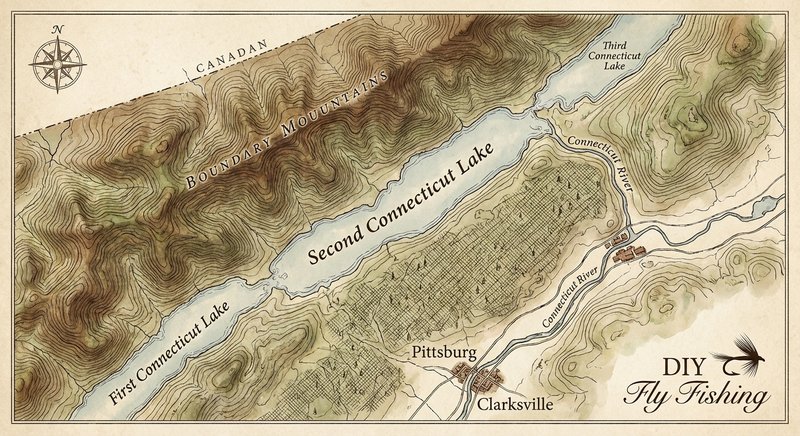
Second Connecticut Lake
Fly fishing in New Hampshire · Intermediate · Best seasons: Summer, Fall
Target Species
Brook Trout, Landlocked Salmon
About This Water
Pittsburg lake with trophy brook trout. Remote wilderness setting.
Fishing Recommendations
Welcome to the "North of the Notches." As a guide in the Great North Woods of New Hampshire, I can tell you that Second Connecticut Lake is a crown jewel for those seeking a true boreal fishing experience. Located in Pittsburg, NH—just miles from the Canadian border—this 1,100-acre lake offers a more rugged, remote feel than First Connecticut Lake, while providing world-class opportunities for cold-water salmonids.
Here is your comprehensive guide to fly fishing Second Connecticut Lake.
🎣 Location Overview
Second Connecticut Lake is a deep, cold, glacial basin surrounded by dense spruce and fir forests. What makes it special is its position in the chain: it is fed by the Connecticut River flowing down from Third Lake and empties through a dam into the "Trophy Stretch" leading to First Lake.
The water is crystal clear and remains cold year-round, which is vital for the health of the landlocked salmon and brook trout. Unlike the larger First Lake, Second Lake feels intimate. It features dramatic drop-offs, rocky shorelines, and several key tributary inlets. Anglers love it because it offers both "big water" lake fishing and exceptional "river-style" fishing at the inlet and outlet.
🐟 Target Species & Behavior
- Landlocked Salmon: These are the "silver bullets" of the north. In Second Lake, they are pelagic hunters, primarily chasing Rainbow Smelt. During the summer, they hold below the thermocline (20–40 feet down). In the fall, they become aggressive and move toward the inlets and the dam in preparation for their spawning run.
- Brook Trout: These are often "wild" or long-term residents that show brilliant colors. They are more structure-oriented than salmon. You’ll find them patrolling the rocky shorelines, submerged timber, and the mouth of the Magalloway Drift.
- Feeding Habits: The primary forage is the smelt. However, Second Lake is famous for its massive Hexagenia limbata (Giant Yellow Mayfly) hatch, which brings even the largest, deepest-dwelling fish to the surface.
📅 Best Times to Fish
Summer (Late June – August)
- The Window: Late June to mid-July is the legendary Hex Hatch.
- Conditions: Fish the "witching hour"—the last 90 minutes of daylight. This is the only time large salmon and trout consistently rise to dry flies in the middle of the lake.
- Daytime: During the heat of the day, use full-sinking lines to find fish in the 25-foot range.
Fall (September – October 15th)
- The Window: September is prime. As water temperatures drop, fish move shallow.
- Conditions: Overcast, "fishy" days are best. The fish are transitioning into their spawning colors and become highly territorial and aggressive toward streamers.
🪰 Recommended Flies & Techniques
Streamer Fishing (The Standard)
Since smelt are the main food source, long, slender streamers are the weapon of choice.
- Patterns: Grey Ghost, Black Ghost, Joe’s Smelt, and the Soft-Hackle Streamer in olive or white.
- Technique: Use a Type 3 or Type 5 sinking line. Cast toward the rocky points or the drop-off "shelf" and use a fast, erratic strip to mimic a wounded smelt.
Dry Fly Fishing (The Hex Hatch)
- Patterns: Hexagenia Paradrake, Yellow Humpy (size 6-8), or a large Light Cahill.
- Technique: When the "big yellows" start popping off the water at dusk, look for the "rings of rise." Cast ahead of a cruising fish and wait. Twitch it slightly to create a ripple.
Nymphing (The Inlets)
- Patterns: Prince Nymphs, Pheasant Tails, and Copper Johns (size 12-16).
- Technique: If fishing the inlet from Third Lake, use a high-stick nymphing technique or an indicator in the pocket water where the river meets the lake.
💡 Pro Tips & Local Knowledge
- The "Inlet" Secret: The mouth where the Connecticut River enters Second Lake (from Third Lake) is a magnet for Brook Trout. In the fall, Salmon stack up here. It is wadeable, but the bottom is "greasy" (slippery)—wear studded boots.
- The Dam Flow: Check the flows at the dam. When the water is pushing through the gates, it creates an oxygenated current that attracts Salmon. Casting streamers into the "boil" near the outlet can be incredibly productive.
- Stealth Matters: Because the water is so clear, long leaders (9–12 feet) are essential, especially on calm summer evenings. If the lake is "glassy," a heavy fly line hitting the water will spook the school.
- Look for the Loons: Local guides watch the loons. If you see a group of loons diving repeatedly in one area, they are likely over a school of smelt. The salmon won't be far away.
⚠️ Important Information
- Regulations: New Hampshire Fish & Game manages this water strictly. The river sections between the lakes are often Fly Fishing Only (FFO) and have specific length/bag limits. Always check the current NH Freshwater Fishing Digest.
- Access: There is a excellent public boat launch on the western shore off Route 3. For those without a boat, the area around the dam and the northern inlet offer the best foot access.
- Safety: This is Moose Country. Be extremely careful driving Route 3 at dawn or dusk. Additionally, Second Lake can whip up whitecaps quickly when a north wind blows; if you are in a small boat or canoe, keep a close eye on the horizon.
- Permits: You will need a New Hampshire freshwater fishing license, which can be purchased at various local shops in Pittsburg (like Young's Store) or online.
Guide’s Final Word: Second Lake is a place for the patient angler. It doesn't always give up its fish easily, but when a 20-inch Landlocked Salmon hits a streamer on a foggy September morning, you’ll understand why we call this place "God’s Country."
Bug Hatches & Matching Flies
| Hatch | Type | Peak months | Time of day | Hook sizes | Matching flies |
|---|---|---|---|---|---|
| Giant Mayfly (Hex) Hexagenia limbata | mayfly | June, July | Dusk/Night | #6-10 | Hexagenia Dry #6-8, Hex Emerger #8, Hex Nymph #6-10 |
| Hendrickson Ephemerella subvaria | mayfly | May, June | Afternoon | #12-14 | Red Quill #12-14, Hendrickson Emerger #14, Pheasant Tail Nymph #12-16 |
| Chironomids (Midges) Chironomidae | midge | May, June, September | All Day | #18-24 | Zebra Midge #18-22, Griffith's Gnat #20-24, Ice Bud #18-20 |
| Light Cahill Stenacron canadense | mayfly | June, July | Evening | #12-16 | Light Cahill Dry #12-16, Cream Variant #14 |
| Blue-Winged Olive (BWO) Baetis / Acerpenna | mayfly | May, September, October | Afternoon | #18-22 | BWO Sparkle Dun #18-22, RS2 #20-22, WD-40 #18-22 |
| Cinnamon Sedge Hydropsyche | caddis | June, July, August | Evening | #14-18 | Elk Hair Caddis (Tan) #14-16, Pupa-Le-Do #16, Gold Ribbed Hare's Ear #14-18 |
| Yellow Sally Isoperla | stonefly | June, July | Afternoon/Evening | #14-16 | Yellow Sally Dry #14-16, Little Yellow Stone Nymph #14-16 |
| Flying Ants Camponotus | terrestrial | August, September | Late Afternoon | #14-18 | Black Winged Ant #14-18, Chernobyl Ant #12-14 |
| Great Autumn Brown Sedge Pycnopsyche | caddis | September, October | Evening | #8-12 | Stimulator (Orange) #8-12, Godzilla Caddis #10 |
| White Miller Ephoron leukon | mayfly | August | Late Evening | #12-14 | White Wulff #12-14, Ephoron Dun #14 |