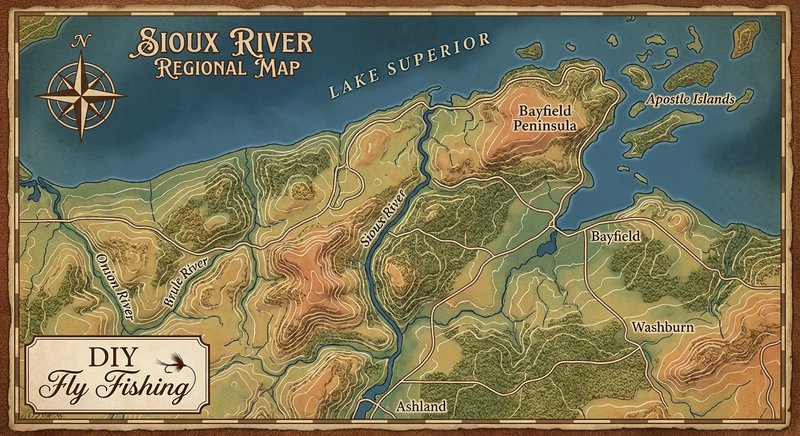
Sioux River
Fly fishing in Wisconsin · Intermediate · Best seasons: Spring, Fall
Target Species
Steelhead, Brook Trout
About This Water
Lake Superior tributary with steelhead runs. Remote northern Wisconsin fishing.
Fishing Recommendations
The Sioux River, located in Bayfield County, Wisconsin, is one of the "crown jewels" of the Lake Superior south shore. It is an intimate, scenic, and often challenging fishery that rewards anglers who appreciate wild surroundings and hard-fighting lake-run fish.
As your guide, here is the comprehensive breakdown for fishing the Sioux.
🎣 Location Overview
The Sioux River is a quintessential Lake Superior tributary. It is smaller and more "brushy" than the neighboring Bois Brule, offering a sense of solitude that is hard to find elsewhere.
The river is characterized by its tea-colored (tannic) water and a bottom consisting of sand, gravel, and volcanic rock. Because it flows through a region with high red clay content, the river is notoriously "flashy"—it rises quickly after rain and can turn a murky chocolate milk color. However, when the water is "trout green" (clearing but still holding color), it provides some of the best fly fishing in the Midwest. Anglers love it for its classic pool-and-riffle structure and the fact that you can often have a world-class Steelhead run all to yourself.
🐟 Target Species & Behavior
Steelhead (Lake-run Rainbow Trout)
These are the primary draw. They spend their lives in the cold depths of Lake Superior and enter the Sioux to spawn.
- Behavior: They are powerful and skittish. Unlike river-resident fish, they are built for the open lake. When hooked in a small stream like the Sioux, they tend to bolt downstream, making for an adrenaline-filled fight.
- Holding Water: Look for "seams" where fast and slow water meet, deep undercut banks, and the "tail-outs" of pools (the shallowing area at the end of a hole) just before dark.
Brook Trout
The Sioux holds a healthy population of resident Brookies in its upper reaches and tributaries (like the Big Sioux and Little Sioux).
- Behavior: These are opportunistic feeders. In the cold, clean headwaters, they hide under log jams and in deep "pocket water" behind boulders.
- Coasters: Occasionally, you may encounter "Coaster" Brook Trout—migratory Brookies that spend time in Lake Superior and return to the river. These are significantly larger and more silver than their resident cousins.
📅 Best Times to Fish
Spring (The Main Event)
- Months: Late March through early May.
- Peak: Usually mid-April.
- Conditions: You are waiting for the ice-out and the water temperature to hit the 40°F mark. Once the water hits 42–45°F, the Steelhead become very active and begin to move onto the gravel redds to spawn.
Fall (The Scenic Run)
- Months: Late September through November.
- Peak: October.
- Conditions: While the fall Steelhead run is smaller than the spring, the fish are in peak physical condition—fat from a summer of feeding in the lake. You will also encounter Coho Salmon and occasional Brown Trout during this window.
Best Time of Day
- Early Morning: First light is critical for Steelhead, especially in the clear water of the Sioux.
- Overcast Days: Because the river is small and relatively shallow, "bluebird" sunny days often push fish into the deepest, darkest wood cover. Low-light conditions are your best friend.
🪰 Recommended Flies & Techniques
For Steelhead
- Nymphing (Most Productive):
- Patterns: Egg patterns (Glo-bugs, Trout Beads in "Oregon Cheese" or "Mottled Roe"), Prince Nymphs (size 8-12), and the Superior X-way (a local stonefly favorite).
- Technique: High-stick nymphing or indicator nymphing. You must get the fly to the bottom. If you aren't ticking the rocks occasionally, you aren't deep enough.
- Swinging Streamers:
- Patterns: Egg-sucking Leeches, Black or Olive Woolly Buggers, and small Intruders.
- Technique: A "trout spey" or light switch rod is great here. Cast cross-stream and let the fly swing through the tail-out of the pool.
For Brook Trout
- Dry Flies: Elk Hair Caddis, Stimulators, and Royal Wulffs (June–August).
- Nymphs: Pheasant Tails and Gold-Ribbed Hare's Ears (size 14-16).
- Streamers: Small Muddler Minnows or Black Ghosts to mimic sculpins and dace.
💡 Pro Tips & Local Knowledge
- The "Red Clay" Rule: Check the weather and USGS gauges before driving. If the area has received more than an inch of rain in the last 24 hours, the Sioux will likely be unfishable due to turbidity. Give it 48 hours to "drop and clear."
- Stealth is Mandatory: Because the Sioux is narrow, heavy wading will spook every fish in the hole. Stay on the bank where possible, wear drab clothing (earth tones), and move slowly.
- Focus on Wood: The Sioux is a "woody" river. Many anglers skip the log jams because they are afraid of losing flies. Don't. The biggest Steelhead and Brookies live under those logs. Use a heavier tippet (1X or 2X for Steelhead) to pull them out of the brush.
- The Hwy 13 Bridge: The stretch around the Highway 13 bridge is popular but gets pressured. If you are willing to hike a mile upstream or downstream from the main access points, your catch rate will usually double.
⚠️ Important Information
Access
- Public Access: There are several bridges with public access, including Highway 13 and Friendly Valley Road. Much of the river corridor is private property, but under Wisconsin law, as long as you keep your "feet wet," you are legally allowed to navigate the stream.
- Parking: Be respectful of local landowners. Do not block gates or driveways.
Regulations & Permits
- Licenses: You need a valid Wisconsin Fishing License.
- Stamps: You MUST have both the Inland Trout Stamp and the Great Lakes Salmon and Trout Stamp to legally fish for Steelhead in the Sioux.
- Regulations: The Sioux has specific regulations regarding "Type" water. Generally, from the mouth up to the first dam/barrier, Great Lakes tributary regulations apply (higher minimum size limits for keeping fish). Many anglers practice 100% catch and release here to preserve the wild genetics.
Safety
- Wading: The rocks in the Sioux can be incredibly slippery (covered in "snot" algae). Felt-soled boots or studs are highly recommended.
- Cell Service: Spotty at best once you get into the ravines. Let someone know where you are going.
Guide’s Final Word: The Sioux River isn't about high numbers; it's about the quality of the experience. Landing one wild Steelhead on this intimate water is worth ten fish on a larger, more crowded river. Respect the fish, respect the landowners, and enjoy the silence of the Northwoods.
Bug Hatches & Matching Flies
| Hatch | Type | Peak months | Time of day | Hook sizes | Matching flies |
|---|---|---|---|---|---|
| Early Black Stonefly Capniidae | stonefly | March, April | Mid-day | #14-18 | Early Girl Stone #16-18, Little Black Sloan #14-16 |
| Blue-winged Olive Baetis spp. | mayfly | April, May, September, October | Mid-day/Afternoon | #18-22 | RS2 #20-22, Parachute Adams #18-22, Pheasant Tail #18-20 |
| Hendrickson Ephemerella subvaria | mayfly | May | Afternoon | #12-14 | Hendrickson Sparkle Dun #12-14, Red Quill #12-14 |
| Grannom Caddis Brachycentrus occidentalis | caddis | May | Morning/Evening | #14-16 | LaFontaine's Deep Pupa #14-16, Elk Hair Caddis (Olive) #14-16 |
| Giant Black Stonefly Pteronarcys dorsata | stonefly | May, June | Night/Evening | #4-8 | Pat's Rubber Legs #4-8, Kaufmann's Stone #6-8 |
| Brown Drake Ephemera simulans | mayfly | June | Late Evening/Dusk | #10-12 | Brown Drake Spinner #10-12, Harrop's CDC Parachute Drake #10-12 |
| Cinnamon Caddis Hydropsyche spp. | caddis | June, July, August | Evening | #14-18 | Tan Elk Hair Caddis #14-16, Hydropsyche Larva #14-18 |
| Trico Tricorythodes spp. | mayfly | July, August, September | Morning | #20-24 | Trico Spinner #20-24, Sunken Trico Spinner #22-24 |
| Terrestrials Formicidae / Gryllidae | terrestrial | July, August, September | Mid-day | #10-16 | Chernobyl Ant #10-12, Black Foam Beetle #14-16, Cinnamon Flying Ant #16-18 |