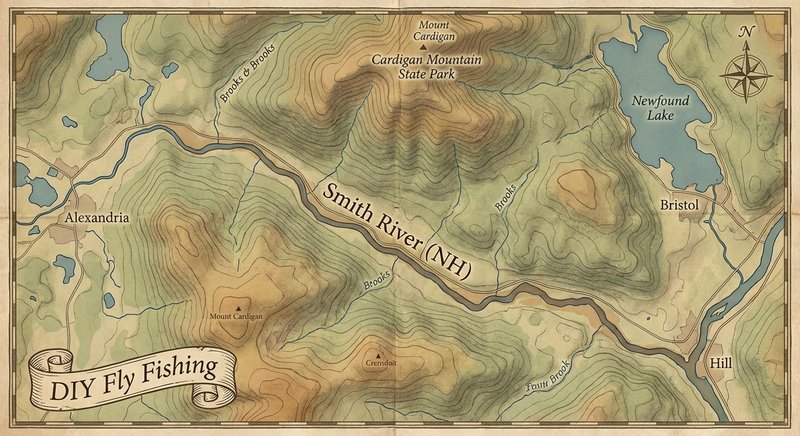
Smith River (NH)
Fly fishing in New Hampshire · Beginner · Best seasons: Spring, Summer, Fall
Target Species
Brown Trout, Brook Trout
About This Water
Grafton County stream with brown trout. Good public access.
Fishing Recommendations
The Smith River in central New Hampshire is often overshadowed by the larger Pemigewasset and Merrimack Rivers, but for the discerning trout angler, it is one of the most rewarding freestone streams in the Granite State. Flowing through the towns of Grafton, Danbury, Alexandria, and Bristol before meeting the "Pemi," the Smith offers a quintessential New England fly fishing experience.
🎣 Location Overview
The Smith River is a classic freestone stream characterized by its diversity of water. It transitions from a tumbling mountain brook in its upper reaches to a medium-sized river with deep pools, long riffles, and dramatic drops—most notably at the stunning Profile Falls.
What makes the Smith special is its "wild" feel despite being relatively accessible. While NH Fish & Game stocks it heavily with Brook and Brown trout, the river’s complex structure—boulders, undercut banks, and woody debris—allows for excellent "holdover" potential. Anglers love it for its technical variety; you can spend the morning tight-line nymphing through a boulder garden and the evening casting dry flies to rising fish in a glassy pool.
🐟 Target Species & Behavior
- Brown Trout: These are the "smart" residents of the Smith. Larger holdover browns often tuck themselves into the deepest, darkest undercut banks or under submerged logs during the day. They are highly piscivorous (fish-eaters) and become most active during low-light conditions or after a rain event.
- Brook Trout: You will find both stocked "beauties" and smaller, brilliantly colored wild brookies in the cooler, upper tributaries. They are opportunistic feeders, often holding in the "cushion" in front of rocks or in the bubbly oxygenated water at the head of pools.
- Behavioral Note: The trout in the Smith are sensitive to overhead shadows. Because the water is often crystal clear, a stealthy approach and long leaders are frequently required for success.
📅 Best Times to Fish
- Spring (May – June): This is the "Golden Window." As the spring runoff subsides and the water warms into the 50s, the insect life explodes. This is the best time for consistent dry fly action.
- Summer (July – August): Fishing becomes more technical. You must carry a thermometer; the Smith can get warm in the lower reaches. Focus on the early morning (sunrise to 10:00 AM) or the final hour of light. Look for "thermal refuges"—areas where colder feeder streams enter the main river.
- Fall (September – October): A favorite for many guides. Brown trout become aggressive and territorial as they prepare for the spawn. The foliage is world-class, and the fish take on deep, vibrant spawning colors.
- Prime Window: 6:00 PM to dark during the summer months is when the "Big Bug" hatches (like Hexagenia or large Caddis) bring the biggest fish to the surface.
🪰 Recommended Flies & Techniques
Top Fly Patterns
- Dry Flies: Hendrickson (May), Elk Hair Caddis (Tan/Olive, all season), Royal Wulff (attractor), and the Yellow Stimulator (Size 12-16) for the faster pocket water.
- Nymphs: Bead-head Pheasant Tail, Prince Nymph, and Perdigons (size 14-18) for reaching the bottom quickly in the fast runs.
- Streamers: Black or Olive Woolly Buggers, Muddler Minnows, and the Grey Ghost (a classic NH pattern).
Techniques
- Pocket Water Nymphing: The Smith is full of "pockets" behind boulders. Use a high-sticking or Euro-nymphing technique to keep your line off the conflicting currents.
- The "Dry-Dropper": In the early summer, a buoyant foam fly (like a Chubby Chernobyl) with a small Pheasant Tail dropped 18 inches below is deadly for covering two parts of the water column.
- Streamer Stripping: In the deep pools below Profile Falls, cast a weighted streamer across the current and use erratic, jerky strips to mimic a wounded dace or sculpin.
💡 Pro Tips & Local Knowledge
- The Profile Falls Area: Below the falls, the water is highly oxygenated and deep. This area holds fish even when the rest of the river warms up. However, it is a popular swimming hole; fish it very early in the morning to have the water to yourself.
- The "Pemi" Connection: In late spring and fall, large trout often migrate from the Pemigewasset River up into the lower Smith. If you are fishing the lower mile of the river, be prepared for a fish much larger than the average stockie.
- Wading Safety: The rocks in the Smith can be notoriously "greasy." Felt-soled boots or studs are highly recommended, as the riverbed is a mix of round river stones and slick ledge.
- Focus on the "Bends": Look for the river bends between Danbury and Alexandria. These areas create natural scour holes where the biggest Browns reside.
⚠️ Important Information
- Access: Key access points include the Profile Falls Recreation Area (off Rt 3A), various bridge crossings on Route 104, and the area near the Danbury Country Store. Much of the river flows through private land; always look for "Posted" signs and respect landowner rights to ensure future access.
- Regulations: The Smith River generally falls under General Fishing Trout Water rules in NH, but regulations can change. Always check the current NH Fish & Game Freshwater Fishing Digest for bag limits and seasonal closures.
- Catch & Release: While not a dedicated "Fly Fishing Only" water, practicing catch and release (especially for wild brookies and holdover browns) is strongly encouraged to maintain the quality of the fishery.
- Temperature Watch: If the water temperature hits 68°F (20°C), please stop fishing for trout. They are under high stress in warm water and often won't survive the catch-and-release process.
Bug Hatches & Matching Flies
| Hatch | Type | Peak months | Time of day | Hook sizes | Matching flies |
|---|---|---|---|---|---|
| Blue Winged Olive Baetis / Pseudocloeon | mayfly | April, May, September, October | Midday | #18-22 | RS2 #18-22, Parachute Adams #18-22, Pheasant Tail Nymph #18-20 |
| Hendrickson Ephemerella subvaria | mayfly | May | Afternoon | #12-14 | Red Quill #12-14, Hendrickson Emerger #12-14, Gold Ribbed Hare's Ear #12-14 |
| Grannom Caddis Brachycentrus | caddis | April, May | Morning/Afternoon | #14-16 | Elk Hair Caddis (Black/Olive) #14-16, Pupa #14-16, Peacock Caddis #14-16 |
| March Brown Maccaffertium vicarium | mayfly | May, June | Afternoon | #10-12 | March Brown American #10-12, Hare's Ear Nymph #10-12, March Brown Wet Fly #12 |
| Sulphur Ephemerella invaria / dorothea | mayfly | June, July | Evening | #14-18 | Sulphur Parachute #14-18, Sulphur Snowshoe Emerger #16-18, Pheasant Tail #16-18 |
| Light Cahill Stenonema ithaca | mayfly | June, July, August | Evening | #12-14 | Light Cahill #12-14, Cream Usual #12-14 |
| Isonychia / Slate Drake Isonychia bicolor | mayfly | August, September | Late Afternoon | #10-12 | Iso Parachute #10-12, Prince Nymph #10-12, Zug Bug #10-12 |
| Cinnamon Caddis Hydropsyche | caddis | June, July, August | Evening | #14-18 | Tan Elk Hair Caddis #14-18, LaFontaine's Deep Pupa #14-16 |
| Golden Stonefly Acroneuria | stonefly | June, July | Morning/Evening | #6-10 | Golden Stone #8-10, Pat's Rubber Legs #6-10, 20 Incher Stone #8-12 |
| Terrestrials Formicidae / Gryllidae | terrestrial | July, August, September | All Day | #12-18 | Black Foam Ant #16-18, Chernobyl Ant #10-12, Crow Beetle #14-16 |