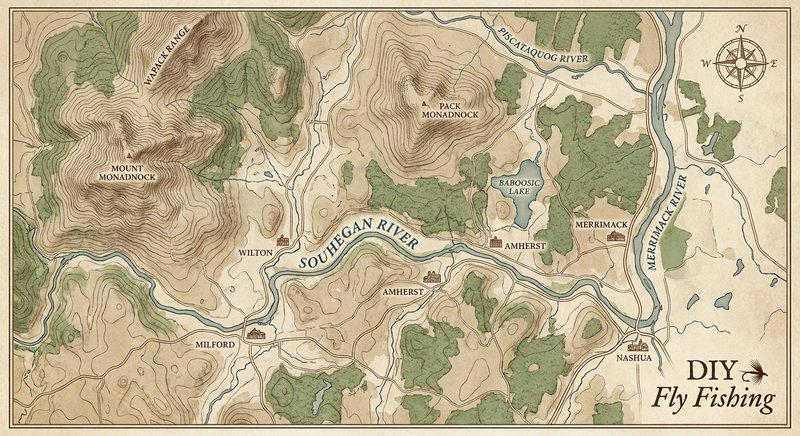
Souhegan River
Fly fishing in New Hampshire · Beginner · Best seasons: Spring, Summer, Fall
Target Species
Brown Trout, Brook Trout
About This Water
Hillsborough County stream with trout. Accessible near Milford.
Fishing Recommendations
Tight lines! As your guide for the day, let’s dive into the Souhegan River, a southern New Hampshire gem. While the state is famous for its northern freestone streams in the White Mountains, the Souhegan offers some of the best trout fishing in the "bottom half" of the state, providing a classic New England experience without the long drive north.
🎣 Location Overview
The Souhegan River is a classic "lowland" river that flows roughly 30 miles from Ashburnham, Massachusetts, through the New Hampshire towns of Greenville, Wilton, Milford, Amherst, and Merrimack before joining the Merrimack River.
What makes the Souhegan special is its diverse character. In the upper reaches near Wilton, you’ll find high-gradient "pocket water" with boulders and plunges. As it moves through Milford and Amherst, it transitions into beautiful riffles, long glides, and deep undercut banks. It is heavily stocked by NH Fish and Game, but because of its structure, it offers more "technical" fly fishing than your average stocked stream.
🐟 Target Species & Behavior
The Souhegan is primarily a Brown and Brook Trout fishery.
- Brook Trout: These are the primary residents in the spring. They are aggressive and tend to hold in the oxygenated "heads" of pools and behind medium-sized boulders. They aren't particularly fly-shy and will move a long way to grab a well-presented nymph or dry.
- Brown Trout: The "smart" residents of the river. Browns typically hold in the deeper, slower water—underneath overhanging banks or in the "tail-outs" of pools. If you find a deep hole near a downed tree, there is likely a Brown Trout lurking there.
- Behavior: During the spring, fish are opportunistic. In the summer, they become extremely temperature-dependent and will migrate toward "cold water seeps" or the mouths of smaller tributaries.
📅 Best Times to Fish
Optimal Seasons
- Spring (Late April – June): This is the gold standard for the Souhegan. The water levels are usually perfect after the spring runoff subsides, and the insect activity is at its peak.
- Fall (September – October): NH Fish and Game often does a secondary stocking in the fall. As water temperatures drop, the remaining Brown Trout become aggressive as they prepare for their spawning cycle.
Best Times of Day
- Spring: 10:00 AM – 3:00 PM (Wait for the sun to warm the water slightly to trigger insect activity).
- Summer: Dawn and Dusk (First light until 9:00 AM is critical).
- Fall: Mid-day is most productive.
Prime Windows
The "Hendrickson Hatch" in mid-to-late May is the legendary window on this river. If you can catch a cloudy day in May with water temps in the mid-50s, you are in for a world-class day of dry fly fishing.
🪰 Recommended Flies & Techniques
Top Fly Patterns
- Dry Flies:
- Hendrickson (Light & Dark) - Size 12-14 (May)
- Elk Hair Caddis (Tan or Olive) - Size 14-18 (Year-round)
- Blue Winged Olive (BWO) - Size 18-22 (Early spring/Fall/Rainy days)
- Nymphs:
- Pheasant Tail - Size 14-18 (Classic profile)
- Hare’s Ear - Size 12-16 (Works great in the riffles)
- Pat’s Rubber Legs - Size 8-10 (For high water or deep holes)
- Streamers:
- Woolly Bugger (Black or Olive) - Size 6-10 (The go-to for big Browns)
Effective Techniques
- Tight-Line/Euro Nymphing: Because the Souhegan has so many varied currents and "pocket water" sections, tight-lining allows you to get your flies deep into the pockets without the drag issues of a floating indicator.
- The "Dry-Dropper": In the riffles of Milford/Amherst, a Size 14 Elk Hair Caddis with a Size 18 Pheasant Tail dropped 2 feet below it is deadly.
- Swing the Wet: On the long glides, swinging a Soft Hackle Partridge and Orange can trigger strikes when there is no visible hatch.
💡 Pro Tips & Local Knowledge
- Focus on Wilton & Milford: The stretch through Wilton (near the "Gorge") is high-gradient and beautiful. For more traditional wading, the Milford "Fish Hatchery" area (near North River Road) offers excellent access and consistent fish holding water.
- The "Cold Water" Secret: During the summer, the Souhegan can get warm (above 70°F). Seek out the points where small, cold-water feeder streams enter the main stem. The trout congregate there for survival.
- Stealth Matters: Despite being a stocked river, the Souhegan is relatively clear. Wear earthy colors and avoid "lining" the fish (casting your fly line directly over their heads).
- Check the Gauge: Check the USGS gauge for the "Souhegan River at Merrimack." Ideally, you want flows between 100 and 300 cfs for safe wading and active fishing.
⚠️ Important Information
Access & Parking
- Milford: Look for public pull-offs along Route 101A and North River Road.
- Amherst: The Stearns Road area and various conservation land parcels offer great access.
- Wilton: Use the public parking near the police station or designated fishing access points along Route 31.
Regulations & Permits
- A New Hampshire Freshwater Fishing License is required for anyone 16 years or older.
- The Souhegan is generally open to fishing year-round, but check the NH Fish and Game Lawbook for specific "Delayed Harvest" zones or special tackle restrictions that can change annually.
- Catch and Release is highly encouraged, especially during the summer months to help the population survive the heat.
Safety Considerations
- The rocks in the Souhegan are notoriously slippery (covered in "didymo" or algae). Felt soles or metal studs on your wading boots are highly recommended.
- Keep an eye on the weather; the river can rise quickly after a heavy rain in the Monadnock region.
Guide’s Final Word: The Souhegan is a river that rewards the observant angler. Don't just cast at the big pools near the bridges—walk a half-mile in either direction, find a pocket of water the size of a hula-hoop, and I guarantee you'll find a trout waiting for you.
Tight lines!
Bug Hatches & Matching Flies
| Hatch | Type | Peak months | Time of day | Hook sizes | Matching flies |
|---|---|---|---|---|---|
| Blue Winged Olive Baetis | mayfly | April, May, September, October | Afternoon | #18-22 | BWO Sparkle Dun #18-20, Pheasant Tail #18-22, RS2 #20 |
| Hendrickson Ephemerella subvaria | mayfly | April, May | Afternoon | #12-14 | Red Quill #12-14, Hendrickson Nymph #12-14, Rabbit Foot Emerger #14 |
| Tan Caddis Hydropsyche | caddis | May, June | Evening | #14-18 | Elk Hair Caddis #14-16, Pupa #14-16, LaFontaine's Deep Sparkle Pupa #14-18 |
| Sulphur Ephemerella invaria | mayfly | May, June | Evening | #14-18 | Sulphur Parachute #14-18, CDC Sulphur Emerger #16-18 |
| Slate Drake Isonychia bicolor | mayfly | June, September | Afternoon/Evening | #10-14 | Isonychia Nymph #10-12, Parachute Adams #12-14 |
| Light Cahill Stenacron canadense | mayfly | June, July | Evening | #12-16 | Light Cahill Dry #14-16, Gold Ribbed Hare's Ear #14-16 |
| Trico Tricorythodes | mayfly | July, August, September | Early Morning | #22-26 | Trico Spinner #22-24, Drowned Trico #24 |
| Terrestrials Formicidae / Coleoptera | terrestrial | July, August, September | All Day | #12-18 | Black Foam Ant #16-18, Hi-Viz Beetle #12-14 |