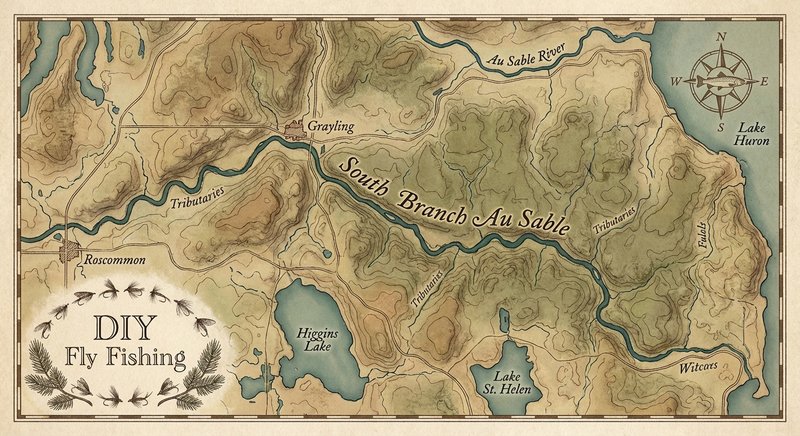
South Branch Au Sable
Fly fishing in Michigan · Advanced · Best seasons: Spring, Summer, Fall
Target Species
Brown Trout, Brook Trout
About This Water
Mason Tract flies-only section offers premier dry fly fishing for brown trout.
Fishing Recommendations
The South Branch of the Au Sable River is often whispered about with a sense of reverence in the fly fishing world. While the Main Stream gets the "Holy Water" moniker, many seasoned Michigan guides consider the South Branch—specifically the stretch through the Mason Tract—to be the true soul of Michigan trout fishing.
Here is your comprehensive guide to fishing the South Branch.
🎣 Location Overview
The South Branch flows through a 14,000-acre slice of heaven known as the Mason Tract. Gifted to the state by George Mason (former CEO of Nash-Kelvinator), this land is strictly protected from development. You won't see cabins or manicured lawns here; instead, you’ll find towering cedars, steep sand banks, and pristine wilderness.
The water is characterized by its classic "sand and gravel" composition. It is a medium-sized river, ranging from 30 to 60 feet wide, with a gentle gradient. It is famous for its "sweepers"—downed cedar trees that fall into the river, creating complex overhead cover and deep scouring holes that hold legendary fish.
🐟 Target Species & Behavior
- Brook Trout: These are the native jewels of the river. They are most prevalent in the upper reaches and cooler tributaries. They are opportunistic feeders, often found in the "soft" water behind logs or in the dappled shade along the banks.
- Brown Trout: The South Branch is famous for its wild, buttery-colored Browns. While smaller fish are active during the day, the "lunkers" (20+ inches) are notoriously nocturnal. They hold deep under the root wads and sweepers during the hour of high sun and move into the shallow riffles and tail-outs to feed once the sun dips below the treeline.
📅 Best Times to Fish
- Spring (Late April – May): This is the "Dry Fly Opener." The Hendrickson hatch in late April is the first major event. It’s a great time for daytime surface action before the water warms up.
- Summer (June – Early July): This is the Prime Window. June brings the "Big Three": Sulphurs, Brown Drakes, and the world-famous Hexagenia Limbata (The Hex). The Hex hatch occurs at night, usually between 10:00 PM and 2:00 AM.
- Fall (September – October): As the water cools, the Browns become aggressive ahead of the spawn. This is peak streamer season. The crowds have thinned, the colors are spectacular, and the fish are looking for a big meal.
- Best Time of Day: In mid-summer, the best fishing starts at dusk. During the shoulder seasons (Spring/Fall), the 11:00 AM to 4:00 PM window is most productive.
🪰 Recommended Flies & Techniques
Dry Flies
- Adams (Size 12-18): The ultimate Michigan generalist.
- Robert’s Yellow Drake: A local legend pattern for the Brown Drake hatch.
- Hex Patterns (Size 4-6): Use foam-bodied or deer hair versions that float high and are easy to see in the dark.
- The Patriot: Excellent for Brookies in the faster runs.
Nymphs
- Pheasant Tail & Hare’s Ear (Size 14-18): Standard producers.
- Rubber-Legged Stoneflies: Great for high water in the spring.
Streamers
- Sculpin Patterns: Olive or tan patterns worked tight to the wood.
- Galloup’s Zoo Cougar: A white or yellow version is deadly during the fall.
Techniques
- The Reach Cast: Critical for getting a drag-free drift around the numerous sweepers.
- Dapping: In tight brushy areas, sometimes you don't cast; you simply "dap" the fly over the log.
- Night Fishing: For the Hex, use a "heavy" leader (1X or 2X) because you aren't worried about leader spooking fish—you're worried about breaking off a 24-inch Brown in the wood.
💡 Pro Tips & Local Knowledge
- The "Mason Tract" Strategy: Start at Chase Bridge and float/wade down to Smith Bridge. This is a long day (or a short overnight). The further you get from the access points, the better the fishing gets.
- Wade Stealthily: The South Branch is very clear and relatively slow. If you splash or "push" water while wading, every trout within 50 yards will know you're there. Move like a heron.
- The "Sweeper" Rule: If you see a massive downed cedar in a bend with deep water underneath, there is a big Brown Trout under it. To catch him, you must cast your fly within inches of the wood. If you aren't losing a few flies to the trees, you aren't fishing where the big fish are.
- The Cedar Swamp "Air Conditioning": On hot July days, look for areas where cold groundwater seeps in from the cedar swamps. The water temperature can be 5 degrees cooler here, and Brookies will stack up in these thermal refuges.
⚠️ Important Information
- Regulations: Large portions of the South Branch (specifically within the Mason Tract) are Gear Restricted. This usually means Artificial Lures Only and strict Catch and Release or high minimum size limits. Always check the current Michigan DNR "Trout Sidewalk" map before heading out.
- Access Points:
- Chase Bridge: The upper entry to the Mason Tract.
- The Castle: A historic stone structure offering mid-tract access (requires a hike).
- Smith Bridge: The lower exit of the Tract.
- Sand Sensitivity: The Au Sable system is fragile. Use the designated "sand slides" or access points to prevent erosion.
- Safety: The South Branch has many "suck holes" around downed logs. Wading can be tricky because the sand can shift. A wading staff is highly recommended.
Guide’s Final Word: The South Branch is not a numbers river; it is a "soul" river. Come for the history and the silence of the Mason Tract, and if you're lucky, you'll leave with a story about a massive Brown Trout that broke you off in the cedars at midnight.
Bug Hatches & Matching Flies
| Hatch | Type | Peak months | Time of day | Hook sizes | Matching flies |
|---|---|---|---|---|---|
| Hendrickson Ephemerella subvariabilis | mayfly | April, May | Afternoon | #12-14 | Red Quill #12-14, Hendrickson Emerger #14, Pheasant Tail #12-14 |
| Sulphur Ephemerella invaria | mayfly | May, June | Evening | #14-18 | Sulphur Parachute #14-18, Sulphur CDC Comparadun #16-18, Hare's Ear #16 |
| Brown Drake Ephemera simulans | mayfly | May, June | Late Evening | #10-12 | Brown Drake Spinner #10-12, Brown Drake Paradrake #10-12, Wiggle Nymph #10-12 |
| Hex Hexagenia limbata | mayfly | June, July | Night | #4-8 | Hexagenia Spinner #4-6, Roberts Yellow Drake #6-8, Hex Nymph #6-8 |
| Blue-Winged Olive Baetis | mayfly | April, May, September, October | Afternoon | #18-22 | BWO Sparkle Dun #18-22, BWO Parachute #20, RS2 #20-22 |
| Trico Tricorythodes | mayfly | July, August, September | Morning | #20-24 | Trico Spinner #22-24, Trico Parachute #22, Zebra Midge #20-22 |
| Grannom Caddis Brachycentrus | caddis | April, May | Morning/Afternoon | #14-16 | Elk Hair Caddis (Olive) #14-16, Holy Grail #14-16, Peacock Caddis Larva #14-16 |
| Isonychia Isonychia bicolor | mayfly | June, July, August, September | Evening | #10-12 | Iso Parachute #10-12, Zug Bug #10-12, Iso Cripple #12 |
| Grasshopper Orthoptera | terrestrial | July, August | All Day | #8-12 | Joe's Hopper #8-12, Dave's Hopper #10-12, Fat Albert #8-10 |