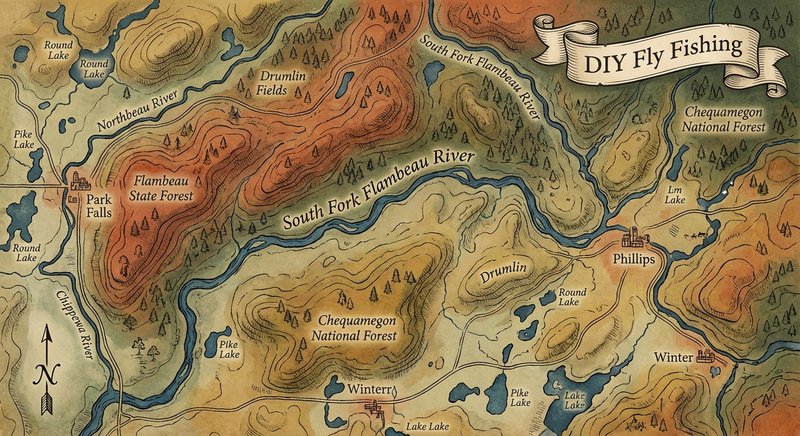
South Fork Flambeau River
Fly fishing in Wisconsin · Intermediate · Best seasons: Summer, Fall
Target Species
Brook Trout, Musky, Smallmouth Bass
About This Water
Northern Wisconsin river with trout in upper sections. Musky and bass below.
Fishing Recommendations
The South Fork of the Flambeau River is one of Wisconsin’s best-kept secrets for the "wild" experience. Unlike its more famous sibling, the North Fork, the South Fork is entirely undammed, meaning it breathes with the seasons. It is a rugged, boulder-strewn, and highly scenic river that offers a true Northwoods backcountry feel.
Here is your guide to mastering the South Fork of the Flambeau.
🎣 Location Overview
The South Fork flows through Price and Sawyer counties, cutting through the Flambeau River State Forest. What makes it special is its wild character. Because there are no dams, the water levels fluctuate naturally, creating a diverse habitat of Class I-II rapids, deep holes, and extensive "rock gardens."
The water is "tannic" (tea-colored) due to the surrounding hemlock and cedar swamps, which provides excellent cover for fish but requires anglers to use high-contrast flies. It is a remote fishery; once you launch, you are often miles from the nearest road, surrounded by timber wolves, bald eagles, and black bears.
🐟 Target Species & Behavior
Smallmouth Bass
The "bread and butter" of the South Fork. These are lean, river-bred fish that use the heavy current to their advantage.
- Behavior: They hold in the "pillows" in front of large boulders and in the soft eddies behind them.
- Feeding: They focus on crayfish and hellgrammites. In late summer, they look up for terrestrial insects and dragonflies.
Musky
The South Fork is famous for "River Muskies." These fish are generally sleeker and more aggressive than lake muskies.
- Behavior: Ambush predators. They sit in the deepest pools or tight against downed timber near the bank.
- Feeding: They target suckers, smaller bass, and even ducklings.
Brook Trout
Found primarily in the upper reaches and near the mouths of cold-water feeder creeks.
- Behavior: They are temperature-sensitive. In the heat of summer, they stack up where cold springs enter the main stem.
- Feeding: Highly opportunistic. They focus on mayflies, caddis, and small terrestrial beetles.
📅 Best Times to Fish
Summer (June – August)
- Prime Window: This is the peak for Smallmouth Bass and Brook Trout.
- Conditions: Look for stable, medium-low water levels.
- Time of Day: Early morning and "golden hour" before sunset offer spectacular topwater action for bass.
Fall (September – October)
- Prime Window: The "Pre-Winter Feed" for Musky.
- Conditions: As water temperatures drop into the 50s, Muskies become highly active. The Smallmouth fishing remains good until the first hard frost.
- Time of Day: Mid-day is often best in the fall as the sun warms the water slightly, activating the baitfish.
🪰 Recommended Flies & Techniques
For Smallmouth Bass
- Topwater: BoogleBugs or Hard-body Poppers in black or chartreuse. Use a "pop-and-pause" retrieve near the banks.
- Sub-surface: Murdoch Minnow or Clouser Minnow (Red/White or Chartreuse/White).
- Technique: "Swing" streamers through the riffles just like you would for steelhead.
For Musky
- Patterns: Double Deceivers, Game Changers, or Buford-style flies (8–12 inches long). High-contrast colors like Black/Orange or "Firetiger" work best in the tannic water.
- Technique: Use a 9wt or 10wt rod. Strip fast and always perform a "Figure-8" at the boat/bankside. Many South Fork muskies will follow the fly out from under a boulder and strike at the last second.
For Brook Trout
- Dry Flies: Elk Hair Caddis (size 14-16) or Royal Wulff.
- Nymphs: Bead-head Pheasant Tail or Prince Nymph.
- Technique: Focus on the "confluence" points. Cast into the clear, cold water of the incoming creek and let it drift into the darker river water.
💡 Pro Tips & Local Knowledge
- The "Rock Garden" Strategy: The South Fork is notorious for its rocks. If you are floating, use a raft or a beat-up aluminum canoe. For fishing, focus on the "seams" where fast water meets slow water. Smallmouths love to sit right on that edge.
- Water Levels are King: Check the USGS gauge at Fifield. If the water is too low (below 500 cfs), you will be dragging your boat over rocks. If it's over 1,500 cfs, the fishing becomes difficult as the fish move deep into the flooded brush.
- Stealth Matters: Despite the tea-colored water, these fish are wild. Long casts are often necessary, especially for the larger Smallmouths in the flat pools.
⚠️ Important Information
- Access points:
- Smith Rapids: Beautiful covered bridge area, great for wading.
- Fifield (Hwy 13): A common launch point.
- Lugerville: Access to some of the deeper Musky holes.
- Regulations: The South Fork has specific regulations. Musky size limits are strictly enforced (usually 40" or 50" depending on the specific stretch—check the current WDNR handbook). It is largely a "Catch and Release" culture among local fly anglers to preserve the wild genetics.
- Safety: This is a remote area. Cell service is spotty to non-existent. Always carry a physical map, a first-aid kit, and plenty of bug spray (the mosquitoes and biting gnats are legendary in the summer).
- Permit: A standard Wisconsin fishing license with an inland trout stamp (if targeting Brookies) is required.
Guide’s Final Word: The South Fork isn't about numbers; it's about the environment. You're fishing in one of the last truly wild river corridors in the Midwest. Respect the river, watch your backcast for hemlock trees, and hold on tight—the Smallies here hit like freight trains.
Bug Hatches & Matching Flies
| Hatch | Type | Peak months | Time of day | Hook sizes | Matching flies |
|---|---|---|---|---|---|
| Hendrickson Ephemerella invaria | mayfly | May | Afternoon | #12-14 | Red Quill #12-14, Pheasant Tail #12-14, Hendrickson Emerger #14 |
| Grannom Caddis Brachycentrus | caddis | May | Morning/Afternoon | #14-16 | Elk Hair Caddis (Olive/Black) #14-16, Peacock Caddis #16, Deep Sparkle Pupa #14-16 |
| Brown Drake Ephemera simulans | mayfly | June | Evening/Dusk | #8-12 | Brown Drake Para-Wulff #10-12, Harrop's Brown Drake #10, Brown Drake Nymph #8-10 |
| Giant Stonefly Pteronarcys dorsata | stonefly | May, June | Morning/Evening | #4-8 | Pat's Rubber Leg #4-8, Kaufmann's Stone #6-8, Stimulator (Orange) #8 |
| Hexagenia Hexagenia limbata | mayfly | June, July | Late Evening/Night | #4-8 | Hexagenia Spinner #4-6, Wiggle Hex Nymph #6-8, Paradrake Hex #6 |
| White Fly Ephoron leukon | mayfly | August | Evening/Dusk | #12-14 | White Wulff #12-14, Ephoron Spinner #14, White Miller #12 |
| Blue Winged Olive Baetis spp. | mayfly | April, May, September, October | Afternoon | #18-22 | RS2 (Gray/Olive) #20-22, BWO Sparkle Dun #18-20, Parachute Adams #18-22 |
| Isonychia Isonychia bicolor | mayfly | July, August, September | Late Afternoon/Evening | #10-12 | Isonychia Nymph #10-12, Prince Nymph #10-14, Dun Variant #12 |