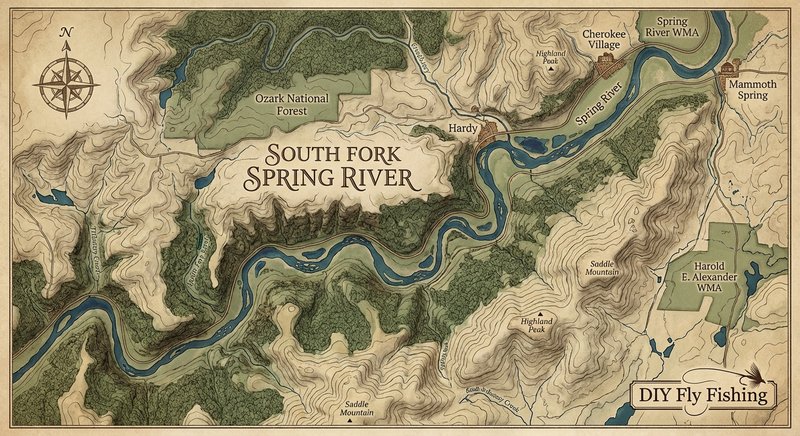
South Fork of the Spring River
Fly fishing in Arkansas · Intermediate · Best seasons: Spring, Summer, Fall
Target Species
Rainbow Trout
About This Water
Crystal-clear spring creek with wild rainbow trout. Technical fishing in pristine water.
Fishing Recommendations
The South Fork of the Spring River in the Arkansas Ozarks is a hidden gem that often sits in the shadow of its larger sibling, the main Spring River. While the main stem is famous for its massive volume of 58-degree water from Mammoth Spring, the South Fork offers a more intimate, classic "Ozark stream" experience.
As your guide, I need to be upfront: The South Fork is a seasonal trout fishery. While the main Spring River holds trout year-round, the South Fork is primarily a Smallmouth Bass stream that receives heavy stockings of Rainbow Trout from late fall through spring.
🎣 Location Overview
The South Fork originates near Salem, Arkansas, and winds its way through Fulton and Sharp counties before joining the main Spring River at Hardy. It is a classic freestone-style river characterized by long, glassy pools separated by bubbling riffles and limestone shelves.
Unlike the main Spring River, which can feel like a "trout factory," the South Fork feels wilder. It is smaller, narrower, and much easier to read. The water is exceptionally clear, making it a "sight-fishing" paradise when conditions are right. Because it isn't as cold as the main stem, the South Fork has a diverse ecosystem where you might catch a Rainbow Trout on one cast and a 14-inch Smallmouth Bass on the next.
🐟 Target Species & Behavior
Rainbow Trout are the primary target here, supplemented by the Arkansas Game and Fish Commission (AGFC) stocking program.
- Behavior: Since these are stocked fish, they initially congregate in deep "put-and-take" holes near bridges and public access points. However, as they acclimate, they move into the oxygenated riffles and the "heads" of pools.
- Holding Patterns: Look for "seams" where fast water meets slow water. In the South Fork, trout love to tuck behind large limestone rocks or in the shadows of overhanging sycamore trees.
- Feeding: They are opportunistic feeders. In the spring, they focus on aquatic insects (midges and mayflies). In the fall, they become more aggressive, chasing minnows and crawfish to bulk up for the winter.
📅 Best Times to Fish
While the prompt mentions Spring, Summer, and Fall, timing is critical on the South Fork:
- Spring (March – May): Prime Time. Water temperatures are perfect, and the bugs are hatching. This is the best window for dry fly action.
- Summer (June – August): Caution. The South Fork can get quite warm in mid-summer. Trout will migrate toward the confluence of the main Spring River (where the water is colder) or seek out deep, spring-fed holes. Guide Tip: If the water is over 70°F, pivot to Smallmouth Bass to protect the trout.
- Fall (October – November): Excellent. As air temperatures drop, the water cools, and the AGFC begins its winter stocking runs. The fish are active, and the fall foliage is world-class.
- Best Time of Day: Early morning (dawn until 10:00 AM) and late afternoon (4:00 PM until dusk). The "evening rise" on the South Fork can be spectacular in May.
🪰 Recommended Flies & Techniques
Nymphing (The High-Percentage Play)
This is the most effective way to catch numbers.
- Patterns: Zebra Midge (size 18-22) in red or black, Gold-Ribbed Hare’s Ear (size 14-16), and Pheasant Tail Nymphs.
- The "Secret Weapon": Sowbugs and Scuds. Because this is a limestone-rich spring system, the river is crawling with these crustaceans. A gray or olive Scud (size 16) is a must-have.
Dry Flies
- Patterns: Parachute Adams (size 14-18), Elk Hair Caddis (tan, size 16), and in late summer/early fall, Terrestrials (foam ants and beetles).
- Technique: Use a long leader (9ft 5X) to avoid spooking fish in the clear, flat pools.
Streamers
- Patterns: Woolly Buggers (White or Olive, size 8-10) and small Clouser Minnows.
- Technique: Swing the streamer across the current at the tail-out of a riffle.
💡 Pro Tips & Local Knowledge
- The "Hardy Confluence" Trick: If the South Fork is running too warm in the summer, head to the confluence where it meets the main Spring River at Hardy. The cold water from the main stem "backs up" into the mouth of the South Fork, creating a thermal refuge where trout stack up.
- Stealth is Key: Because the South Fork is smaller and shallower than the main river, the fish are spookier. Wade slowly and try to avoid "crunching" the gravel. Wear earthy tones to blend into the Ozark backdrop.
- The "Salem Stretch": Focus on the areas around the City Park in Salem for easy access to freshly stocked fish. For a more "wild" feel, look for low-water bridges between Salem and Hardy.
- Check the Gauge: The South Fork is rain-dependent. If there has been a heavy downpour, it will turn muddy ("blown out") much faster than the main Spring River. Check the USGS gauge for "South Fork Spring River at Salem."
⚠️ Important Information
- Access: Most of the South Fork runs through private land. Stick to public access points at bridge crossings and city parks (Salem and Hardy).
- Regulations: You must have a valid Arkansas Fishing License AND a Trout Permit.
- Wading Safety: The rocks in the Spring River system are notoriously slippery—often described as "greased bowling balls." Felt-soled boots or studs are highly recommended.
- Canoe Traffic: In the summer, the lower section near Hardy can get busy with recreational floaters. To have the best experience, be off the water by 11:00 AM on Saturdays.
Bug Hatches & Matching Flies
| Hatch | Type | Peak months | Time of day | Hook sizes | Matching flies |
|---|---|---|---|---|---|
| Blue-Winged Olive Baetis spp. | mayfly | March, April, October, November | Late Morning/Afternoon | #18-22 | RS2 #18-22, Parachute Adams #18-20, Pheasant Tail Nymph #18-22 |
| Light Cahill Stenonema ithaca | mayfly | May, June, July | Evening | #12-14 | Light Cahill Dry #12-14, Hare's Ear Nymph #12-14 |
| Spotted Sedge Hydropsyche | caddis | May, June, July, August | Evening | #14-16 | Elk Hair Caddis #14-16, Hydropsyche Larva #14-16, Pupa Emerger #14-16 |
| Midges Chironomidae | midge | January, February, March, December | All Day | #20-26 | Zebra Midge #20-24, Griffith's Gnat #20-22 |
| Grannom Caddis Brachycentrus | caddis | April | Afternoon | #14-16 | Peacock Caddis #14-16, Deep Sparkle Pupa #14-16 |
| Trico Tricorythodes | mayfly | July, August, September | Early Morning | #20-24 | Trico Spinner #22-24, Sunken Trico #22-24 |
| Terrestrials Formicidae / Acrididae | terrestrial | July, August, September | Afternoon | #8-16 | Chernobyl Ant #8-12, Black Foam Beetle #14-16, Dave's Hopper #10-14 |
| March Brown Maccaffertium vicarium | mayfly | March, April | Afternoon | #10-12 | March Brown American #10-12, Gold Ribbed Hare's Ear #10-12 |