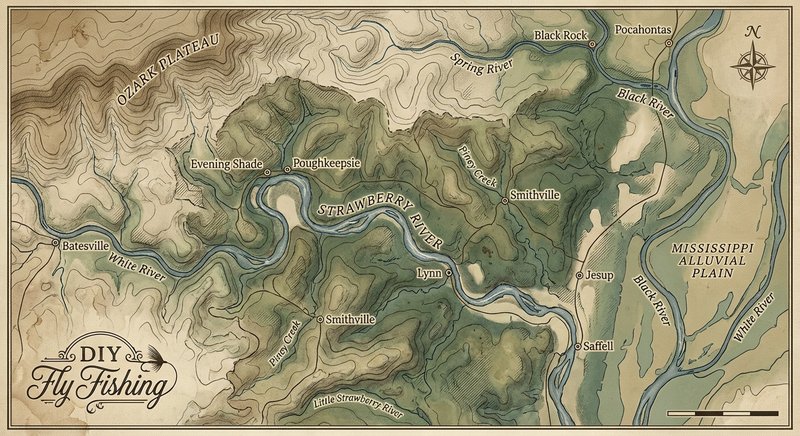
Strawberry River
Fly fishing in Arkansas · Beginner · Best seasons: Spring, Summer, Fall
Target Species
Smallmouth Bass, Spotted Bass
About This Water
Clear Ozark stream with smallmouth bass. Less pressured than famous rivers.
Fishing Recommendations
The Strawberry River in north-central Arkansas is a hidden gem of the Ozark foothills. Unlike the high-profile White or Little Red Rivers that draw international crowds for trout, the Strawberry is an intimate, wild, and incredibly scenic warm-water fishery. Designated as an "Extraordinary Resource Water" by the state, it boasts remarkable biodiversity and offers some of the best wade-and-float fly fishing for native Smallmouth Bass in the region.
🎣 Location Overview
The Strawberry River originates in the Ozark Mountains and flows southeast toward the Black River. It is characterized by its clarity, gravel bottoms, and classic "pool-and-riffle" structure.
What makes it special is its unspoiled nature. It feels like a step back in time; you won't see many houses, and you'll likely see more bald eagles and blue herons than other anglers. The water is generally cool for a warm-water stream, fed by numerous springs, which keeps the bass active even when other rivers get too lethargic in the heat of summer. It is a smaller river, making it perfectly suited for 5-weight to 7-weight fly rods.
🐟 Target Species & Behavior
Smallmouth Bass (The "Bronzeback")
The star of the show. The Strawberry holds a healthy population of "Ozark-strain" Smallmouths. They are exceptionally hard-fighting for their size.
- Behavior: They are ambush predators. They hold in the "seams" where fast water meets slow water, behind submerged boulders, and in the deep "bluff holes" where the river cuts against limestone cliffs.
- Diet: Their primary diet consists of crawfish, hellgrammites (dobsonfly larvae), and various minnows (stonerollers and shiners).
Spotted Bass (Kentucky Bass)
Found more frequently in the lower, slower sections of the river.
- Behavior: Unlike the Smallmouth, "Spotty" bass tend to hang around woody debris, fallen logs, and submerged root balls in slightly deeper, slower water.
- Diet: Similar to Smallmouth but more prone to chasing smaller baitfish and terrestrial insects.
📅 Best Times to Fish
Spring (April – June)
- Window: This is prime time. As water temperatures hit 55°F, the bass become aggressive.
- Conditions: Watch the USGS gauges; spring rains can blow the river out. Once it drops and clears, the pre-spawn and post-spawn feeding frenzy is world-class.
Summer (July – Early September)
- Window: Early morning (dawn till 10 AM) and late evening (6 PM till dark).
- Conditions: The water is lower and clearer. Stealth becomes vital. This is the peak season for topwater action, which is arguably the most exciting way to fish the Strawberry.
Fall (Late September – November)
- Window: Mid-day as the sun warms the water.
- Conditions: As the leaves change, the bass gorge themselves to prepare for winter. The bite is consistent, and the scenery is spectacular.
🪰 Recommended Flies & Techniques
Topwater (The Fun Stuff)
- Patterns: BoogleBugs (size 4-8) in yellow or white, Todd’s Wiggle Minnow, and foam cicada patterns.
- Technique: Cast toward the bank or near overhanging brush. Let the rings dissipate before twitching. A "pop-pop-pause" rhythm usually triggers the strike.
Streamers (The Meat)
- Patterns: Clouser Minnows (chartreuse/white or olive/white), Wooly Buggers (olive or black with rubber legs), and Near Nuff Crawfish.
- Technique: Fish these on a weight-forward floating line or a light sink-tip. Swing them through riffles or strip them erratically through deep pools.
Sub-Surface/Nymphing
- Patterns: Pat’s Rubber Legs (size 6-10) or Hellgrammite imitations.
- Technique: If the fish aren't looking up, "high-stick" a heavy rubber-legs through the deep slots between rocks. Smallmouths love a meal that looks like a drifting crawdad.
💡 Pro Tips & Local Knowledge
- The "Shadow" Cast: In the heat of summer, Smallmouth will hug the shadows created by the high bluffs or overhanging trees. If a spot is in direct, bright sunlight, move on to a shaded bank.
- Wade or Float: In high water (Spring), a canoe or kayak is necessary. However, in Summer/Fall, the "drag and wade" method is best. Float until you find a productive-looking run, anchor, and fish it thoroughly on foot.
- The Crawdad Connection: If you aren't sure what color to fish, look under a rock. If the crawfish are molting (turning blue/soft), use a blue/grey fly. Otherwise, olive and orange are the gold standard here.
- Stealth Matters: Because the water is so clear, long casts and light leaders (3X or 4X) are often necessary. Don't splash your oars or stomp through the gravel.
⚠️ Important Information
Access Points
- Smithville: The bridge at Highway 115 is a common launch point.
- Poughkeepsie: The Highway 58 bridge offers good access for wading or launching.
- Camp Kiwanis: A popular spot for those looking for a shorter float or bank access.
Regulations
- License: An Arkansas Resident or Non-Resident Fishing License is required.
- Limits: Check the current Arkansas Game and Fish Commission (AGFC) guidebook. There are often specific length limits for Smallmouth Bass on the Strawberry to ensure the trophy potential of the river.
Safety & Gear
- Water Levels: The Strawberry can get very low in August. If the Smithville gauge is below 3 feet, expect to drag your boat over gravel bars.
- Footwear: Wear sturdy wading boots with felt or sticky rubber soles; the rocks can be incredibly slick.
- Leave No Trace: This river is a biological treasure. Please pack out everything you pack in and handle fish with wet hands to protect their slime coat.
Bug Hatches & Matching Flies
| Hatch | Type | Peak months | Time of day | Hook sizes | Matching flies |
|---|---|---|---|---|---|
| Giant Mayfly (Hex) Hexagenia limbata | mayfly | June, July | Dusk/Night | #6-10 | Hexagenia Dry #6-8, Burrowing Mayfly Nymph #8-10 |
| White Miller Nectopsyche | caddis | July, August | Evening | #12-16 | White Elk Hair Caddis #14-16, White Soft Hackle #14-16 |
| Blue-winged Olive Baetis | mayfly | March, April, October, November | Mid-day/Afternoon | #18-22 | Parachute BWO #18-20, Pheasant Tail Nymph #18-22 |
| Golden Stonefly Acronuria | stonefly | May, June | Morning/Evening | #8-12 | Golden Stone Nymph #8-12, Stimulator (Yellow) #10-12 |
| Light Cahill Stenacron | mayfly | May, June | Evening | #12-14 | Light Cahill #12-14, Gold Ribbed Hare's Ear #14 |
| Dobsonfly (Hellgrammite) Corydalus cornutus | terrestrial | June, July, August | All Day | #2-6 | Hellgrammite Pattern #4-8, Black Wooly Bugger #2-6 |
| Grasshopper Acrididae | terrestrial | July, August, September | Late Morning/Afternoon | #8-12 | Dave's Hopper #8-12, Chernobyl Ant #8-10 |
| Common Midge Chironomidae | midge | January, February, March, December | All Day | #20-24 | Zebra Midge #20-22, Griffith's Gnat #20-24 |