Sturgeon River
Fly fishing in Michigan · Advanced · Best seasons: Spring, Summer, Fall
Target Species
Brown Trout, Brook Trout
About This Water
One of the fastest rivers in the Lower Peninsula. Wild brown trout and challenging wading.
Fishing Recommendations
The Sturgeon River in Michigan’s Northern Lower Peninsula is a gem for the adventurous angler. Unlike many of Michigan's slower, meandering "sand-trap" rivers, the Sturgeon is widely considered the fastest river in the Lower Peninsula. It is a cold, powerful, and challenging fishery that rewards technical skill and physical agility.
🎣 Location Overview
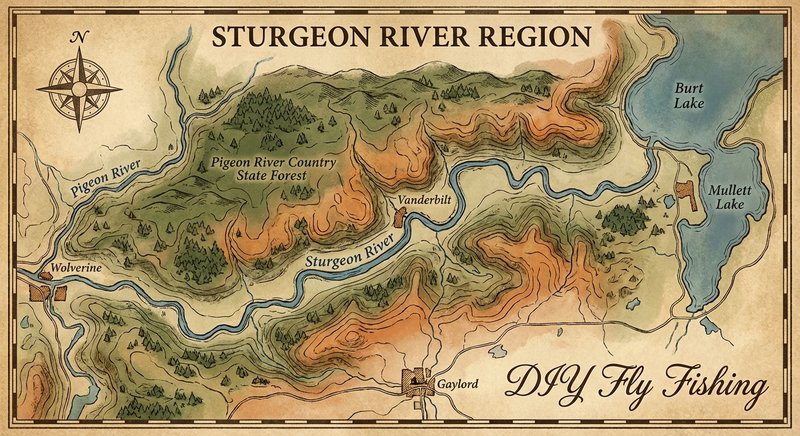
Flowing through Otsego and Cheboygan counties—specifically through the towns of Vanderbilt and Wolverine—the Sturgeon River is a high-gradient stream that eventually empties into Burt Lake. What makes it special is its thermal stability. Because it is heavily fed by cold-water springs, it remains fishable and cold even during the heat of July and August when other rivers are pushing dangerous temperatures for trout.
The water is crystal clear, and the bottom is a mix of gravel, cobble, and occasional sand. However, anglers should be warned: the current is deceptively strong, and the river is littered with "sweepers" (fallen trees) and log jams. This is not a river for a casual wade; it requires "fishing the wood" and navigating tight quarters.
🐟 Target Species & Behavior
- Brook Trout: Found predominantly in the upper reaches (upstream of Vanderbilt) and in the colder tributaries. They are opportunistic feeders but remain wary due to the clear water. They hold in the softest pockets of water, often right against the bank or behind small rocks.
- Brown Trout: The stars of the Sturgeon. These fish are strong, acrobatic, and utilize the heavy current to their advantage. They are notorious for holding deep under undercut banks and within the "kitchen" of massive log jams.
- Behavior: Because of the high flow, these fish don't like to expend unnecessary energy. They sit in "seams"—the interface between fast and slow water. When they strike, they do so violently, often turning back into the wood immediately.
📅 Best Times to Fish
- Spring (Late April – May): This is the time for Black Quill and Hendrickson hatches. It’s also the best time for high-protein streamer fishing as the fish look to regain weight after winter.
- Summer (June – August): The "Main Event." June brings the Drake and Hexagenia limbata hatches. Because the Sturgeon stays cold, the daytime terrestrial bite (grasshoppers, ants, beetles) is world-class in July and August.
- Fall (September – October): Brook trout take on brilliant spawning colors. This is also when the resident "trophy" browns become aggressive and territorial.
- Time of Day: During the heat of summer, midday can be surprisingly productive with terrestrials, but for the larger, "nocturnal" browns, the hour before and after dusk is prime.
🪰 Recommended Flies & Techniques
Top Fly Patterns
- Dry Flies: Roberts Yellow Drake (a local legend), Borchers Special, Parachute Adams (size 12-18), and Foam Hoppers/Chernobyl Ants in late summer.
- Nymphs: Prince Nymphs, Pheasant Tails, and Hare’s Ears. Use weighted flies to get down through the fast surface current.
- Streamers: Sculpin patterns are king here. Olive or Black Muddler Minnows, Kelly Galloup’s Dungeon (small to medium), or the Sturgeon River Special (a local streamer variation).
Techniques
- The "Tight-Line" Drift: Because of the complex currents, long mends are difficult. High-stick nymphing or short-leash dry fly fishing is most effective.
- Streamer "Pounding": Cast your streamer tight to the wood on the opposite bank and strip aggressively. Be ready for a strike the second the fly hits the water.
- Twitching Terrestrials: On windy summer days, fish a foam ant or hopper with a slight twitch to mimic a struggling insect.
💡 Pro Tips & Local Knowledge
- Fish the "Wood": If you aren't losing a few flies to the trees, you aren't fishing where the big browns live. The Sturgeon is a "structure" river.
- Stealth is Key: Because the water is so clear, wearing earthy tones (camo, olive, tan) and moving slowly upstream is vital. Avoid "lining" the fish (casting your fly line directly over their heads).
- Wading Safety: Use a wading staff. The current is powerful, and the sand can occasionally give way to deep holes.
- The "Vanderbilt to Wolverine" Stretch: This is the most popular section. It offers a great mix of pocket water and deeper runs.
⚠️ Important Information
- Access: Much of the river is bordered by the Pigeon River Country State Forest. There are numerous bridge crossings (Sturgeon Valley Rd, Trowbridge Rd) and designated access sites.
- Regulations: The Sturgeon River is generally managed under Type 4 regulations (check the current MDNR Fishing Guide for specific dates and size limits). Typically, the season for trout opens the last Saturday in April and closes September 30th, though some sections allow for extended catch-and-release.
- Permits: A standard Michigan Fishing License is required.
- Private Property: While Michigan law allows you to wade any navigable stream, the river banks are often private. Stay in the water to avoid trespassing disputes.
Guide’s Final Word: The Sturgeon is a "blue-collar" trout stream. It’s tough, it’s fast, and it’ll break your heart in the logs—but landing a 20-inch buttery Brown in that heavy current is an experience you’ll never forget.
Bug Hatches & Matching Flies
| Hatch | Type | Peak months | Time of day | Hook sizes | Matching flies |
|---|---|---|---|---|---|
| Blue-Winged Olive Baetis / Pseudocloeon | mayfly | April, May, September, October | Afternoon | #18-22 | BWO Sparkle Dun #18-20, Pheasant Tail #18-22 |
| Hendrickson Ephemerella subvaria | mayfly | May | Afternoon | #12-14 | Red Quill #12-14, Hendrickson Emerger #12-14 |
| American Grannom Brachycentrus | caddis | May | Morning/Afternoon | #14-16 | Elk Hair Caddis (Olive) #14-16, Deep Sparkle Pupa #14-16 |
| Sulphur Ephemerella dorothea | mayfly | June | Evening | #16-18 | Sulphur Parachute #16-18, Sulphur CDC Emerger #16-18 |
| Brown Drake Ephemera simulans | mayfly | June | Late Evening/Night | #10-12 | Brown Drake Cripple #10-12, Brown Drake Nymph #10-12 |
| Giant Black Stonefly Pteronarcys dorsata | stonefly | May, June | Evening/Night | #4-8 | Pats Rubber Legs #4-8, Black Stimulator #6-8 |
| Slate Drake Isonychia bicolor | mayfly | July, August, September | Afternoon/Evening | #10-12 | Iso Parachute #10-12, Isonychia Nymph #10-12 |
| Cinnamon Caddis Hydropsyche | caddis | June, July, August | Evening | #14-18 | Godzilla Caddis #14-16, LaFontaine Sparkle Pupa #14-16 |
| Terrestrials Orthoptera / Formicidae | terrestrial | July, August, September | All Day | #8-16 | Dave's Hopper #8-12, Black Foam Ant #14-16 |