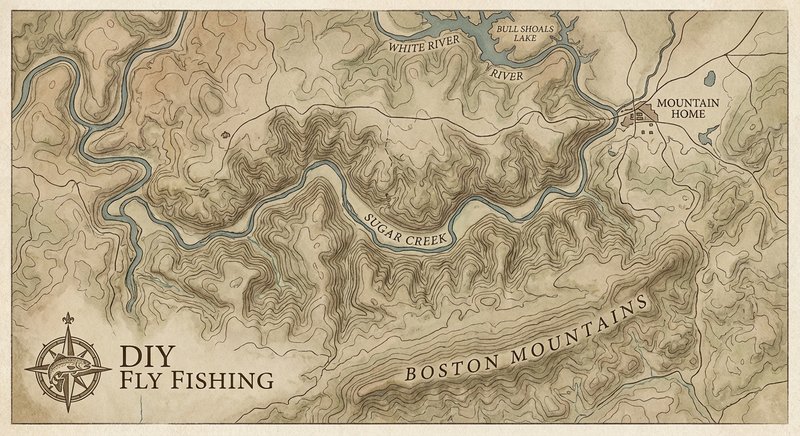
Sugar Creek
Fly fishing in Arkansas · Beginner · Best seasons: Spring, Summer, Fall
Target Species
Smallmouth Bass, Spotted Bass
About This Water
Northwest Arkansas stream with smallmouth bass. Scenic Ozark fishing.
Fishing Recommendations
Sugar Creek, located in the rolling hills of Northwest Arkansas (Benton County), is a quintessential Ozark mountain stream. While it eventually flows into the Elk River in Missouri, the Arkansas stretches offer some of the finest "blue ribbon" style smallmouth fishing for those who prefer intimate, clear-water environments over large reservoirs.
Here is your comprehensive guide to fly fishing Sugar Creek, Arkansas.
🎣 Location Overview
Sugar Creek is a classic Ozark limestone stream characterized by crystal-clear water, flint-rock gravel bars, and dramatic limestone bluffs. What makes this creek special is its intimacy; it is not a wide, daunting river, but a series of interconnected pools, riffles, and "runs" that are perfectly suited for the wade angler or the small-craft kayaker.
Anglers love Sugar Creek because it offers a "trout-like" experience for Smallmouth Bass. The water is often so clear that you can sight-fish for "bronzebacks" holding near sunken timber or beneath the shadow of a bluff. It feels wild, secluded, and embodies the rugged beauty of the Ozark Highlands.
🐟 Target Species & Behavior
- Smallmouth Bass: The undisputed king of the creek. These fish are lean, muscular, and incredibly aggressive. They hold in the "seams" where fast water meets slow water, behind large boulders, and in the deep "blue holes" beneath bluffs.
- Spotted Bass (Kentucky Bass): Found more frequently in the slightly slower, deeper pools. They are less prone to jumping than smallmouth but fight hard toward the bottom.
- Longear Sunfish: While not the primary target, these are arguably the most beautiful fish in the Ozark's. They are extremely aggressive and provide great action on light tackle between bass hookups.
Feeding Behavior: These fish are opportunistic. Their diet consists primarily of crawfish, followed by sculpins, stonerollers (minnows), and during the warmer months, a significant amount of terrestrial insects (grasshoppers, cicadas, and beetles).
📅 Best Times to Fish
- Spring (April – June): This is the prime window. As water temperatures climb into the 50s and 60s, bass become highly active. Pre-spawn and post-spawn periods offer the chance for the largest fish of the year.
- Summer (July – August): Best for topwater action. The water levels can get low, so focus on early mornings and late evenings. The "shadow lines" created by the bluffs are hot spots during the heat of the day.
- Fall (September – early November): As the leaves change, the bass feed heavily to bulk up for winter. The water is usually at its clearest, requiring a stealthy approach and longer leaders.
Prime Conditions: A "falling and clearing" creek after a light rain is the gold standard. The slight stain in the water gives the fish confidence to move out of cover to hunt.
🪰 Recommended Flies & Techniques
Topwater (The Thrill)
- Patterns: Boogle Bugs (Poppers) in yellow or white, Sneaky Petes, and Foam Grasshoppers.
- Technique: Cast tight to the bank or under overhanging brush. Let the rings dissipate before the first twitch. Use a "pop-and-pause" cadence.
Subsurface (The Bread & Butter)
- Patterns: Near Nuff Craw (brown/orange), Clouser Minnows (olive/white or chartreuse/white), and the Gamechanger (small versions).
- Technique: "Dead-drift" crawfish patterns through riffles into the head of a pool. For streamers, use an erratic "strip-strip-pause" to mimic a wounded minnow.
Nymphing (The Secret Weapon)
- Patterns: Size 8-12 Rubber-legged Stoneflies or Pat’s Rubber Legs.
- Technique: If the bite is slow, fish a heavy nymph under an indicator through the deepest slots. Smallmouth will often take a nymph when they won't chase a streamer.
💡 Pro Tips & Local Knowledge
- The "Bella Vista" Stretch: The areas around and downstream of Bella Vista offer great access. However, as you move toward the Missouri line (Pea Ridge area), the creek feels much more remote.
- Stealth is Key: Because the water is exceptionally clear, wear natural colors (tan/green) and avoid "lining" the fish. Long casts are often necessary to avoid spooking the big ones.
- Fish the "Tailouts": In the evening, Smallmouth move from the deep holes into the shallow "tailouts" (the end of a pool before it turns into a riffle) to hunt minnows. Do not overlook water that is only 12 inches deep.
- The Crawfish Kick: If you aren't catching fish, change your fly to something with orange or rusty red. Ozark crawfish are a staple, and the fish are programmed to look for those colors.
⚠️ Important Information
- Access: Much of the land surrounding Sugar Creek is private. Always stay within the high-water mark or obtain landowner permission. Public bridge crossings are common access points—park safely and legally off the roadway.
- Regulations: An Arkansas Fishing License is required. Be sure to check the Arkansas Game and Fish Commission (AGFC) regulations for specific length and bag limits on Smallmouth Bass, as "Ozark Zone" rules often apply (typically a 12-inch minimum).
- Safety: The rocks in Sugar Creek are notoriously slippery (chert and limestone). Felt-soled boots or boots with aluminum studs are highly recommended. Also, keep an eye out for Copperheads and Cottonmouths along the root wads during summer.
- Wade vs. Float: During mid-summer, the creek may be too low to float comfortably in a kayak. Be prepared to "wet wade" (wading in shorts and wading boots).
Guide’s Final Word: Sugar Creek isn't about trophy size (though 3lb+ smallies exist); it's about the quality of the environment and the technical challenge of the catch. Bring a 5-weight or 6-weight rod, a box of crawfish, and take your time—the Ozarks are best enjoyed slowly.
Bug Hatches & Matching Flies
| Hatch | Type | Peak months | Time of day | Hook sizes | Matching flies |
|---|---|---|---|---|---|
| Blue Winged Olive Baetis spp. | mayfly | March, April, October, November | Midday | #18-22 | RS2 #18-22, Parachute Adams #18-20, Pheasant Tail Nymph #18-20 |
| Grannom Caddis Brachycentrus | caddis | April, May | Morning/Evening | #14-16 | Elk Hair Caddis #14-16, Holy Grail Caddis #14-16, Deep Sparkle Pupa #14-16 |
| March Brown Maccaffertium vicarium | mayfly | April, May | Afternoon | #12-14 | March Brown Dry #12-14, Gold Ribbed Hare's Ear #12-14, Soft Hackle March Brown #14 |
| Sulfur / Pale Evening Dun Ephemerella invaria | mayfly | May, June | Evening | #16-18 | Sulfur Parachute #16-18, Sulfur Emerger #16-18, Frenchie #16-18 |
| Golden Stonefly Acronuria spp. | stonefly | May, June, July | Morning/Afternoon | #8-12 | Pats Rubber Legs #8-12, Golden Stimulator #10-12, Kaufmann's Stone #8-10 |
| Zebra Midge Chironomidae | midge | January, February, March, December | All Day | #18-24 | Zebra Midge #18-22, Griffith's Gnat #20-22, Top Secret Midge #20-22 |
| Cinnamon Sedge Hydropsyche | caddis | June, July, August, September | Evening | #14-18 | Cinnamon Ant #16, LaFontaine's Sparkle Pupa #16-18, X-Caddis #14-16 |
| Terrestrials Orthoptera / Formicidae | terrestrial | July, August, September | Afternoon | #10-16 | Dave's Hopper #10-12, Chernobyl Ant #12-14, Black Foam Beetle #14-16 |