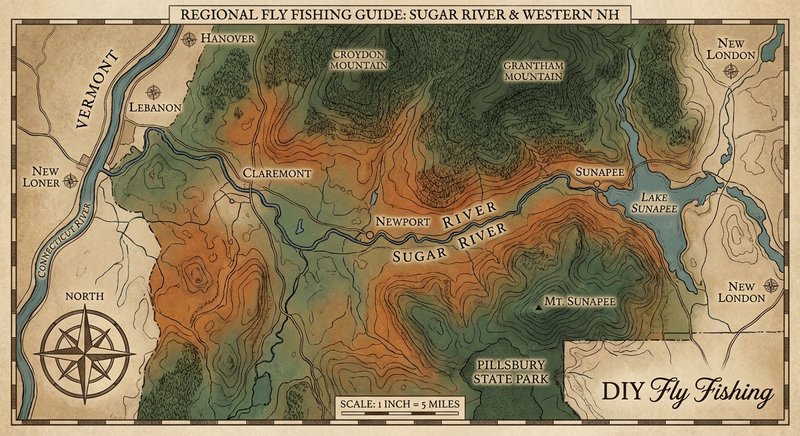
Sugar River
Fly fishing in New Hampshire · Beginner · Best seasons: Spring, Summer, Fall
Target Species
Brown Trout, Rainbow Trout
About This Water
Sullivan County stream with brown and rainbow trout. Rail trail access.
Fishing Recommendations
The Sugar River in Western New Hampshire is one of the state’s most storied trout streams. Flowing from the outlet of Lake Sunapee in Newport and winding its way west to the Connecticut River in Claremont, it offers a diverse range of water types—from tumbling pocket water to slow, deep meandering runs.
As your guide, here is the comprehensive breakdown for fishing the "Sugar."
🎣 Location Overview
The Sugar River is a classic New England freestone-style river, though its flow is partially regulated by the dam at Lake Sunapee. It is divided into two distinct personalities: the Upper Sugar (Newport/Sunapee area) and the Lower Sugar (Claremont area).
What makes this river special is the Fly Fishing Only (FFO) section. This stretch provides a sanctuary for trout and a high-quality experience for anglers looking to escape the crowds often found on the more famous rivers to the north. The river features excellent bank access, manageable wading (mostly), and a beautiful canopy of hardwoods that makes fall fishing particularly spectacular.
🐟 Target Species & Behavior
The Sugar River is primarily a Brown and Rainbow Trout fishery.
- Rainbow Trout: These are the "action" fish of the Sugar. They tend to hold in the faster, highly oxygenated water—heads of riffles, bubbly pockets, and the "seams" where fast and slow water meet. They are opportunistic feeders and will often rise to a well-presented dry fly even when no hatch is visible.
- Brown Trout: The "residents." While many fish are stocked, the Sugar has a reputation for holding over large, wary Brown Trout. These fish are nocturnal and predatory. They hold in the "dark water"—undercut banks, deep holes under log jams, and the slow tails of pools. To catch the big ones, you often need to fish streamers or large nymphs deep.
📅 Best Times to Fish
Spring (Late April – June)
The "Golden Era" on the Sugar. Once the spring runoff subsides (usually mid-May), the Hendrickson and Quill Gordon hatches begin. This is the best time for consistent dry fly action.
Summer (July – August)
The Sugar can get warm. During mid-summer, focus your efforts on the upper reaches closer to the Sunapee outlet where the water stays cooler. Pro Tip: Carry a thermometer; if the water hits 70°F, stop fishing to protect the trout. Stick to early mornings (dawn till 10 AM).
Fall (September – October)
Arguably the best time for big Browns. As water temperatures drop, the fish become aggressive before the winter. The foliage is world-class, and the crowds disappear.
🪰 Recommended Flies & Techniques
Dry Flies
- Hendrickson (Size 12-14): Late May.
- Elk Hair Caddis (Size 14-18): Tan or Olive. A staple for the riffles.
- Light Cahill (Size 14-16): Great for summer evenings.
- Stimulators (Size 8-12): Excellent "searcher" patterns in the faster pocket water.
Nymphs
- Pheasant Tail (Size 14-18): The most reliable fly on the river.
- Prince Nymph (Size 12-16): Works well in the faster runs.
- Zebra Midge (Size 18-22): Essential for low-water summer conditions.
- Pats Rubber Legs (Size 8-12): Stoneflies are present; use these in the heavy current.
Streamers
- Woolly Bugger (Black or Olive, Size 6-10): The standard.
- Muddler Minnow: Excellent when swung through riffles to imitate sculpins.
Techniques
- High-Sticking/Euro Nymphing: The Sugar is full of "pocket water" (bowlder-strewn sections). Short-line nymphing without a buoy-style indicator is lethal here.
- The "Swing": On the Lower Sugar, swinging a wet fly or small streamer through the long runs is a traditional and effective method for Rainbows.
💡 Pro Tips & Local Knowledge
- Focus on the FFO Stretch: The section from the North Newport bridge downstream to the covered bridge is a designated Fly Fishing Only/Catch and Release area. This water holds the highest concentration of educated, holdover fish.
- The "Pocket Water" Secret: Most anglers crowd the big, easy-to-stand-in pools. The pros fish the "pockets"—the small 2-foot circles of calm water behind large rocks. One well-placed cast with a heavy nymph or a bushy dry fly here often yields the best fish of the day.
- Stealth Matters: The Sugar is not a massive river. In the summer, the water is crystal clear. Wear drab clothing (greens/browns), keep a low profile, and avoid splashing.
⚠️ Important Information
- Regulations: Always check the NH Fish and Game Fresh Water Digest. Certain sections are Fly Fishing Only (FFO), while others allow lures/bait. The FFO section is strictly Catch and Release.
- Access: Access is excellent along Route 11 and Route 103. Look for "Angler Parking" signs or pull-offs near bridge crossings. The Sugar River Rail Trail runs alongside much of the river, providing miles of walking access to water that rarely sees a fly.
- Wading Safety: The rocks in the Sugar can be exceptionally "greasy." Felt-soled boots or studs are highly recommended. A wading staff is a smart move in the faster Claremont sections.
- Licensing: You must have a valid New Hampshire freshwater fishing license, which can be purchased online at the NH Fish and Game website.
Tight lines on the Sugar! It’s a gem of the Granite State.
Bug Hatches & Matching Flies
| Hatch | Type | Peak months | Time of day | Hook sizes | Matching flies |
|---|---|---|---|---|---|
| Hendrickson Ephemerella subvariabilis | mayfly | April, May | Afternoon | #12-14 | Red Quill #12-14, Hendrickson Nymph #12-14, Hendrickson Emerger #12-14 |
| Blue-Winged Olive Baetis spp. | mayfly | April, May, September, October | Mid-day/Afternoon | #18-22 | RS2 #18-22, Parachute BWO #18-22, Pheasant Tail #18-20 |
| Grannom Caddis Brachycentrus | caddis | May | Morning/Afternoon | #14-16 | Elk Hair Caddis (Olive) #14-16, Deep Sparkle Pupa #14-16, Peacock Caddis #16 |
| Sulphur Ephemerella invaria | mayfly | May, June | Evening | #14-18 | Sulphur Parachute #14-18, CDC Sulphur Emerger #14-18, Sulphur Spinner #14-16 |
| March Brown Maccaffertium vicarium | mayfly | May, June | Afternoon | #10-14 | March Brown Wet Fly #12-14, March Brown Parachute #10-12, Gold Ribbed Hare's Ear #10-12 |
| Tan Caddis Hydropsyche | caddis | June, July, August | Evening | #14-18 | Elk Hair Caddis (Tan) #14-18, LaFontaine's Emergent Pupa #14-16, Holy Grail #14-16 |
| Light Cahill Stenacron interpunctatum | mayfly | June, July | Evening | #14-16 | Light Cahill #14-16, Cream Usual #14-16 |
| Slate Drake Isonychia bicolor | mayfly | June, July, August, September | Afternoon/Evening | #10-12 | Iso Parachute #10-12, Zug Bug #10-12, Prince Nymph #10-14 |
| Trico Tricorythodes | mayfly | July, August, September | Morning | #22-26 | Trico Spinner #22-24, Griffith's Gnat #20-24 |
| Common Terrestrials Formicidae / Gryllidae | terrestrial | July, August, September | All Day | #12-18 | Black Foam Ant #14-18, Cinnamon Ant #14-16, Fat Albert #12-14 |