Swift River
Fly fishing in New Hampshire · Beginner · Best seasons: Spring, Summer, Fall
Target Species
Brook Trout
About This Water
White Mountain stream with wild brook trout. Kancamagus Highway access.
Fishing Recommendations
The Swift River in New Hampshire is the quintessential White Mountain freestone stream. Running alongside the scenic Kancamagus Highway, it offers some of the most stunning "calendar-quality" fly fishing in New England. It is a high-gradient, crystal-clear river characterized by granite boulders, deep turquoise pools, and pocket water that holds both wild and stocked trout.
🎣 Location Overview
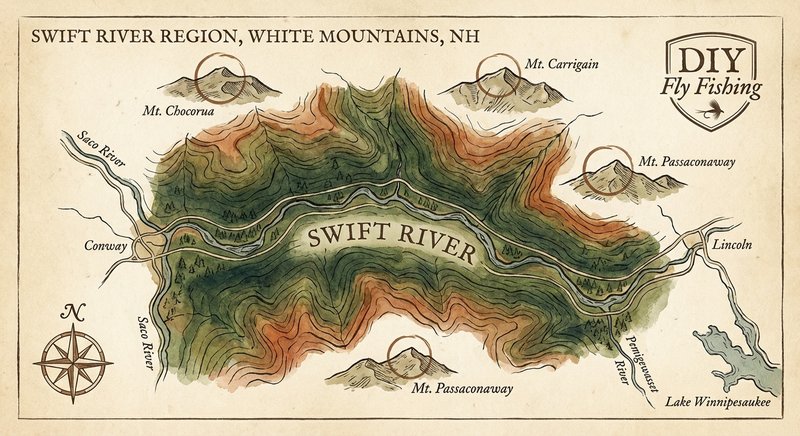
The Swift River is a classic mountain freestone stream. It originates in the high peaks of the White Mountain National Forest and flows eastward toward its confluence with the Saco River in Conway.
What makes it special is its transparency and accessibility. Because the water is incredibly clear, it offers a "technical-visual" experience; you can often spot the fish, but they can just as easily spot you. The riverbed is primarily granite, which keeps the water slightly acidic and nutrient-poor, meaning the fish are opportunistic and eager to rise to a well-presented fly. For the angler who loves high-country scenery and classic "pool-and-drop" hydraulics, the Swift is a bucket-list destination.
🐟 Target Species & Behavior
While the river holds some stocked Rainbow trout near the heavier access points, the Brook Trout is the star of the show.
- Wild vs. Stocked: The upper reaches and smaller tributaries hold wild, native "salters" (though they don't reach the sea here) with brilliant vermiculations and blue halos. The lower sections are stocked by NH Fish & Game to supplement the population.
- Holding Patterns: In the fast water of the Swift, Brookies hold in the "cushion" in front of boulders, in the seams between fast and slow water, and in the deep tail-outs of pools during the evening.
- Feeding Behavior: Because of the low nutrient levels in granite-based streams, these fish are not usually selective about species, but they are very sensitive to drag. If your fly doesn't move naturally with the current, they will refuse it.
📅 Best Times to Fish
Optimal Seasons
- Spring (Late May – June): This is the prime window. As the snowmelt recedes and the water warms into the 50s, the fish become highly active. This coincides with the major Hendrickson and Caddis hatches.
- Summer (July – August): The Swift stays cooler than many other NH rivers due to its elevation, but low water can make fish "spooky." Stick to the oxygenated riffles and pocket water.
- Fall (September – October): This is the most beautiful time to fish. The Brook Trout take on their vibrant spawning colors (deep oranges and reds). The fish become aggressive as they prepare for winter.
Prime Windows
- Early Morning: Best during the heat of the summer to find the lowest water temperatures.
- Evening "Power Hour": The last two hours of daylight often see a massive emergence of Caddis or Midges, bringing every fish in the pool to the surface.
🪰 Recommended Flies & Techniques
Top Fly Patterns
- Dry Flies:
- Royal Wulff or Royal Coachman (Size 12-16): A classic attractor that the Brookies can see in the bubbly pocket water.
- Elk Hair Caddis (Tan or Olive, Size 14-18): The staple insect of the White Mountains.
- Stimulators (Orange or Yellow, Size 10-14): Great for imitating stoneflies or grasshoppers.
- Nymphs:
- Pheasant Tail (Size 14-18): Works year-round.
- Prince Nymph (Size 12-16): The "flash" works well in the dark shadows of the granite boulders.
- Bead-head Zebra Midge (Size 18-22): Essential for low-water summer conditions.
- Streamers:
- Black or Olive Woolly Bugger (Size 8-12): Best used in the deeper pools after a rain.
Techniques
- The "Dry-Dropper": This is the most effective way to fish the Swift. Use a buoyant dry fly (like a Stimulator) and hang a small Pheasant Tail nymph 18-24 inches below it.
- High-Sticking: Because of the complex currents around boulders, keep as much fly line off the water as possible to prevent drag.
- Stealth Approach: In the clear pools, crouch low and cast from downstream. If you see your shadow on the water, the fish are already gone.
💡 Pro Tips & Local Knowledge
- Look for "The Kanc" Pull-offs: Many anglers crowd the areas near Lower Falls or Rocky Gorge. Avoid these. Drive further west toward Bear Notch Road or the Lily Pond area. The further you walk from a paved parking lot, the better the fishing gets.
- The "Shadow" Factor: The river runs through a deep valley. Once the sun drops behind the mountains, the temperature drops and the bugs start popping. Don't leave when the sun hits the ridge; that's when the fishing gets good.
- Check the Gauges: The Swift rises and falls incredibly fast. If there’s a heavy rain in the mountains, the river can become dangerous and unfishable within hours. Check the USGS gauge at Conway before heading out.
⚠️ Important Information
- Access: Most of the river is within the White Mountain National Forest (WMNF). You will need a WMNF Recreation Pass (available at self-pay stations) to park at most designated trailheads and picnic areas along the Kancamagus Highway.
- Regulations:
- A New Hampshire freshwater fishing license is required.
- Check the current NH Freshwater Fishing Digest for specific bag limits. Many sections are open to general regulations, but practicing Catch and Release is highly encouraged to protect the wild Brook Trout population.
- Safety: The granite rocks in the Swift are notoriously slippery—felt soles or aluminum-studded boots are highly recommended. Be bear-aware, though they generally avoid the noise of the highway.
- Wading: Be cautious at "Rocky Gorge" and "Lower Falls." The currents are deceptively strong and have claimed lives; these are better for viewing than wading. Stick to the traditional river stretches for fishing.
Bug Hatches & Matching Flies
| Hatch | Type | Peak months | Time of day | Hook sizes | Matching flies |
|---|---|---|---|---|---|
| Quill Gordon Epeorus pluristictis | mayfly | April, May | Midday | #12-14 | Quill Gordon #12-14, Hare's Ear #12-14 |
| Hendrickson Ephemerella subvaria | mayfly | May | Afternoon | #12-14 | Red Quill #12-14, Hendrickson Emerger #12-14, Pheasant Tail #12-16 |
| Grannom Caddis Brachycentrus occidentalis | caddis | May | Morning/Afternoon | #14-16 | Elk Hair Caddis (Olive) #14-16, Peacock Caddis Larva #14-16 |
| Sulphur Ephemerella dorothea | mayfly | June | Evening | #16-18 | Sulphur Parachute #16-18, Sulphur Klinkhammer #16-18 |
| Golden Stonefly Acroneuria lycorias | stonefly | June, July | Morning/Evening | #8-12 | Golden Stone #8-12, Pat's Rubber Leg #8-12 |
| Light Cahill Stenacron interpunctatum | mayfly | June, July, August | Evening | #12-16 | Light Cahill #12-16, Cahill Wet Fly #14 |
| Blue-Winged Olive Baetis vagans | mayfly | April, May, September, October | Afternoon | #18-22 | BWO Sparkle Dun #18-22, RS2 (Gray/Olive) #20-22 |
| Cinnamon Caddis Hydropsyche | caddis | June, July, August | Evening | #14-18 | Cinnamon Toast Caddis #14-16, LaFontaine's Deep Sparkle Pupa #14-16 |
| Terrestrials (Ants/Beetles) Formicidae / Coleoptera | terrestrial | July, August, September | All Day | #12-18 | Black Foam Ant #14-18, Crowe Beetle #12-16 |