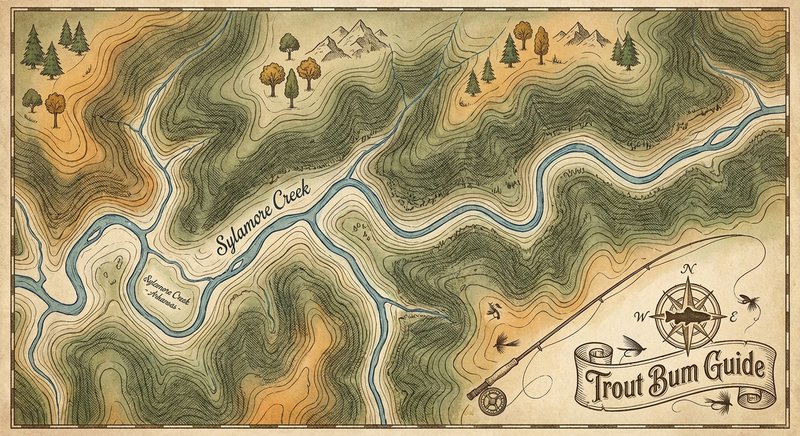
Sylamore Creek
Fly fishing in Arkansas · Beginner · Best seasons: Spring, Fall, Winter
Target Species
Rainbow Trout
About This Water
Ozark stream stocked with rainbow trout. Scenic fishing in national forest setting.
Fishing Recommendations
Welcome to the Ozarks. As a guide in this region, I can tell you that Sylamore Creek (specifically North Sylamore Creek) is one of the most scenic gems in Arkansas. Unlike the massive tailwaters of the White and Norfork Rivers nearby, the Sylamore is a freestone-style stream characterized by limestone bluffs, gin-clear water, and a classic "mountain stream" feel.
While the upper reaches are a premier Smallmouth Bass fishery, the lower sections and the areas influenced by Blanchard Springs offer a unique and intimate trout fishing experience that feels worlds away from the big boats on the White River.
🎣 Location Overview
Sylamore Creek winds through the Ozark National Forest near Mountain View, Arkansas. What makes it special is the karst topography—the creek is fed by numerous springs, most notably the massive discharge at Blanchard Springs.
The water is remarkably clear, often taking on a turquoise hue against the white limestone bluffs. Anglers love it because it offers wade-fishing accessibility in a state dominated by boat-centric rivers. It is technical, beautiful, and requires a stealthy approach that rewards the "purist" fly angler.
🐟 Target Species & Behavior
Rainbow Trout
- Source: The trout in Sylamore Creek are primarily stocked by the Arkansas Game and Fish Commission (AGFC). The highest concentrations are found near Blanchard Springs and the Mirror Lake area, as well as the lower reaches where the cold water of the White River can "back up" into the creek mouth.
- Behavior: Because the water is exceptionally clear, these fish are "spooky." They have a high degree of visibility and will flee to deep ledge holes or under limestone shelf rock if they see a shadow or a sloppy cast.
- Feeding: They focus heavily on Sowbugs and Scuds (common in spring-fed waters), as well as small midges. During hatches, they will look up for caddis and terrestrials.
📅 Best Times to Fish
Seasons
- Winter (December – February): Excellent for trout. The water temperatures remain stable due to the spring influence, and the AGFC stocks heavily during these months.
- Spring (March – May): The prime window. Insect activity increases, water levels are usually sufficient for fish to move between pools, and the redbuds/dogwoods are in bloom.
- Fall (October – November): Great for "holdover" trout and cooler water temps. The fall foliage against the limestone bluffs is world-class.
Conditions & Time of Day
- Low Light: Early morning and late evening are mandatory if the sun is bright. In water this clear, midday fishing is tough unless there is cloud cover.
- Water Level: Look for "median" flows. If the creek is too low, the fish become trapped in disconnected pools; if it’s "blown out" after a heavy rain, the visibility drops (though this can actually make the fish less shy).
🪰 Recommended Flies & Techniques
Top Fly Patterns
- Nymphs:
- Ray Charles or Soft Hackle Sowbugs (Grey/Tan, sizes 14-18) – This is the "bread and butter."
- Zebra Midges (Black/Silver or Red, sizes 18-22).
- Pheasant Tail Nymphs (Size 16-18) for general prospecting.
- Dries:
- Elk Hair Caddis (Tan, size 16) – Great for the riffles.
- Parachute Adams (Size 18) – For technical sipping fish in flat water.
- Streamers:
- Wooly Buggers (Olive or Black, sizes 8-12). Use these in the deep holes beneath the bluffs.
Techniques
- The Stealth Approach: Approach pools from downstream. Stay low and avoid wearing bright colors.
- Long Leaders: Use 9-foot to 12-foot leaders tapered to 5X or 6X fluorocarbon tippet. The thin diameter is crucial for fooling fish in crystal water.
- Sight Fishing: Don't just blind cast. Spend time on the high banks (carefully) spotting fish, then move down to make a surgical presentation.
💡 Pro Tips & Local Knowledge
- The "Spring" Factor: Focus your efforts on the stretch between Blanchard Springs Recreation Area and the confluence with the main creek. The water coming out of the cavern is a constant 58 degrees, making it a sanctuary for trout year-round.
- Gunner Pool: This is a fantastic "Plan B." It’s a bit more remote and offers beautiful pocket water that many anglers skip in favor of the more famous Blanchard area.
- The White River Connection: If you are fishing the very mouth of the Sylamore where it hits the White River, watch the water levels of the White. If the White River is "generating" (high water), it will push cold water and trout a few hundred yards up into the Sylamore.
- Smallmouth Bonus: If you find the trout aren't biting, move upstream. The North Sylamore is one of the best Smallmouth streams in the state. Carry some Crawdad patterns just in case.
⚠️ Important Information
Access Points
- Blanchard Springs Recreation Area: The most popular access with well-maintained trails.
- Gunner Pool Campground: Offers a more rugged experience and beautiful wading.
- Sylamore Creek Bridge (Hwy 5): Good for accessing the lower reaches near the White River.
Regulations & Permits
- License: You must have a valid Arkansas Fishing License AND a Trout Permit.
- Limits: Check the current AGFC guidebook, as regulations on "put-and-take" streams can change. Generally, there is a daily limit on Rainbows, but many locals practice Catch & Release to preserve the fishery.
- Safety: The rocks in Sylamore Creek are notoriously slippery (covered in fine silt and algae). Felt-soled boots or studs are highly recommended.
Guide’s Final Word: Sylamore Creek is not about high fish counts; it’s about the quality of the environment. Bring a 3-weight or 4-weight rod, slow down your pace, and enjoy one of the most beautiful spring-fed streams in the American South. Tight lines!
Bug Hatches & Matching Flies
| Hatch | Type | Peak months | Time of day | Hook sizes | Matching flies |
|---|---|---|---|---|---|
| Blue Winged Olive Baetis spp. | mayfly | March, April, October, November | Late Morning/Afternoon | #18-22 | RS2 #18-22, Parachute Adams #18-22, Pheasant Tail Nymph #18-20 |
| Cinnamon Caddis Hydropsyche spp. | caddis | May, June, July | Evening | #14-18 | Elk Hair Caddis #14-16, Pupa-Zell #16-18, Soft Hackle Hare's Ear #14-16 |
| Golden Stonefly Acroneuria spp. | stonefly | May, June | Morning/Evening | #8-12 | Kaufmann's Stone #8-12, Pat's Rubber Leg #8-10, Stimulator (Yellow) #10-12 |
| Light Cahill Stenacron interpunctatum | mayfly | June, July | Evening | #12-14 | Light Cahill #12-14, Gold Ribbed Hare's Ear #12-14 |
| March Brown Maccaffertium vicarium | mayfly | April, May | Afternoon | #12-14 | March Brown Dry #12-14, Spaced-out Nymph #12-14 |
| Midges Chironomidae | midge | January, February, March, December | Morning/Afternoon | #20-26 | Zebra Midge #20-22, Griffith's Gnat #20-24, Mercury Midge #20-22 |
| Terrestrials (Hoppers/Ants) Orthoptera/Formicidae | terrestrial | July, August, September | All Day | #8-16 | Chernobyl Ant #8-12, Dave's Hopper #10-12, Black Foam Ant #14-16 |
| Slate Drake Isonychia bicolor | mayfly | September, October | Afternoon | #10-12 | Isonychia Nymph #10-12, Parachute Slate Drake #10-12, Zug Bug #10-12 |