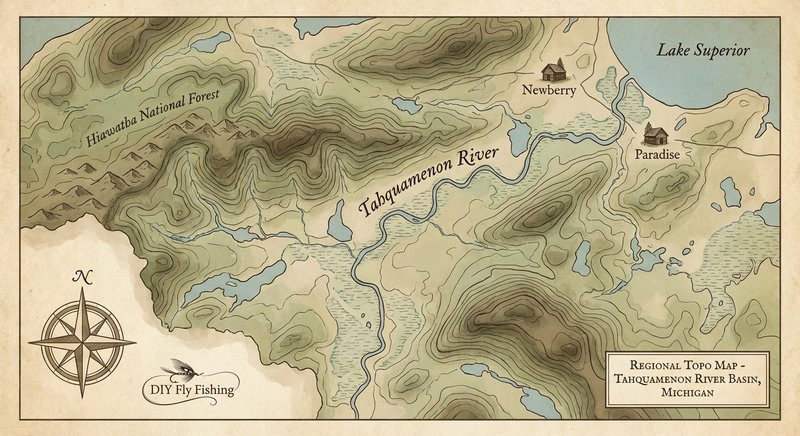
Tahquamenon River
Fly fishing in Michigan · Intermediate · Best seasons: Summer, Fall
Target Species
Brook Trout, Musky, Smallmouth Bass
About This Water
Upper Peninsula's tea-colored waters near famous falls. Brook trout and musky fishing.
Fishing Recommendations
Welcome to the "Root Beer" waters of Michigan’s Upper Peninsula. As a guide, I can tell you that the Tahquamenon River is one of the most iconic and visually striking systems in the Midwest. Known primarily for its massive waterfalls, the river offers a diverse "split personality" fishery that ranges from cold-water trout streams to deep, slow-moving predator water.
🎣 Location Overview
The Tahquamenon is famous for its distinct tannic color—a deep, dark brown reminiscent of root beer or tea, caused by the leaching of tannins from the cedar and hemlock swamps that drain into it.
The river is divided into two distinct worlds by the Upper and Lower Falls.
- The Upper River (and tributaries): This is where you find the cold, oxygenated water perfect for native Brook Trout.
- The Lower River (below the falls): This stretches toward Lake Superior and becomes a warmer, slower, and more powerful ecosystem dominated by apex predators like Musky and Smallmouth Bass.
Anglers love it because it feels prehistoric. It is wild, rugged, and requires a high degree of "river sense" to navigate.
🐟 Target Species & Behavior
Brook Trout (The Gems)
- Behavior: These are native fish. In the main stem of the upper river and its tributaries (like the East Branch), they are opportunistic but wary.
- Holding Water: They tuck tight into undercut banks and behind submerged cedar logs. In the tea-colored water, they rely heavily on their lateral lines to sense vibrations.
- Feeding: They focus on terrestrial insects in late summer and small baitfish/sculpins year-round.
Musky (The Ghosts)
- Behavior: The Tahquamenon holds "Northern Muskellunge." They are the apex predators here. They are notoriously moody but can be aggressive in the darker water.
- Holding Water: Look for "slack water" off the main current, deep weed edges, and large woody debris (log jams).
- Feeding: They eat yellow perch, suckers, and even ducklings.
Smallmouth Bass (The Brawlers)
- Behavior: These fish are incredibly hardy. They love the rocky sections and the transitions where the current picks up.
- Holding Water: Look for rock piles, ledge drops below the falls, and eddies.
- Feeding: Crayfish are the primary protein source here, followed by emerald shiners and dragonfly nymphs.
📅 Best Times to Fish
Summer (June – August)
- Brook Trout: June is prime for the Hexagenia limbata (Hex) hatch on the upper stretches. July and August are "Terrestrial Time"—think grasshoppers and ants.
- Musky/Smallmouth: This is the most consistent window. The metabolism of these warm-water species is peaked.
- Time of Day: Early morning and the "golden hour" before dusk are essential, especially for Smallmouth and Musky.
Fall (September – October)
- Musky: This is "Big Fly" season. As water temperatures drop, Muskies feed heavily to prepare for winter. This is your best chance at a trophy.
- Smallmouth: They congregate in deeper holes.
- Brook Trout: They become aggressive and vibrantly colored as they prepare for the fall spawn (check local regulations for seasonal closures).
🪰 Recommended Flies & Techniques
For Brook Trout
- Dry Flies: Royal Wulff, Stimulators (Orange/Yellow), and the Hexagenia (size 4-6) for late June nights.
- Streamers: Muddler Minnows and Black Ghosts. The dark water makes gold tinsel or copper flash very effective.
- Technique: "Pounding the banks." Cast as close to the wood as possible.
For Musky
- Patterns: Double Showgirls, Gamechangers (8-10 inches), and T-Bones. Use high-contrast colors: Black/Orange, Firetiger, or All-White.
- Technique: Use a 10-12 weight rod and a heavy sink-tip line. Always perform a "Figure-8" at the end of every cast—Tahquamenon Muskies are famous for following flies right to the boat.
For Smallmouth Bass
- Patterns: Clouser Minnows (Olive/White), BoogleBugs (Poppers), and Near Nuff Craws.
- Technique: Swing streamers through the current seams or chug poppers over submerged rock shelves.
💡 Pro Tips & Local Knowledge
- Contrast is Key: In the "root beer" water, flies with copper, gold, or orange blades and flash stand out better than silver. Black is also a high-visibility silhouette against the dark bottom.
- The "East Branch" Secret: If the main river is running high, head to the East Branch of the Tahquamenon. It is one of the finest Brook Trout fisheries in the state and is more manageable for wading.
- The "Follower" Mindset: When Musky fishing, don't just watch your fly; watch the water behind it. The tannins can hide a 45-inch fish until it is two feet from your rod tip.
- Heavy Tippet: This is not the place for 7x tippet. For Brookies, use 3x or 4x. For Musky, use 40-80lb fluorocarbon or wire bite guards. The wood in this river will snap light line instantly.
⚠️ Important Information
Access
- Tahquamenon Falls State Park: Excellent access for the Lower Falls. There are hiking trails that lead to various fishing spots.
- Boat Access: A motorized boat or a sturdy drift boat is highly recommended for the lower river Musky/Smallmouth stretches. There are public launches at the mouth (near Paradise) and at the Dollarville Flooding.
Regulations
- License: A Michigan Fishing License is required.
- Size/creel limits: Muskellunge have a strict 42-inch minimum in most Michigan waters, and many anglers practice 100% Catch & Release for these slow-growing giants.
- Check the Guide: Always consult the Michigan DNR Fishing Guide for current seasonal closures, especially regarding Brook Trout spawning.
Special Considerations
- The Bugs: In June and July, the black flies and mosquitoes are legendary. Bring heavy-duty repellent and a head net.
- Cell Service: Expect zero service once you leave the main roads. Download your maps for offline use.
Bug Hatches & Matching Flies
| Hatch | Type | Peak months | Time of day | Hook sizes | Matching flies |
|---|---|---|---|---|---|
| Hendrickson Ephemerella subvaria | mayfly | May | Afternoon | #12-14 | Red Quill #12-14, Hendrickson Emerger #14, Pheasant Tail #12-14 |
| Brown Drake Ephemera simulans | mayfly | June | Evening | #10-12 | Brown Drake Paradrake #10-12, Brown Drake Cripple #10-12, Hare's Ear #10-12 |
| Giant Michigan Mayfly (Hex) Hexagenia limbata | mayfly | June, July | Late Evening/Night | #4-8 | Hex Spinner #4-8, Robert's Yellow Drake #6-8, Hexagenia Nymph #6-8 |
| Sulphur Ephemerella invaria | mayfly | June | Late Afternoon/Evening | #14-18 | Sulphur Parachute #14-18, Sulphur CDC Emerger #16-18, Split Case Sulphur #16 |
| Grannom Caddis Brachycentrus | caddis | May | Morning/Afternoon | #14-16 | Elk Hair Caddis (Dark) #14-16, LaFontaine's Deep Sparkle Pupa #14-16, Peacock Caddis #16 |
| Isonychia (Slate Drake) Isonychia bicolor | mayfly | July, August, September | Afternoon/Evening | #10-12 | Iso Parachute #10-12, Zug Bug #10-12, Isonychia Nymph #10-12 |
| Giant Black Stonefly Pteronarcys dorsata | stonefly | May, June | Throughout the day | #4-8 | Pat's Rubber Legs #4-8, Black Stimulator #6-8, Kaufmann's Stone #6-8 |
| Terrestrials N/A | terrestrial | July, August, September | Mid-day/Afternoon | #8-16 | Dave's Hopper #8-12, Black Foam Ant #14-18, Beetle Bailey #12-14 |