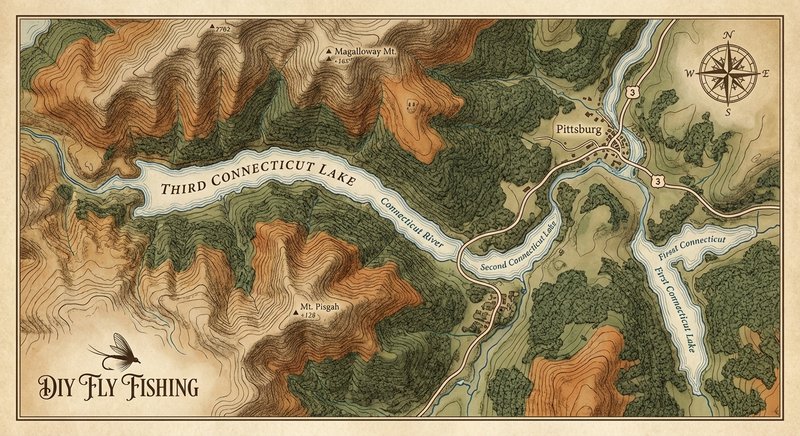
Third Connecticut Lake
Fly fishing in New Hampshire · Advanced · Best seasons: Summer, Fall
Target Species
Brook Trout
About This Water
Pristine Pittsburg lake with native brook trout. Very remote access.
Fishing Recommendations
Welcome to the "North of the Notch." As a guide in the Great North Woods of New Hampshire, I can tell you that Third Connecticut Lake is a crown jewel for the purist. Located just a stone's throw from the Canadian border in Pittsburg, NH, this is the most remote and pristine of the three major Connecticut Lakes.
Here is your professional guide to fishing these hallowed waters.
🎣 Location Overview
Third Connecticut Lake is a 231-acre glacial lake sitting at an elevation of about 2,190 feet. Unlike the larger First and Second Lakes, Third Lake feels like a true wilderness experience. It is surrounded by dense boreal forest—spruce, fir, and birch—and is far less developed.
What makes it special is its water quality. It is exceptionally deep (over 100 feet in spots), cold, and oxygen-rich. While First and Second Lakes are famous for Landlocked Salmon, Third Lake is the stronghold of the Brook Trout. It is a "no-wake" lake, meaning you won't be fighting jet skis or large powerboats. The silence here is only broken by the call of loons and the splash of a rising trout.
🐟 Target Species & Behavior
The primary draw here is the Wild and Holdover Brook Trout. You will also find some Lake Trout (Lakers) in the deep trenches.
- Brook Trout Behavior: These are "Adirondack-style" brookies. In the early season and fall, they patrol the shorelines and rocky points. As the surface warms in mid-summer, they retreat to the thermocline (20–40 feet deep) or hover around "spring holes" where cold groundwater seeps into the lake.
- Feeding: They are opportunistic but can be selective during hatches. They feed heavily on smelt (the primary forage), dragonfly and damselfly nymphs, and various mayfly species.
📅 Best Times to Fish
Summer (Late June – August)
- Conditions: The water remains cooler here than almost anywhere else in the state. However, by mid-July, the fish move deeper.
- Time of Day: First light (5:00 AM – 8:00 AM) and "the witching hour" (sunset). Evening rises can be spectacular during Hexagenia or Caddis hatches.
Fall (September – October 15)
- Conditions: This is the prime time. As water temperatures drop, Brook Trout move into the shallows to prepare for spawning. Their colors become incredibly vivid (deep oranges and reds).
- Time of Day: You can fish all day in the fall. Overcast, drizzly days are often the most productive for "big" fish moving into the shallows near the inlet.
🪰 Recommended Flies & Techniques
Streamer Fishing (The Local Favorite)
Since smelt are the main forage, streamers are deadly.
- Patterns: Soft-hackle Streamers, Grey Ghost, Black Ghost, Muddler Minnow, and the Hornberg.
- Technique: Use a sink-tip line in the summer or a floating line in the fall. Cast toward the rocky drop-offs and use a "twitchy," erratic retrieve to mimic a wounded baitfish.
Dry Fly Fishing
- Patterns: Adams (Size 12-16), Elk Hair Caddis (Tan/Olive), and the Hexagenia Limbata (Size 6-8) in late June/early July. For the fall, small Blue Winged Olives (Size 18-22) are essential.
- Technique: Look for "rings" on the glassy surface. Don't blind cast; wait for a rise and "lead" the fish by a few feet.
Nymphing
- Patterns: Pheasant Tail (Size 14-16), Prince Nymph, and Woolly Buggers (Black or Olive).
- Technique: Slow-trolling a Woolly Bugger from a kayak or float tube is a highly effective "guide secret" for covering water when there is no visible surface activity.
💡 Pro Tips & Local Knowledge
- The Inlet & Outlet: The area where the Connecticut River flows into the lake (at the northern end) and the dam at the southern end are high-traffic zones for trout. In the fall, focus heavily on the northern inlet as fish congregate there to spawn.
- Bring a Float Tube or Kayak: Because of the no-wake rule and the steep, forested banks, fishing from the shore is difficult and limits your reach. A human-powered craft is the best way to stealthily approach rising fish.
- The "Ledge" Transition: Use a depth finder or a topographic map. Brookies love to sit right on the edge where the shelf drops from 10 feet to 30 feet.
- Watch the Wind: Even though it's the smallest of the three lakes, the wind can whip up quickly at this elevation. Always fish the "leeward" side (protected from wind) if you want to see rising fish.
⚠️ Important Information
- Access: There is a public boat launch off Route 3 on the western side of the lake. It is primitive but suitable for small trailers and car-top boats.
- Regulations:
- Motor Rule: Internal combustion engines are allowed, but it is a 5-MPH/No-Wake lake.
- Season: The lake follows general NH trout pond regulations (typically open through Oct 15 for kept fish, but check current NH Fish & Game digests for "catch and release" extensions).
- Licensing: You need a valid New Hampshire fishing license. You can purchase one in Pittsburg at local shops like Young's Store or Lopstick.
- Safety: This is moose country. Drive carefully on Route 3, especially at dusk and dawn. Cell service is spotty to non-existent; tell someone your plan before heading out.
Tight lines—Third Lake is a special place. Treat the wild Brookies with respect, use barbless hooks, and enjoy the silence of the North Woods!
Bug Hatches & Matching Flies
| Hatch | Type | Peak months | Time of day | Hook sizes | Matching flies |
|---|---|---|---|---|---|
| Blue-Winged Olive Baetis / Acerpenna | mayfly | May, September, October | Midday/Afternoon | #18-22 | BWO Sparkle Dun #18-22, Pheasant Tail #18-20, RS2 #20-22 |
| Hendrickson Ephemerella subvaria | mayfly | May, June | Afternoon | #12-14 | Hendrickson Pink Lady #12-14, Red Quill #12-14, Hendrickson Wet Fly #12-14 |
| Giant Michigan Mayfly (Hex) Hexagenia limbata | mayfly | June, July | Dusk/Evening | #6-10 | Hexagenia Spinner #6-8, Hex Nymph #6-10, Extended Body Hex #8 |
| Grannom Caddis Brachycentrus | caddis | May | Morning/Afternoon | #14-16 | Peacock Caddis #14-16, Deep Sparkle Pupa #14-16, Elk Hair Caddis (Olive) #14-16 |
| March Brown Maccaffertium vicarium | mayfly | June | Afternoon | #10-12 | March Brown American #10-12, Gold Ribbed Hare's Ear #10-12, March Brown Wet Fly #10-12 |
| Spotted Sedge Hydropsyche | caddis | June, July, August | Evening | #14-18 | Tan Elk Hair Caddis #14-18, LaFontaine's Emerger #16, Z-Wing Caddis #14-16 |
| Chironomids (Midges) Chironomidae | midge | May, June, September | All Day | #20-26 | Zebra Midge #20-24, Griffith's Gnat #20-22, Chironomid Pupa (Black/Red) #18-22 |
| Flying Ants Formicidae | terrestrial | August, September | Afternoon | #14-18 | Black Fur Ant (Winged) #14-18, Chernobyl Ant (Small) #12-14, Hi-Vis Ant #16 |
| White Miller Ephoron leukon | mayfly | August | Evening/Dusk | #12-14 | White Wulff #12-14, Ephoron Dun #14, Snowshoe Rabbit Emerger #14 |
| Giant Stonefly Pteronarcys dorsata | stonefly | June | All Day | #4-8 | Pats Rubber Legs #6-8, Stimulator (Orange/Yellow) #8-10, Kaufmann's Stone #6 |