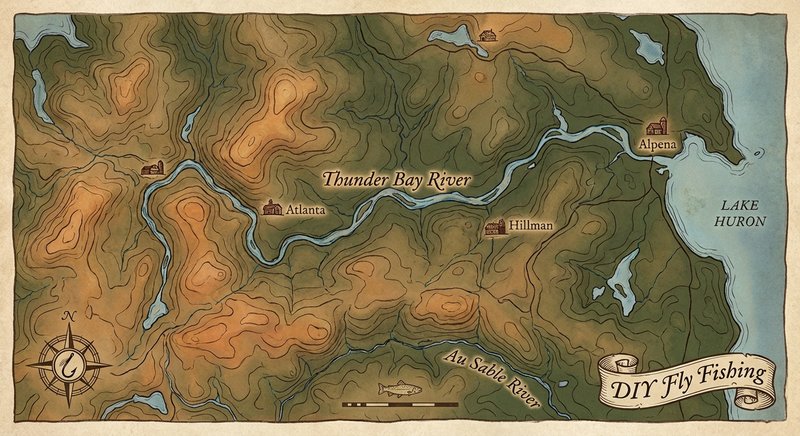
Thunder Bay River
Fly fishing in Michigan · Intermediate · Best seasons: Spring, Fall
Target Species
Steelhead, Brown Trout, Salmon
About This Water
Northeast Michigan river with diverse fishing opportunities. Steelhead runs and resident trout.
Fishing Recommendations
The Thunder Bay River in Northeast Michigan is one of the state’s "sleeper" rivers. While crowds flock to the Au Sable or the Manistee, the Thunder Bay offers a rugged, productive alternative for anglers targeting Lake Huron’s migratory runs. Flowing through Alpena and dumping into the "Shipwreck Capital" of the Great Lakes, this river is characterized by its dark, tannin-stained "Thunder" water and its powerhouse fish.
🎣 Location Overview
The Thunder Bay River is a diverse system, but for the fly angler chasing Steelhead, Salmon, and trophy Browns, the focus is primarily on the lower river below the Seventh Street Dam in Alpena.
What makes this river special is its accessibility combined with its "big water" feel. The water is often stained the color of weak tea due to cedar swamps upstream, which allows anglers to get a bit closer to fish than in crystal-clear streams. The river bottom is a mix of limestone bedrock, shale, and gravel riffles. It is a tailwater system, meaning water temperatures stay slightly more stable, though flow is controlled by a series of dams (Four Mile, Norway Point, and Seventh Street).
🐟 Target Species & Behavior
Steelhead (Spring & Fall)
The "silver bullets" of the Thunder Bay are known for their acrobatics.
- Behavior: In the fall, they enter the river to gorge on salmon eggs. In the spring, they move in to spawn.
- Holding Water: Look for "seams" where fast and slow water meet, or the "tailouts" (the end of a pool before it breaks into a riffle).
Salmon (Chinook & Coho)
- Behavior: These are massive fish that enter the system with one goal: spawning. They are aggressive when they first enter from Lake Huron but become territorial as they hit the gravel.
- Holding Water: Deep staging holes near the mouth early in the season, moving to the gravel runs below the Seventh Street Dam as the season progresses.
Brown Trout
- Behavior: The river holds both resident browns and "Lake Run" browns. The Lake Run fish are massive, often mistaken for steelhead. They are highly predatory and light-sensitive.
- Feeding: They focus on baitfish (sculpins, emerald shiners) and large nymphs. During the salmon run, they are primary egg-eaters.
📅 Best Times to Fish
- Spring (Mid-March – May): This is the prime window for Spring Steelhead. The run peaks when water temperatures hit the 40–50°F range. Late spring also sees the "Sucker Run," which brings in hungry resident trout.
- Fall (September – November):
- September/October: The Chinook (King) Salmon run.
- October/November: The Fall Steelhead and Lake Run Brown Trout follow the salmon. This is arguably the best time for a "Grand Slam."
- Best Time of Day: Because the water is tannin-stained, midday fishing can be productive, but low-light periods (dawn and dusk) are always best for the big, wary Brown Trout.
🪰 Recommended Flies & Techniques
Nymphing (The Bread & Butter)
The most effective way to catch Steelhead and Salmon here is under an indicator.
- Patterns:
- Eggs: Glo-bugs, Estaz eggs, and 8mm/10mm beads in "Oregon Cheese," "Peach," or "Chartreuse."
- Nymphs: Size 8–12 Stoneflies (black or golden), Prince Nymphs, and Pheasant Tails.
- The "Thunder Bay Special": A Hexagenia nymph (wriggler) pattern is often deadly here, as the river has a solid silt-bottom population of Hexes.
Streamer Fishing
For the aggressive Salmon and trophy Browns, swinging or stripping streamers is the way to go.
- Patterns: Wooly Buggers (Black or Olive), Game Changers, and Sculpin patterns.
- Color Tip: In the dark water, contrast is key. Use solid black or very bright colors (chartreuse/pink) so the fish can find the silhouette.
Spey & Switch Casting
The lower river has enough width to allow for Spey casting. Swinging "intruder" style flies for steelhead is a growing and effective trend here.
💡 Pro Tips & Local Knowledge
- The Seventh Street Dam "Combat Zone": The area immediately below the Seventh Street Dam is the end of the road for migratory fish. It gets crowded. If you want a more "wilderness" experience, move a few hundred yards downstream to the deeper bends.
- The Shale Factor: The riverbed has sections of smooth shale and limestone. It is extremely slippery. I highly recommend felt-soled boots with tungsten studs and a wading staff.
- Tannin Vision: Because the water is dark, don't be afraid to use slightly heavier tippet. 10lb or 12lb fluorocarbon is usually fine for steelhead here; you don't need to drop to 4lb like you might on the Ausable.
- The "Alpena Harbor" Secret: Late in the fall, some of the best Brown Trout fishing isn't in the river itself, but in the marina and harbor area where the river meets the lake.
⚠️ Important Information
- Access Points:
- 9th Avenue Bridge: Good access for wading and seeing where fish are holding.
- Bi-Centennial Park / Duck Park: Excellent shore access and wading opportunities near the dam.
- Regulations: The Thunder Bay River has various regulations depending on the stretch. The lower section is generally Type 4 water, but always check the current Michigan DNR Fishing Guide for season dates and creel limits.
- License: You must have a valid Michigan All-Species Fishing License.
- Safety: Be mindful of water release from the dams. If you notice the water rising or becoming increasingly turbid, exit the river immediately.
The Thunder Bay is a "blue-collar" river—it’s tough, dark, and requires some work, but the reward is often a heavy-shouldered fish that hasn't seen a fly all week. Tight lines!
Bug Hatches & Matching Flies
| Hatch | Type | Peak months | Time of day | Hook sizes | Matching flies |
|---|---|---|---|---|---|
| Blue-Winged Olive Baetis spp. | mayfly | May, September, October | Afternoon | #18-22 | BWO Sparkle Dun #18-20, Pheasant Tail Nymph #18-22 |
| Hendrickson Ephemerella subvaria | mayfly | May | Afternoon | #12-14 | Hendrickson Red Quill #12-14, Hendrickson Emerger #14 |
| Grannom Caddis Brachycentrus spp. | caddis | May | Morning/Afternoon | #14-16 | LaFontaine's Deep Sparkle Pupa #14-16, Elk Hair Caddis (Olive) #14-16 |
| Sulphur Ephemerella invaria/dorothea | mayfly | June | Evening | #14-18 | Sulphur Parachute #16-18, Sulphur Snowshoe Emerger #16 |
| Brown Drake Ephemera simulans | mayfly | June | Late Evening | #10-12 | Brown Drake Spinner #10-12, Brown Drake Paradrake #10-12 |
| Hex Hexagenia limbata | mayfly | June, July | Dusk/Night | #4-8 | Hexagenia Spinner #4-6, Robert's Yellow Drake #6-8 |
| Isonychia Isonychia bicolor | mayfly | July, August, September | Late Afternoon/Evening | #10-12 | Iso Parachute #10-12, Prince Nymph #10-14 |
| Trico Tricorythodes | mayfly | July, August | Morning | #22-26 | Trico Spinner #22-24, Griffith's Gnat #22-24 |
| Grasshopper Orthoptera | terrestrial | July, August, September | Afternoon | #8-12 | Dave's Hopper #10-12, Parachute Hopper #8-12 |
| Cinnamon Ant Formicidae | terrestrial | July, August | All Day | #14-18 | Cinnamon Ant #14-18, Chernobyl Ant #12-14 |