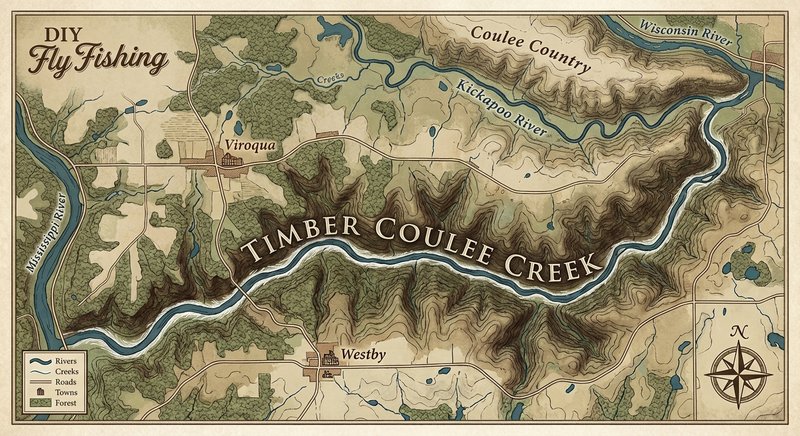
Timber Coulee Creek
Fly fishing in Wisconsin · Intermediate · Best seasons: Spring, Summer, Fall
Target Species
Brown Trout
About This Water
Driftless spring creek with prolific hatches. Wild brown trout in scenic valley.
Fishing Recommendations
Timber Coulee Creek is the crown jewel of Wisconsin’s "Driftless Area." Located in Vernon County near the town of Coon Valley, this spring-fed limestone stream is legendary among fly anglers for its high fish density, classic meadow-style water, and extensive public access.
As your guide, here is the comprehensive breakdown for tackling the "Timber."
🎣 Location Overview
Timber Coulee is a classic spring creek that winds through lush pastures and coulees (valleys). What makes it special is the massive restoration effort undertaken by the DNR and Trout Unlimited. Miles of the creek have been stabilized with "Lunker Structures"—underwater wooden cribs built into the banks that provide perfect overhead cover for trout.
The water is generally clear, cold, and alkaline, which leads to incredible insect biomass. It is a "fertile" stream, meaning it grows trout quickly. The terrain is relatively flat meadow fishing, making it accessible for walking, though the banks can be tall and the mud can be "Driftless deep" in spots.
🐟 Target Species & Behavior
- Species: Primarily Wild Brown Trout. While you may find an occasional Brook Trout in the upper reaches or tributaries, this is a Brown Trout factory.
- Behavior: These fish are wild and can be incredibly spooky. Because the water is often clear and the banks are open, they have a high "startle response."
- Holding Patterns: Look for fish tight against the banks (under those Lunker Structures), in the deep bends, and at the heads of riffles during hatches. Unlike mountain streams, the "seams" here are subtle. A 12-inch fish is average, a 16-inch fish is a great catch, and 20-inchers exist but are nocturnal or very cautious.
📅 Best Times to Fish
- Spring (Late March – May): This is the prime time for the famous Grannom Caddis and Hendrickson hatches. The water is cool, and fish are hungry after winter.
- Summer (June – August): This is Tuber/Terrestrial Season. While midday can be slow and hot, the morning Trico hatches are world-class. Afternoon fishing with hoppers and ants against the tall grass banks is the quintessential Timber Coulee experience.
- Fall (September – October): The fish become aggressive as they prepare for the spawn. This is the best time to throw streamers for the larger, dominant Browns.
- Time of Day: In mid-summer, be on the water at dawn for the Tricos. In spring and fall, the 10:00 AM to 3:00 PM window is usually most productive as the water warms slightly.
🪰 Recommended Flies & Techniques
Top Fly Patterns
- Dry Flies:
- Tricos (Size 20-24) – Essential for summer mornings.
- Caddis (Elk Hair or CDC, size 16-18) – Tan and Olive.
- Hippie Stomper or Fat Albert (Size 12-14) – Great for "Hopper-Dropper" rigs.
- Crane Flies – Very underrated on the Timber.
- Nymphs:
- Pink Squirrel (Size 14-16) – The legendary Driftless fly. It works year-round.
- Scuds (Gray or Olive, size 16-18) – These are the "bread and butter" crustacean for Driftless trout.
- Pheasant Tail (Size 18-20) – For imitating the small mayfly nymphs.
- Streamers:
- Black or Olive Woolly Buggers (Size 8-10).
- Thin Mints.
Techniques
- The "Hopper-Dropper": The most effective summer technique. Use a high-visibility foam terrestrial on top and a weighted Pink Squirrel or Scud 18–24 inches below it.
- Sneak & Peak: Because the banks are open, stay low. Keep a low profile and avoid "lining" the fish (casting your fly line directly over their heads).
- Upstream Presentation: Always fish upstream to avoid sending silt and debris down to the fish you are targeting.
💡 Pro Tips & Local Knowledge
- Curb Your Shadow: On sunny days, your shadow on the water will clear a pool faster than a hungry heron. Keep the sun in your face when possible, or stay far back from the bank.
- The "Twitch": When fishing terrestrials (hoppers/crickets) in July, don't be afraid to give the fly a tiny shake. These fish respond well to the "struggle" of a bug on the water.
- Check the Tributaries: If the main stem of Timber Coulee is crowded, look to its tributaries like Rullands Coulee. They are smaller, tighter, and often hold very aggressive fish.
- Bridge Etiquette: If you see a truck at a bridge, move to the next access point. The Timber has enough public water that there’s no need to "low-hole" another angler.
⚠️ Important Information
- Access: Wisconsin has excellent "Easement" laws. Much of Timber Coulee is private land with public fishing easements. Look for the green "Public Hunting and Fishing" signs. Stay within the mowed or designated corridor along the banks.
- Regulations: Timber Coulee is generally under Category 5 or special regulations in certain stretches. Much of it is Catch and Release Only with artificial lures/flies only. Always check the current Wisconsin Trout Regulations map before casting.
- Licensing: You need a Wisconsin Fishing License AND an Inland Trout Stamp.
- Gear: A 7'6" to 9' rod in a 3-weight or 4-weight is perfect. Use long leaders (9-12 feet) with 5x or 6x fluorocarbon tippet for the best results in the clear water.
Guide’s Final Word: Timber Coulee is the heart of the Driftless for a reason. It is beautiful, productive, and rewarding. Respect the banks, watch your shadow, and don't leave home without a handful of Pink Squirrels!
Bug Hatches & Matching Flies
| Hatch | Type | Peak months | Time of day | Hook sizes | Matching flies |
|---|---|---|---|---|---|
| Blue-Winged Olive (BWO) Baetis | mayfly | March, April, October, November | Mid-day/Afternoon | #18-22 | RS2 #18-22, Parachute Adams #18-22, Pheasant Tail #18-22 |
| Grannom Caddis Brachycentrus | caddis | April, May | Afternoon/Evening | #14-16 | Elk Hair Caddis (Olive/Tan) #14-16, Deep Sparkle Pupa #14-16, Holy Grail #14-16 |
| Sulfur / Pale Morning Dun Ephemerella invaria | mayfly | May, June | Evening | #14-18 | Sulfur Parachute #14-18, Sulfur Emerger #16-18, Frenchie #14-16 |
| Trico Tricorythodes | mayfly | July, August, September | Early Morning | #20-24 | Trico Spinner #20-24, Zebra Midge #20-22, Trico Dun #20-22 |
| Terrestrials (Hoppers/Ants/Beetles) Orthoptera/Formicidae | terrestrial | July, August, September | All Day | #10-18 | Hippie Stomper #12-16, Cinnamon Ant #16-18, Black Beetle #14-16 |
| Early Black Stonefly Capniidae | stonefly | February, March | Mid-day | #14-18 | Early Black Stone #16-18, Prince Nymph #14-18 |
| Cranefly Tipulidae | other | August, September | Late Afternoon/Evening | #10-14 | Daddy Long Legs #10-14, Killer Bug #12-14 |
| Scud Gammarus | other | All Year | All Day | #12-16 | Pink Scud #12-16, Olive Scud #14-16 |
| Light Cahill Stenacron interpunctatum | mayfly | June, July | Evening | #12-14 | Light Cahill #12-14, Gold Ribbed Hare's Ear #12-14 |