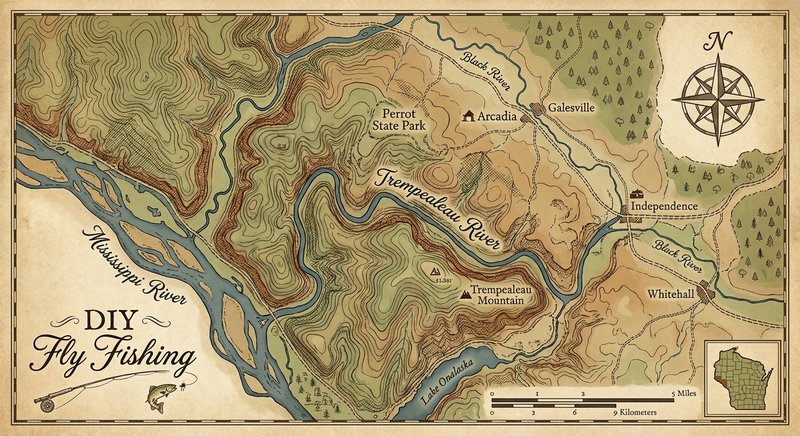
Trempealeau River
Fly fishing in Wisconsin · Intermediate · Best seasons: Spring, Summer, Fall
Target Species
Brown Trout, Brook Trout
About This Water
Western Wisconsin stream with wild brown trout. Driftless Area fishing.
Fishing Recommendations
The Trempealeau River, winding through the heart of Wisconsin’s legendary Driftless Area, offers a quintessential Midwestern spring creek experience. Unlike the steeper mountain streams of the West, the Trempealeau is defined by its meandering path, fertile limestone-rich waters, and lush meadow banks. While the lower sections transition into a warm-water fishery, the upper reaches and its numerous tributaries are a cold-water haven for trout enthusiasts.
🎣 Location Overview
The Trempealeau River system is a centerpiece of Buffalo and Trempealeau Counties. What makes it special is the limestone geology; the water is alkaline and nutrient-dense, leading to incredible insect biomass.
The river is characterized by deep undercut banks, slow-moving pools, and short, bubbly riffles. It is a "technical" fishery—the water is often clear, and the banks can be tall and grassy, requiring stealthy approaches. Anglers love it because it feels intimate yet capable of producing surprisingly large fish, especially in the deeper bends where the big Browns lurk.
🐟 Target Species & Behavior
- Brown Trout: The dominant species in the main stem and larger tributaries. These fish are wary and highly territorial. They hold tight to undercut banks and submerged logs. During the day, they are opportunistic nymph feeders, but they become aggressive predators (streamer eaters) during high water or low light.
- Brook Trout: Found primarily in the headwaters and the smaller, colder "Class 1" tributaries. These are the "jewels of the Driftless"—native, vibrant, and usually smaller than the Browns. They are less "picky" than Browns but extremely spooky. They hold in the swifter water at the heads of pools.
📅 Best Times to Fish
Spring (Late March – May)
- The Window: This is the "Early Season."
- Conditions: Look for the Hendrickson and Blue-Winged Olive (BWO) hatches.
- Best Time: Mid-day (11:00 AM – 3:00 PM) as the sun warms the water and triggers insect activity.
Summer (June – August)
- The Window: The season of the "Terrestrial."
- Conditions: Mornings and late evenings are best to avoid the heat.
- Prime Activity: This is peak dry-fly time. The Trico hatch in July/August offers world-class technical dry fly fishing at dawn, followed by fantastic hopper fishing in the afternoon.
Fall (September – October)
- The Window: Pre-spawn aggression.
- Conditions: Cool, crisp days.
- Best Time: All day. Browns become more visible as they move toward spawning gravel and defend their territory. This is the best time to throw large streamers.
🪰 Recommended Flies & Techniques
Dry Flies
- Terrestrials: Fat Albert (Size 10-14), Dave’s Hopper, and Foam Beetles. In the Driftless, a beetle pattern dropped right against a grassy bank is lethal.
- Mayflies: Adams (Classic and Parachute), BWO (Size 18-22), and Light Cahills.
- Midges/Tricos: Trico Spinners (Size 20-24) for the summer morning "smoke" on the water.
Nymphs
- The "Driftless Standard": Pink Squirrel (Size 14-16). This is a local legend pattern.
- Scuds: Gray or Olive Scuds (Size 16-18) are vital because the river is full of freshwater shrimp.
- Classic: Pheasant Tail Nymphs and Gold-Ribbed Hare’s Ears.
Streamers
- Wooly Buggers: Black or Olive (Size 8-10).
- Sculpin Patterns: The Trempealeau has a high sculpin population; use Muddler Minnows or weighted sculpin patterns to "jig" along the undercut banks.
💡 Pro Tips & Local Knowledge
- The "Cows and Banks" Rule: Much of the river runs through active or former pastureland. If you see a steep, grassy bank with water flowing underneath it, there is a trout there. Cast your fly as close to the grass as possible—within inches.
- Stealth is Mandatory: The fish can see you from a long way off on these flat meadows. Wear earth-toned clothing and consider kneeling while you cast to stay below the fish’s window.
- Focus on the Tributaries: While the main Trempealeau is great, don't overlook tributaries like Dutcher Creek or the North/South Branches. These often stay cooler during the heat of July.
- The "Hop-and-Drop": A very effective local technique is a "Hopper-Dropper" rig. Use a buoyant foam hopper as your indicator and hang a Pink Squirrel 18 inches below it.
⚠️ Important Information
Access
Wisconsin has unique water laws. You must stay in the water (keep your "feet wet") if the land is private, but most of the upper Trempealeau has excellent Public Fishing Easements. Look for the green and white "Public Hunting/Fishing" signs at bridge crossings.
Regulations
- Licenses: You need a Wisconsin Fishing License AND an Inland Trout Stamp.
- Seasons: The general trout season usually runs from the first Saturday in May to October 15th, but there is an "Early Catch and Release" season that often starts in early January.
- Bag Limits: Many sections are Category 5 (Special Regulations), which may require artificial lures only or have specific size limits. Always check the current WDNR Trout Tool (online map) before fishing.
Special Considerations
- Ticks and Parsnip: Be wary of Wood Ticks and Deer Ticks in the tall grass. Also, watch out for Wild Parsnip—the sap causes severe chemical burns when exposed to sunlight. Wear long pants!
Bug Hatches & Matching Flies
| Hatch | Type | Peak months | Time of day | Hook sizes | Matching flies |
|---|---|---|---|---|---|
| Blue-Winged Olive Baetis | mayfly | April, May, September, October | Afternoon | #18-22 | RS2 #18-22, Parachute BWO #18-20, Pheasant Tail #18-20 |
| Grannom Caddis Brachycentrus | caddis | April, May | Afternoon/Evening | #14-16 | Peacock Caddis #14-16, Deep Sparkle Pupa #14-16, Elk Hair Caddis (Olive) #14-16 |
| Sulfur Ephemerella invaria | mayfly | May, June | Evening | #14-18 | Sulfur Parachute #16-18, Sulfur Spinner #14-18, Pheasant Tail (Flashback) #14-16 |
| Trico Tricorythodes | mayfly | July, August, September | Morning | #20-24 | Trico Spinner #20-24, Drowned Trico #22-24, Griffith's Gnat #20-22 |
| Tan Caddis Hydropsyche | caddis | June, July, August | Evening | #14-18 | Elk Hair Caddis (Tan) #14-18, LaFontaine's Emerger #14-16, Hydropsyche Larva #14-16 |
| Light Cahill Stenacron interpunctatum | mayfly | June, July | Evening | #12-16 | Light Cahill Dry #12-14, Gold Ribbed Hare's Ear #12-14 |
| Grasshoppers Orthoptera | terrestrial | July, August, September | Afternoon | #8-12 | Morrish Hopper #8-12, Dave's Hopper #10-12, Chubby Chernobyl #10-12 |
| Zebra Midge Chironomidae | midge | March, April, October, November | All Day | #18-24 | Zebra Midge (Black/Silver) #18-22, Palomino Midge #20-22 |