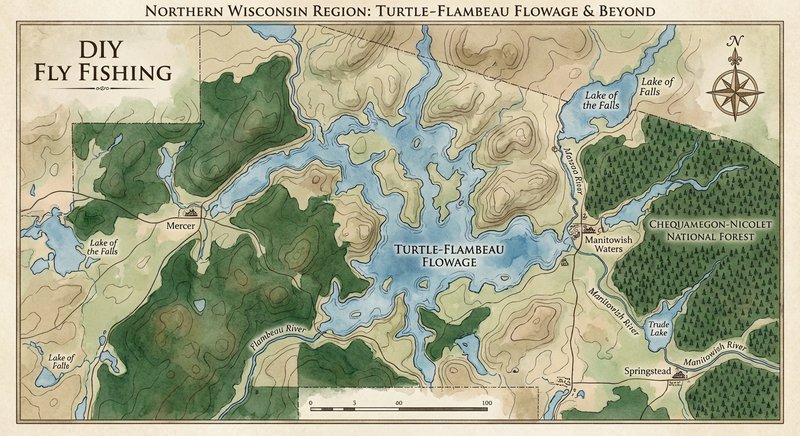
Turtle-Flambeau Flowage
Fly fishing in Wisconsin · Intermediate · Best seasons: Summer, Fall
Target Species
Musky, Walleye, Largemouth Bass
About This Water
Northern Wisconsin wilderness lake with musky and walleye. Remote fishing experience.
Fishing Recommendations
Welcome to the "Everglades of the North." As your guide, I can tell you that the Turtle-Flambeau Flowage (TFF) in Iron County, Wisconsin, is one of the most unique fly fishing destinations in the Midwest. Spanning over 13,000 acres with nearly 200 islands, this is a wild, stump-filled, tannin-stained labyrinth that offers a true wilderness experience.
Here is your comprehensive guide to fly fishing the TFF for Musky, Walleye, and Bass.
🎣 Location Overview
The Turtle-Flambeau Flowage was created in 1926 by the damming of the Turtle and Flambeau rivers. What makes it special is its wild character—90% of the shoreline is state-owned and undeveloped.
The water is "dark"—stained dark brown by natural tannins from the surrounding hemlock and cedar swamps. This acidity and low visibility mean the fish behave differently than in clear-water lakes. It is a shallow flowage, averaging 7–10 feet, filled with submerged stumps, standing timber, and expansive weed beds. For the fly angler, it’s a target-rich environment where every stump could hold a trophy.
🐟 Target Species & Behavior
Musky (The Apex)
The TFF is a high-density Musky water. While they may not reach the massive proportions of Green Bay fish, they are aggressive and plentiful.
- Behavior: They are "ambush predators" here. They tuck tightly into log jams and the "shadow side" of stumps.
- Feeding: They key in on yellow perch, suckers, and small walleye.
Walleye (The Challenge)
Targeting Walleye on the fly is a TFF specialty, though it requires patience.
- Behavior: In this stained water, Walleye are often shallower than in clear lakes because light doesn't penetrate as deep. They hold on rocky humps and transitions from wood to sand.
- Feeding: They focus on emerald shiners, leeches, and mayfly nymphs during hatches.
Largemouth Bass
The TFF is a world-class Bass fishery that is often overlooked in favor of the Musky.
- Behavior: They live deep in the "slop" and the heavy timber. Because of the dark water, they are less spooky than clear-water bass.
- Feeding: Frogs, crayfish, and large insects.
📅 Best Times to Fish
Summer (Late June – August)
- Conditions: Peak weed growth (cabbage and coontail).
- Prime Window: Low light is king. 4:00 AM to 8:00 AM and 7:00 PM until dark.
- Strategy: This is prime time for Largemouth on topwater and Musky in the weeds.
Fall (September – October)
- Conditions: Water temperatures drop, and the "Turnover" occurs.
- Prime Window: Mid-day becomes productive as the sun warms the shallows. 10:00 AM to 3:00 PM.
- Strategy: This is the Trophy Musky window. Large females move into the shallowest remaining green weeds to forage before winter. Walleyes congregate on steep breaks and river channels.
🪰 Recommended Flies & Techniques
For Musky
- Patterns: 8–12 inch Bufords (for pushing water), Game Changers (for side-to-side action), and Double Deceivers.
- Colors: In the TFF’s dark water, use High Contrast: Black/Orange ("Halloween"), Firetiger (Chartreuse/Orange/Gold), or Solid Black.
- Technique: Use a 10wt or 11wt rod with a 350–450 grain sink-tip line. You must perform a "Figure-8" at the end of every single cast—TFF muskies are notorious for following flies right to the boat.
For Walleye
- Patterns: Clouser Minnows (Chartreuse/White), Woolly Buggers (Size 4, Black or Olive), and Bunny Leeches.
- Technique: Use a 6wt rod with a full-sink line. You want to "tick" the bottom of rocky bars. Slow, short strips that mimic a crawling leech or a dying minnow are most effective.
For Largemouth Bass
- Patterns: Dahlberg Divers, Deer Hair Poppers, and weedless Frog patterns. For sub-surface, use crayfish imitations with heavy lead eyes.
- Technique: Cast directly into the heaviest wood cover you can find. Let the rings dissipate before moving the fly. Bass here hit hard and fast to prevent the prey from escaping into the stumps.
💡 Pro Tips & Local Knowledge
- Navigational Warning: The TFF is extremely dangerous for boat lower units. There are thousands of "deadheads" (submerged logs) just inches below the surface. Even if you are in the channel, stay vigilant. Use a GPS map (Navionics) specifically for the TFF.
- The "Stained Water" Rule: Because the fish have lower visibility, they rely heavily on their lateral line. Use flies that vibrate or push water. Think "noisy" flies—rattles and wide-profile heads.
- Focus on "Cabbage": Not all weeds are equal. Look for Broadleaf Pondweed (Tobacco Cabbage). If you find a patch of green cabbage near a river channel edge in September, you have found a Musky goldmine.
- The River Channels: The old beds of the Turtle and Flambeau rivers still exist under the water. Fish the "lips" of these channels where the depth drops from 6 feet to 15 feet.
⚠️ Important Information
- Access: The best fly fishing launches are Fisherman’s Landing (central) and Springstead Landing (east side). Both offer good access to diverse habitat.
- Regulations:
- Musky: 50-inch minimum length limit (it is managed as a trophy fishery).
- Walleye: Special bag limits apply (usually 3 fish, but check the current year’s DNR pamphlet as it changes frequently to protect the population).
- Safety: Always carry a compass and a cell phone power bank. It is incredibly easy to get turned around in the islands as the sun goes down.
- Gear: Bring a heavy-duty net and long-nose pliers. Between the Musky teeth and the Walleye spines, you want to keep your hands clear.
Guide’s Final Word: The TFF rewards the "grinder." It is a massive body of water that can feel intimidating, but if you focus on the wood and maintain your confidence through the dark water, you’ll find some of the most aggressive fish in the Northwoods. Good luck!
Bug Hatches & Matching Flies
| Hatch | Type | Peak months | Time of day | Hook sizes | Matching flies |
|---|---|---|---|---|---|
| Giant Mayfly (The Hex) Hexagenia limbata | mayfly | June, July | Dusk/Night | #4-8 | Hex Hagen #6-8, Wiggle Hex Nymph #4-6, Floating Hex Nymph #6-8 |
| Brown Drake Ephemera simulans | mayfly | May, June | Evening | #10-12 | Brown Drake Cripple #10-12, Parachute Brown Drake #10-12 |
| Cinnamon Caddis Hydropsyche | caddis | June, July, August | Evening | #14-18 | Elk Hair Caddis (Cinnamon) #14-16, LaFontaine's Deep Sparkle Pupa #14-18 |
| Trico Tricorythodes | mayfly | July, August, September | Morning | #20-24 | Trico Spinner #20-24, RS2 #20-22 |
| White Miller Ephoron leukon | mayfly | August | Evening/Night | #12-14 | White Wulff #12-14, Snowshoe Emerger #14 |
| Midges Chironomidae | midge | April, May, September, October | All Day | #18-24 | Zebra Midge #18-22, Griffith's Gnat #18-22 |
| Japanese Beetles & Terrestrials Popillia japonica | terrestrial | July, August | Afternoon | #10-14 | Joan's Beetle #12-14, Chernobyl Ant #8-12 |
| Damselflies Enallagma | terrestrial | June, July | Afternoon | #10-12 | Marabou Damselfly Nymph #10-12, Adult Damsel (Blue) #10-12 |