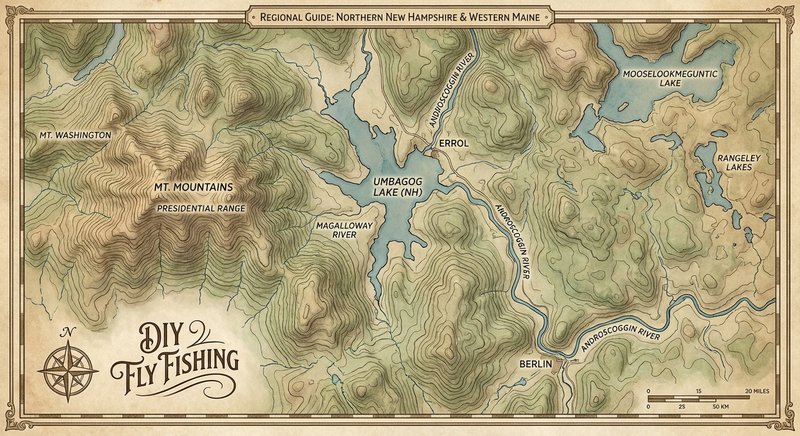
Umbagog Lake (NH)
Fly fishing in New Hampshire · Intermediate · Best seasons: Spring, Summer, Fall
Target Species
Landlocked Salmon, Brook Trout, Smallmouth Bass
About This Water
NH portion of border lake with landlocked salmon. National Wildlife Refuge.
Fishing Recommendations
Welcome to the wild north. As a guide in the Great North Woods, I consider Umbagog Lake to be one of the most unique fisheries in the Northeast. Straddling the border of New Hampshire and Maine, this is not your typical deep, crystal-clear glacial lake. It is shallow, stump-filled, and incredibly productive—a true wilderness experience where you’re as likely to see a moose or a nesting bald eagle as you are another angler.
Here is your comprehensive guide to fly fishing Umbagog Lake.
🎣 Location Overview
Umbagog Lake is the crown jewel of the Umbagog National Wildlife Refuge. It serves as the headwaters of the Androscoggin River and is fed by several legendary fly fishing rivers: the Magalloway and the Rapid River.
What makes Umbagog special is its diversity. It is a "transitional" fishery. While much of the lake is shallow (averaging only 15 feet) and supports a world-class Smallmouth Bass population, the massive inflows of cold water from the Magalloway and Rapid Rivers create "cold-water tongues" where Landlocked Salmon and Brook Trout thrive. It is a wild, undeveloped landscape where the wind can whip up quickly and the underwater structure is dominated by flooded timber and rock reefs.
🐟 Target Species & Behavior
Smallmouth Bass
The "Smallies" here are the primary draw for many fly anglers. They are dark-colored, aggressive, and grow large on a diet of crayfish and yellow perch.
- Behavior: They hold tight to the "stump fields" and rocky points. In June, they move to the shallows to spawn.
- Feeding: Very opportunistic. They will smash topwater poppers in the low light of morning and evening.
Landlocked Salmon
These are the "silver bullets" of the north. Unlike the bass, they are highly migratory.
- Behavior: In early spring, they follow the Smelt runs toward the river mouths. In the fall, they congregate at the inlets (Magalloway/Rapid) preparing to move upstream to spawn.
- Feeding: Almost exclusively piscivorous (fish-eaters). They want streamers that mimic Smelt.
Brook Trout
Umbagog holds beautiful, wild Brookies, often found where cold tributary streams enter the lake.
- Behavior: They are temperature-sensitive. During the heat of summer, they retreat to the oxygenated "bubbles" at the mouths of the Rapid and Magalloway.
- Feeding: They take a mix of aquatic insects (Mayflies/Caddis) and small baitfish.
📅 Best Times to Fish
- Spring (Ice-out through Mid-June): This is the "Prime Time" for Landlocked Salmon and Brook Trout. As the ice leaves, salmon are in the top 5 feet of the water column. Mid-to-late June is the peak for Smallmouth Bass spawning.
- Summer (July - August): Focus on Smallmouth Bass in the early morning and late evening. For Trout and Salmon, you must focus strictly on the river inlets where the water stays cool.
- Fall (September - October): The "Second Season." Salmon and Brook Trout become aggressive and colorful as they prepare to spawn. Smallmouth Bass feed heavily on the rocky flats to bulk up for winter.
🪰 Recommended Flies & Techniques
For Smallmouth Bass
- Topwater: Boogle Bugs (Poppers) in Chartreuse or Black, and Murdich Minnows (fished on a floating line).
- Subsurface: Clouser Minnows (Chartreuse/White or Olive/White), Rubber-legged Woolly Buggers, and crayfish patterns like the Near Nuff Crayfish.
- Technique: Target the "stump fields." Cast your popper, let the rings disappear, then give it two sharp chugs. Hang on.
For Landlocked Salmon & Brook Trout
- Streamers: Classic New England patterns like the Gray Ghost, Black Ghost, and Joe’s Smelt. Modern patterns like the Gamechanger (small) or Flashy Buggers also work well.
- Dry Flies: During June caddis hatches near the river mouths, use Elk Hair Caddis (#12-16) or Stimulators.
- Technique: "Swinging" streamers at the river mouths or stripping them rapidly from a drifting boat. Salmon love speed; don't be afraid to strip fast.
💡 Pro Tips & Local Knowledge
- The "Stump" Hazard: Umbagog is notorious for submerged stumps that can shear a lower unit off an outboard. If you are navigating, stay in the marked channels or go slow. For fishing, these stumps are gold—Smallmouth hide in the root balls.
- Focus on the Inflows: If the lake fishing is slow, head to Sunday Cove (where the Rapid River enters) or the Magalloway River arm. These areas have constant current and cooler temperatures, acting as a magnet for all three target species.
- The "Umbagog Wave": Because the lake is shallow, it can get very rough very fast. If the wind picks up from the Northwest, get to the leeward side of the islands or head back to the dock.
- The Smelt Connection: In May, look for "shiners" or smelt dimpling the surface. If you see birds diving, the Salmon are pushing bait up. Get a streamer in there immediately.
⚠️ Important Information
- Access: The primary access is Umbagog Lake State Park in Cambridge, NH (Route 26). There is a public boat launch and excellent camping.
- Regulations: Umbagog is a border water. A New Hampshire or Maine fishing license is generally valid on the lake (check the current reciprocity map as some specific river sections require the specific state's license).
- Special Rules: The Magalloway and Rapid Rivers have fly-fishing-only sections and specific length limits. Always check the NH Fish & Game "Open Water" digest before casting.
- Safety: This is remote country. Cell service is spotty at best. Carry a map, a whistle, and plenty of bug spray—the black flies in June are legendary.
Guide’s Final Word: If you want a trophy Smallmouth on a popper or a wild Salmon in a setting that feels like Alaska, Umbagog is your spot. Respect the wind, watch for moose, and keep your fly in the water!
Bug Hatches & Matching Flies
| Hatch | Type | Peak months | Time of day | Hook sizes | Matching flies |
|---|---|---|---|---|---|
| Hex (Giant Michigan Mayfly) Hexagenia limbata | mayfly | June, July | Dusk/Evening | #6-10 | Hexagenia Dry #6-8, Hex Nymph #8-10, Wiggle Hex #8 |
| Blue-Winged Olive Baetis | mayfly | May, September, October | Midday | #18-22 | RS2 #20-22, Parachute BWO #18-22, Pheasant Tail Nymph #18-20 |
| Grannom Caddis Brachycentrus | caddis | May | Morning/Afternoon | #14-16 | Elk Hair Caddis (Dark) #14-16, Peacock Caddis #16, Deep Sparkle Pupa #14-16 |
| Damselfly Enallagma | other | June, July, August | Daytime | #10-14 | Marabou Damsel Nymph #10-12, Parachute Damsel #12-14 |
| Hendrickson Ephemerella subvaria | mayfly | May, June | Afternoon | #12-14 | Hendrickson Pink Lady #12-14, Red Quill #12-14, Hare's Ear Nymph #12-14 |
| Slate Drake Isonychia bicolor | mayfly | June, September | Afternoon/Evening | #10-12 | Isonychia Parachute #10-12, Zug Bug #10-12, Iso Nymph #10-12 |
| Chironomids (Midges) Chironomidae | midge | May, June, September | Morning/Evening | #18-24 | Zebra Midge #18-22, Griffith's Gnat #20-22, Ice Midge #20 |
| Black Carpenter Ant Camponotus | terrestrial | July, August | Daytime | #12-16 | Black Foam Ant #12-16, Chernobyl Ant #10-12 |
| Cinnamon Caddis Hydropsyche | caddis | June, July, August | Evening | #14-18 | Tan Elk Hair Caddis #14-18, LaFontaine's Emerger #16, Tan Soft Hackle #14-16 |