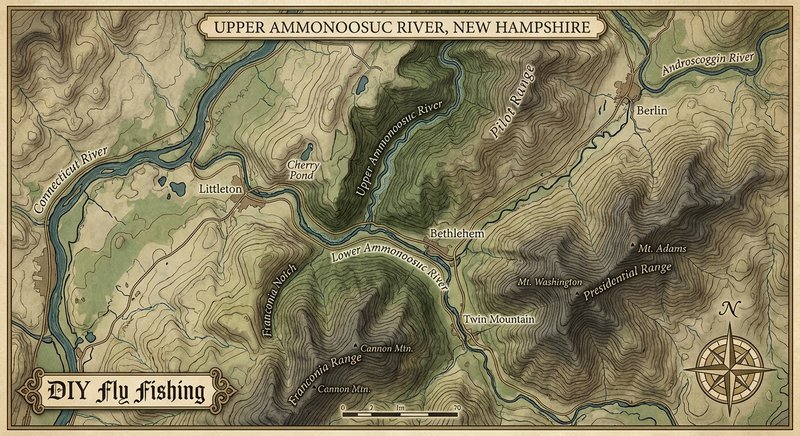
Upper Ammonoosuc River
Fly fishing in New Hampshire · Intermediate · Best seasons: Summer, Fall
Target Species
Brook Trout
About This Water
Coos County stream with wild brook trout. Remote mountain water.
Fishing Recommendations
The Upper Ammonoosuc River (often called the "Upper Ammo") is one of New Hampshire’s best-kept secrets. Located in the rugged North Country of Coos County, it is a quintessential cold-water freestone stream. Unlike the main stem of the Ammonoosuc that follows Route 302, the Upper Ammo flows from the Kilkenny Wilderness through West Milan and Groveton before joining the Connecticut River.
Here is your guide to mastering the Upper Ammonoosuc.
🎣 Location Overview
The Upper Ammonoosuc is a rugged, scenic river characterized by its "pocket water" and classic North Country charm.
- Character: In its upper reaches, it is a boulder-strewn mountain stream with tumbling falls and deep, tea-colored pools. As it moves toward West Milan, it transitions into a mix of riffles, runs, and some slower meadow sections.
- The Appeal: Anglers love this river for its solitude and the opportunity to catch wild, native Brook Trout. While it is stocked in certain access points, the further you hike away from the road, the more likely you are to find wild fish with vibrant, fire-red bellies.
- Water Type: It is a classic freestone river, meaning its flow and temperature are highly dependent on snowmelt and rainfall.
🐟 Target Species & Behavior
The star of the show here is the Brook Trout. You will also find some Rainbow Trout and the occasional Brown Trout in the lower reaches near Groveton, but the upper stretches are a Brookie's paradise.
- Behavior: These fish are opportunistic but can be incredibly spooky in the crystal-clear summer water. They are "pocket water" specialists, sitting in the soft water behind boulders or in the "cushion" just in front of them.
- Feeding: In the summer, they look upward for terrestrials. In the fall, they become highly aggressive as they prepare for the spawn, often striking streamers out of territorial dominance.
📅 Best Times to Fish
Summer (Late June – August)
- Conditions: Water levels drop and clear. This is "dry fly" season.
- Time of Day: Early morning (6:00 AM – 10:00 AM) and "the magic hour" before sunset.
- Strategy: Focus on the faster, highly oxygenated water (riffles and plunges) as the main pools can get too warm.
Fall (September – October)
- Conditions: The "Prime Time." Water temperatures drop, and the Brook Trout dawn their spectacular spawning colors.
- Time of Day: Mid-day becomes more productive as the sun warms the water slightly.
- Strategy: Look for fish moving into gravelly tail-outs or staging near the mouths of tributary streams like Bog Brook.
🪰 Recommended Flies & Techniques
Dry Flies
Brookies in the North Country aren't usually picky, but they require a good presentation.
- Elk Hair Caddis (Size 14-18): The gold standard for the Ammo.
- Royal Wulff (Size 12-16): Highly visible in bubbly pocket water.
- Stimulators (Orange or Yellow, Size 12): Great for mimicking large stoneflies or grasshoppers.
- Terrestrials: Black Ants and Foam Beetles are deadly in August.
Nymphs
- Pheasant Tail (Size 14-18): Mimics almost any mayfly nymph.
- Prince Nymph: The extra flash helps in the tea-colored water.
- Copper John (Red or Silver): Great for getting deep in the plunge pools.
Streamers
- Black or Olive Woolly Bugger (Size 8-10): A staple for larger Brookies in the fall.
- Muddler Minnow: Excellent for mimicking sculpins or being skittered across the surface to trigger an aggressive rise.
Technique: "The Short Line"
Because the river is rocky and brushy, long casts are rarely necessary. High-sticking or "Euro-style" nymphing through the pockets is highly effective. If using dries, use a short leader (7.5 to 9 feet) to maintain accuracy in the wind and tight quarters.
💡 Pro Tips & Local Knowledge
- Focus on the "Kilkenny": For the truest wild Brookie experience, head toward the Kilkenny Wilderness section. The water stays colder here throughout the summer.
- The West Milan Meadows: The stretch near West Milan features some deeper undercut banks. If you are hunting for a "trophy" (for a Brookie, that's 12+ inches), fish a weighted streamer tight against these banks.
- Follow the Bubbles: In the summer heat, Brook Trout will congregate exactly where the white water meets the pool. If there isn't foam, there usually isn't enough oxygen.
- Stealth is Key: Because the river is relatively small, your shadow will send fish darting for cover. Always wade upstream and wear earthy tones (greens/browns) to blend into the forest.
⚠️ Important Information
- Access: Route 110 follows the river for a significant portion, providing many pull-offs. Much of the river runs through the White Mountain National Forest, which offers excellent public access.
- Regulations: Always check the NH Fish & Game Freshwater Digest. While much of the river is open to general regulations, some tributaries or specific sections may have "Fly Fishing Only" or "Catch and Release" rules.
- Safety:
- Wading: The rocks are notoriously slippery. Felt soles or studs are highly recommended.
- Wildlife: This is moose and bear country. Keep your eyes open, especially if fishing at dawn or dusk.
- Bugs: In June and July, the black flies and "no-see-ums" are legendary. Bring heavy-duty repellent or a head net.
The Upper Ammonoosuc is a river for the angler who values the journey and the beauty of the fish over sheer size. Tight lines!
Bug Hatches & Matching Flies
| Hatch | Type | Peak months | Time of day | Hook sizes | Matching flies |
|---|---|---|---|---|---|
| Hendrickson Ephemerella subvaria | mayfly | May | Afternoon | #12-14 | Red Quill #12-14, Hendrickson Emerger #14, Pheasant Tail #12-14 |
| Blue Winged Olive Baetis | mayfly | May, September, October | Late Morning/Afternoon | #18-22 | RS2 #20-22, Parachute BWO #18-20, WD-40 #20 |
| Grannom Caddis Brachycentrus | caddis | May | Morning/Afternoon | #14-16 | Grannom Pupa #14-16, Elk Hair Caddis (Olive) #14-16, Holy Grail Caddis #14-16 |
| March Brown Maccaffertium vicarium | mayfly | June | Afternoon | #10-12 | March Brown American #10-12, Hare's Ear #10-12, March Brown Wet #12 |
| Giant Black Stonefly Pteronarcys dorsata | stonefly | June | Evening/Night | #4-8 | Kaufmann's Stone #6-8, Pat's Rubber Leg #6-10, Chubby Chernobyl #8-10 |
| Light Cahill Stenacron interpunctatum | mayfly | June, July | Evening | #12-14 | Light Cahill #12-14, Gold Ribbed Hare's Ear #14, Cream Usual #14 |
| Yellow Sally Isoperla | stonefly | June, July | Afternoon/Evening | #14-16 | Yellow Sally #14-16, Yellow Stimulator #14-16, Iron Lotus #16 |
| Isonychia Isonychia bicolor | mayfly | July, August, September | Late Afternoon | #10-12 | Isonychia Parachute #10-12, Prince Nymph #10-12, Zug Bug #10-12 |
| Cinnamon Caddis Hydropsyche | caddis | June, July, August | Evening | #14-18 | Elk Hair Caddis (Tan) #14-16, LaFontaine's Deep Pupa #16, Soft Hackle Hare's Ear #14-16 |
| Terrestrials (Ants/Beetles) Formicidae/Coleoptera | terrestrial | July, August, September | All Day | #12-18 | Cinnamon Ant #14-18, Black Foam Beetle #12-16, Chernobyl Ant #10-12 |