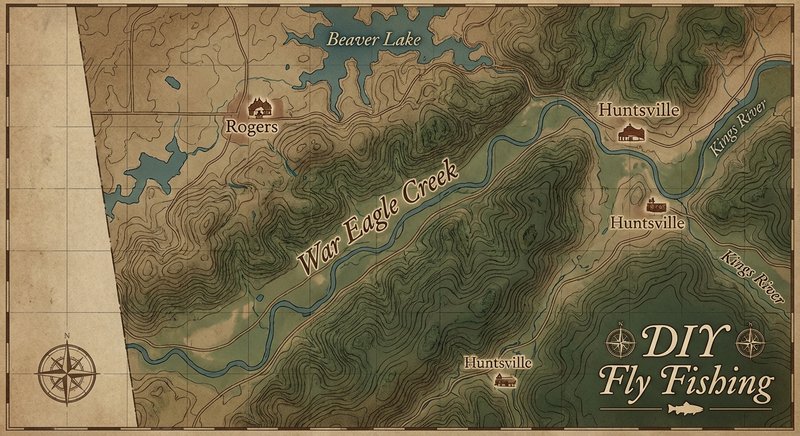
War Eagle Creek
Fly fishing in Arkansas · Beginner · Best seasons: Spring, Summer, Fall
Target Species
Smallmouth Bass, Largemouth Bass
About This Water
Scenic Ozark stream with smallmouth bass. Popular float fishing destination.
Fishing Recommendations
War Eagle Creek, Arkansas. Smallmouth Bass, Largemouth Bass. Spring, Summer, Fall.
🎣 Location Overview
War Eagle Creek is one of the hidden gems of the Ozark Mountains in Northwest Arkansas. Flowing through Madison and Benton counties before emptying into Beaver Lake, it is a classic Ozark stream characterized by limestone bluffs, gravel bars, and deep, turquoise-tinted pools.
What makes War Eagle special is its "intimate" feel. Unlike the larger White or Kings Rivers, War Eagle is smaller and more technical. It offers a quintessential "Ozark Smallmouth" experience: crystal clear water where you can often sight-fish for aggressive bronze-backs. It is a slow-to-medium gradient stream, making it perfect for both wading and kayak fishing. Anglers love it for the solitude and the striking scenery—especially the iconic views near the historic War Eagle Mill.
🐟 Target Species & Behavior
- Smallmouth Bass (The Star): These are the primary targets. Ozark Smallmouth are known for being exceptionally scrappy. They hold in the "transition zones"—the areas where fast-moving riffles dump into deeper pools. Look for them behind submerged boulders, undercut banks, and along the bluff walls.
- Largemouth Bass: Found primarily in the slower, deeper sections and the lower reaches near the lake. They tend to stick closer to heavy woody debris (fallen sycamore trees) and lily pads in the sloughs.
- Feeding Habits: Their diet consists heavily of crayfish (the "steak" of the Ozarks), sculpins, and various minnow species (stonerollers and shiners). During the summer, they also look skyward for terrestrial insects like grasshoppers and cicadas.
📅 Best Times to Fish
- Spring (Late March – May): This is "Pre-spawn" and "Spawn" season. The fish are aggressive and moving into shallower gravel areas. Note: Be mindful of spawning beds (redds) to protect future populations.
- Summer (June – August): The most consistent time for topwater action. Fish early in the morning or late in the evening to avoid the midday heat. This is the prime time for "wet wading."
- Fall (September – early November): My personal favorite. As the water cools, bass feed heavily to prepare for winter. The colors of the Ozark foliage against the limestone bluffs are world-class.
- Optimal Conditions: Look for "green" water—not muddy from a recent rain, but not gin-clear either. A slight stain gives the fish more confidence to strike large streamers.
🪰 Recommended Flies & Techniques
Top Fly Patterns
- Crayfish Patterns: Near-Nuff Crayfish or Clouser Crayfish (Size 2-6) in olive, brown, or orange.
- Streamers: The Clouser Minnow is king here. Chartreuse/White or Olive/White. Also, Game Changers for larger predatory fish.
- Topwater: Boogle Bugs (Poppers) in "Electric Yellow" or "Frog," and Todd's Wiggle Minnow (which dives and swims like a crankbait).
- Terrestrials: Large foam grasshoppers or Chernobyl Ants during late summer.
Techniques & Presentation
- The "Crayfish Hop": Cast a weighted crayfish pattern into a riffle and let it tumble into the pool. Use short, erratic strips to mimic a fleeing crawdad.
- The Swing: Cast a Clouser Minnow 45 degrees downstream and let the current swing it across the face of a bluff wall.
- Topwater Chug: When using poppers, slow down. Cast near wood or a rock, let the rings disappear, give it one "pop," and wait. Often, the bass hits while the fly is sitting still.
💡 Pro Tips & Local Knowledge
- The "Shadow Line": In the heat of summer, Smallmouth will hug the shadows created by the tall limestone bluffs. Cast your fly into the shade, even if it’s only a foot wide along the bank.
- Focus on the "Tail-outs": While everyone fishes the deep holes, big Smallmouth often move to the very end of a pool (the tail-out) just before it breaks into the next riffle to hunt for minnows.
- Gear Selection: A 6-weight fast-action fly rod is the "Goldilocks" choice for War Eagle. It has enough backbone to throw heavy streamers and fight the wind, but is still fun for 12-inch fish. Use a 0X or 1X fluorocarbon leader; these fish aren't usually leader-shy, and you'll need the strength to pull flies out of logs.
⚠️ Important Information
- Access: Much of the land surrounding War Eagle Creek is private. Use public access points such as the Withrow Springs State Park area or the War Eagle Mill. Kayak floating is the best way to see the water—check water levels before going (the USGS gauge at Hindsville should ideally be between 100-300 cfs for a safe float).
- Regulations: An Arkansas Fishing License is required. There are specific length and creel limits for Smallmouth Bass in the Ozark Zone. Many local anglers practice 100% Catch and Release for Smallmouth to preserve the trophy quality of these slow-growing fish.
- Safety: Be aware of "root wads" and downed timber while floating. The creek can rise very rapidly after a rainstorm in the Ozark hills; always check the weather forecast for the entire watershed.
Bug Hatches & Matching Flies
| Hatch | Type | Peak months | Time of day | Hook sizes | Matching flies |
|---|---|---|---|---|---|
| Blue-Winged Olive Baetis spp. | mayfly | March, April, October, November | Late Morning/Afternoon | #18-22 | Adams Parachute #18-20, RS2 #20-22, Pheasant Tail #18-22 |
| Cinnamon Caddis Hydropsyche | caddis | May, June, September | Evening | #14-18 | Elk Hair Caddis (Tan) #14-16, Hydropsyche Larva #14-16, Pupa (Cinnamon) #16 |
| March Brown Maccaffertium vicarium | mayfly | April, May | Afternoon | #12-14 | March Brown Dry #12-14, Gold Ribbed Hare's Ear #12-14 |
| Hexagenia Hexagenia limbata | mayfly | June, July | Dusk/Night | #6-10 | Hexagenia Dry #6-8, Burrowing Mayfly Nymph #8-10 |
| White Fly Ephoron leukon | mayfly | August, September | Evening | #12-14 | White Wulff #12-14, Snowshoe Spinner #14 |
| Golden Stonefly Acroneuria spp. | stonefly | May, June | Morning/Afternoon | #8-12 | Kaufmann's Stone (Gold) #8-12, Stimulator (Yellow) #10-12 |
| Grasshoppers Orthoptera | terrestrial | July, August, September | Mid-day/Afternoon | #6-12 | Dave's Hopper #8-10, Fat Albert #6-12 |
| Midges Chironomidae | midge | January, February, December | Morning | #20-26 | Zebra Midge #20-22, Griffith's Gnat #20-24 |
| Trico Tricorythodes spp. | mayfly | August, September | Early Morning | #20-24 | Trico Spinner #22-24, Trico Drown #22 |