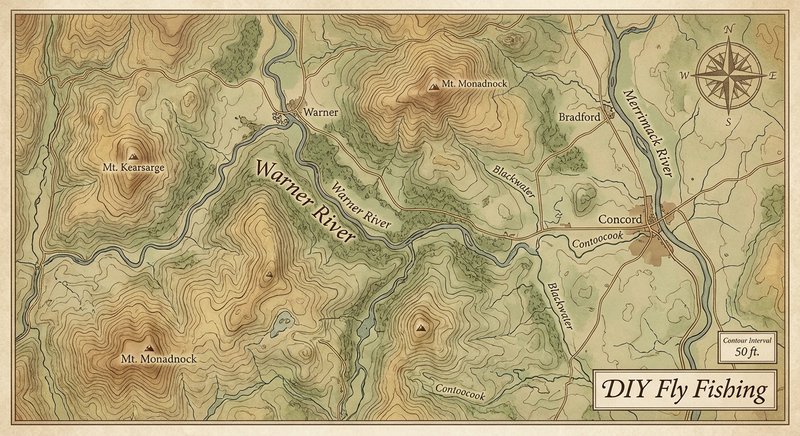
Warner River
Fly fishing in New Hampshire · Beginner · Best seasons: Spring, Summer, Fall
Target Species
Brown Trout, Brook Trout
About This Water
Merrimack County stream with brown trout. Mount Kearsarge area.
Fishing Recommendations
The Warner River is one of southern New Hampshire’s most cherished fly fishing gems. Flowing roughly 20 miles from the Sunapee mountains down to its confluence with the Contoocook River, it offers a quintessential New England trout fishing experience characterized by covered bridges, dense woodlands, and classic freestone water.
🎣 Location Overview
The Warner River is a medium-sized freestone stream that drains a significant portion of the Merrimack River watershed. What makes it special is its diversity of water; you’ll find everything from tumbling pocket water and bouldery runs in its upper reaches to deep, slow-moving "meadow" sections as it nears Hopkinton.
Anglers love the Warner because it feels remote yet is highly accessible from I-89. It is heavily stocked by New Hampshire Fish and Game (NHFG), but it also harbors a modest population of holdover fish and wild Brook Trout in its colder tributaries. The scenery—including the iconic Dalton and Waterloo covered bridges—provides a stunning backdrop for a day on the water.
🐟 Target Species & Behavior
The Warner is primarily a Brown Trout and Brook Trout fishery.
- Brook Trout: These are the most active feeders in the spring. They tend to hold in the quicker "oxygenated" water—the heads of pools and behind mid-stream boulders. They are aggressive and less "leader-shy" than the Browns.
- Brown Trout: The "kings" of the Warner. Browns prefer the undercut banks, deep woody debris, and the dark tail-outs of pools. They are more nocturnal and cautious. If you’re hunting a larger holdover Brown, look for structure—fallen logs or deep crevices in the riverbed.
- Feeding Behavior: In the spring, they focus on sub-surface nymphs and larvae. As the water warms in June, they look to the surface for the heavy hatches of Mayflies and Caddis. In late summer, terrestrials (ants/beetles) become their primary focus.
📅 Best Times to Fish
- Spring (Late April – June): This is the prime window. Once the spring runoff (snowmelt) subsides and the water hits 50°F, the fish become very active. This coincides with the peak of the stocking season.
- Summer (July – August): Fishing becomes technical. The Warner can get warm, and water levels often drop. Focus on the early morning (6 AM – 10 AM) or the last hour of light. Note: If water temperatures exceed 70°F, please stop fishing to protect the trout from lethal stress.
- Fall (September – October): A fantastic time to be on the water. The Brookies take on their brilliant spawning colors, and the Browns become aggressive again as they prepare for winter. The "fall bite" is often triggered by the first few frosts.
🪰 Recommended Flies & Techniques
Dry Flies
- Elk Hair Caddis (Sizes 14-18): A staple on the Warner. Use this in the riffles.
- Adams / Parachute Adams (Sizes 14-20): The best general attractor for Mayfly hatches.
- Light Cahill (Sizes 14-16): Effective in late afternoon during June.
- Stimulators (Sizes 10-12): Great for "skating" across the surface to trigger aggressive strikes.
Nymphs
- Pheasant Tail Nymph (Sizes 14-18): Mimics almost any Mayfly nymph in the river.
- Gold-Ribbed Hare’s Ear (Sizes 12-16): Best for the deeper, slower pools.
- Perdigons / Jig Nymphs: Use these in the pocket water to get down deep and fast.
Streamers
- Woolly Bugger (Black or Olive, Sizes 6-10): The ultimate "searching" pattern. Swing these through deep holes.
- Muddler Minnow: Excellent for mimicking the small sculpins found in the Warner.
Techniques
- The "Tight-Line" Nymph: Because the Warner has many boulders, a European-style or tight-line nymphing rig is incredibly effective for reaching fish in the "pockets" behind rocks.
- Dry-Dropper: A favorite for summer. Hang a small Pheasant Tail 18 inches below an Elk Hair Caddis to cover two levels of the water column.
💡 Pro Tips & Local Knowledge
- The Waterloo Stretch: The area around the Waterloo Covered Bridge is legendary. It has great oxygenation and holding water. However, it sees the most pressure. If it's crowded, hike half a mile upstream or downstream to find overlooked fish.
- "Bagley" Area: Check the stretches near the Bagley athletic fields. There is a mix of slow water and riffles here that often holds larger Browns that moved up from the Contoocook.
- Follow the Cold: During a hot July, look for where small feeder streams enter the river. These "cold water plumes" act as thermal refuges for trout.
- Stealth is Key: The Warner is not a huge river. In the summer, the water is crystal clear. Dress in drab colors (olive/tan), stay low, and try not to splash when wading.
⚠️ Important Information
- Regulations: The Warner River is generally open to fishing year-round, but trout "possession" season usually runs from the fourth Saturday in April through October 15th. Always check the NH Fish and Game Compendium for the most current rules.
- Licensing: A valid New Hampshire freshwater fishing license is required for anyone 16 or older.
- Access: Much of the river runs through private land. While NH has a culture of open access, always respect "Posted" signs. Use the various bridge crossings and designated pull-offs along Route 103.
- Wading Safety: The riverbed can be very "greasy" with algae. Felt-soled boots or studs are highly recommended to prevent slipping on the round river rocks.
Bug Hatches & Matching Flies
| Hatch | Type | Peak months | Time of day | Hook sizes | Matching flies |
|---|---|---|---|---|---|
| Hendrickson Ephemerella subvaria | mayfly | April, May | Afternoon | #12-14 | Red Quill #12-14, Hendrickson Emerger #14, Pheasant Tail #12-14 |
| Tan Caddis Hydropsyche | caddis | May, June, July | Evening | #14-18 | Elk Hair Caddis (Tan) #14-16, LaFontaine's Sparkle Pupa #14-18, Pulsating Caddis #14-16 |
| Blue Winged Olive Baetis | mayfly | April, May, September, October | Afternoon | #18-22 | BWO Sparkle Dun #18-20, RS2 #20-22, WD-40 #18-22 |
| Sulphur Ephemerella invaria/dorothea | mayfly | June, July | Evening | #14-18 | Sulphur Parachute #16-18, Sulphur Emerger #16, Split Case Sulphur #14-16 |
| March Brown Maccaffertium vicarium | mayfly | May, June | Afternoon | #10-12 | March Brown Dry #10-12, Hare's Ear Nymph #10-12, Gold Ribbed Hare's Ear #10-12 |
| Grannom Caddis Brachycentrus | caddis | April, May | Morning/Afternoon | #14-16 | Grannom Pupa #14-16, Peacock Caddis #14-16, Bead Head Caddis Larva #14-16 |
| Light Cahill Stenacron interpunctatum | mayfly | June, July, August | Evening | #12-16 | Light Cahill Dry #12-16, Cahill Wet Fly #14 |
| Golden Stonefly Acroneuria | stonefly | June, July | Afternoon/Evening | #8-12 | Pat's Rubber Legs #8-12, Golden Stimulator #10-12 |
| Terrestrials Formicidae / Coleoptera | terrestrial | July, August, September | All Day | #12-18 | Black Foam Ant #16-18, Crowe Beetle #14-16, Cinnamon Ant #16-18 |