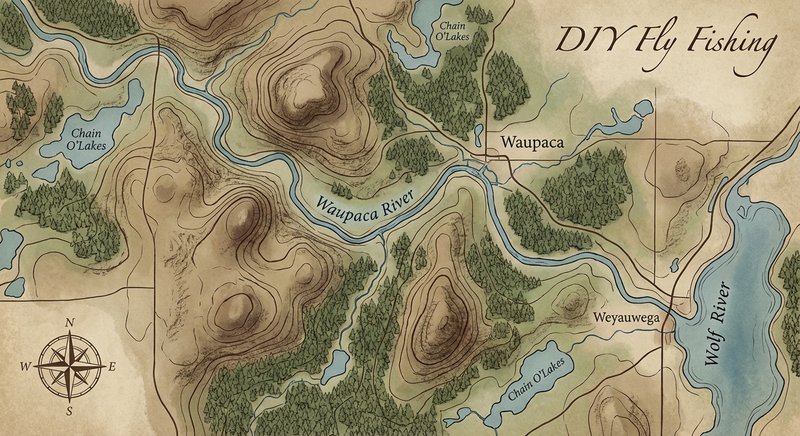
Waupaca River
Fly fishing in Wisconsin · Beginner · Best seasons: Spring, Summer, Fall
Target Species
Brown Trout, Smallmouth Bass
About This Water
Central Wisconsin stream with trout and smallmouth bass. Chain of lakes connection.
Fishing Recommendations
The Waupaca River (and its upper reach, known as the Tomorrow River) is one of Central Wisconsin’s most underrated fly fishing gems. Unlike the rugged coulees of the Driftless Area to the west, the Waupaca offers a classic Midwestern pastoral experience, characterized by crystalline water, sandy bottoms, and lush forests. It is a rare "dual-threat" river, transitioning from a premier cold-water trout fishery into a world-class smallmouth bass destination.
🎣 Location Overview
The river undergoes a bit of a "personality split." In Portage County, it is known as the Tomorrow River, a pristine, spring-fed trout stream. Once it crosses into Waupaca County, it becomes the Waupaca River.
What makes it special is the diversity of the water. The upper reaches feature gravel runs and deep undercut banks perfect for elusive Brown Trout. As the river moves through the city of Waupaca and eastward, the water warms slightly and the substrate shifts to larger boulders and swifter currents—prime habitat for hard-fighting Smallmouth Bass. It is a river that demands stealth, accurate casting, and an appreciation for diverse ecosystems.
🐟 Target Species & Behavior
Brown Trout (Upper River / Tomorrow River)
The Browns here are primarily wild and can be exceptionally spooky. They are "structure-oriented," meaning they live and die by the wood.
- Holding Spots: Look for them tucked deep under overhanging tag alders, behind fallen log jams, or in the deep "buckets" at the tail-outs of bends.
- Feeding: They are opportunistic but selective during hatches. They feed heavily on scuds and cressbugs year-round due to the river's limestone influence.
Smallmouth Bass (Lower River)
The "Bronzebacks" of the Waupaca are known for their aggression.
- Holding Spots: They prefer the faster water below dams, the edges of current seams, and the shadows of large mid-river boulders.
- Feeding: They are predatory, focusing on crayfish, hellgrammites, and emerald shiners. In the mid-summer, they will look up for large terrestrial insects or topwater disturbances.
📅 Best Times to Fish
- Spring (Late April – June): This is the "Golden Era" for trout. You’ll see the major aquatic insect hatches (Hendricksons and Sulphurs). For bass, this is pre-spawn/spawn time; they are aggressive and hungry.
- Summer (July – August): The best time for the "Double Header." Fish for trout in the cool mornings using terrestrials, then move downstream in the afternoon to target Smallmouth Bass on topwater poppers when the sun is high.
- Fall (September – October): A favorite for local guides. Brown Trout become aggressive and colorful as they prepare to spawn (please avoid fishing over active spawning redds in late Oct). For bass, this is "streamer season" as they bulk up for winter.
🪰 Recommended Flies & Techniques
For Brown Trout
- Dry Flies: Elk Hair Caddis (size 14-18), Light Cahill (14-16), and the "Purple Haze" (14-18).
- Nymphs: Gold-ribbed Hare’s Ear, Flashback Pheasant Tail, and Scud patterns (size 16-20) in olive or gray.
- Technique: "Dapping" or short-leash nymphing. The canopy is tight, so a 7'6" to 8'6" 4-weight rod is ideal for navigating the brush.
For Smallmouth Bass
- Topwater: Boogle Bugs or small foam poppers in yellow or chartreuse.
- Sub-surface: The Murdich Minnow (white/silver), Woolly Buggers (black or olive), and Crawfish imitations.
- Technique: For bass, use a 6-weight rod with a weight-forward floating line. Focus on "swinging" streamers through the riffles or stripping them erratically near sunken wood.
💡 Pro Tips & Local Knowledge
- The "Sand" Factor: The Waupaca has a lot of sand. While easy to wade, it can be featureless. Experienced anglers look for "dark water"—any area where the bottom is dark (gravel or logs) usually indicates a depth change or cover where fish hold.
- Stealth is Mandatory: On the upper Tomorrow/Waupaca, the water is exceptionally clear. If you can see the trout, they have likely already seen you. Wear earthy tones, stay low, and move upstream slowly.
- The "Hatch" to Watch: The Caddis activity on this river is legendary. Often, a simple tan Elk Hair Caddis skittered across the surface at dusk will outproduce any complex nymphing rig.
- The City Stretch: Don't overlook the water right through the town of Waupaca. The areas around the parks offer excellent access and surprisingly good bass fishing.
⚠️ Important Information
Access Information
- The Tomorrow River Trail: Offers excellent access points in Portage County.
- Bridge Crossings: Most bridges have a small area for parking, but ensure you are off the pavement. Wisconsin law allows anglers to fish any navigable stream as long as they keep their "feet wet" or stay within the ordinary high-water mark.
- Wayding: Generally easy wading, but be cautious of "muck holes" in the slower sections that can trap a boot.
Regulations & Permits
- License: A valid Wisconsin Inland Fishing License AND an Inland Trout Stamp are required.
- Specific Rules: Regulations change as you cross county lines. Some sections are "Catch and Release Only," while others allow harvest. Always check the WDNR Trout Tool (online map) before your first cast.
- Season: Generally, the trout season runs from the first Saturday in May to October 15th, but "Early Season" (Catch & Release) often opens in January.
Guide’s Final Word: The Waupaca River isn't about trophy sizes every day; it's about the technical challenge and the beauty of the environment. Bring a 4-weight for the trout, a 6-weight for the bass, and plenty of bug spray—the mosquitoes are the only thing more active than the fish!
Bug Hatches & Matching Flies
| Hatch | Type | Peak months | Time of day | Hook sizes | Matching flies |
|---|---|---|---|---|---|
| Blue-Winged Olive Baetis spp. | mayfly | April, May, September, October | Mid-day | #18-22 | RS2 #18-22, Parachute BWO #18-20, Pheasant Tail Nymph #18-20 |
| Hendrickson Ephemerella subvaria | mayfly | April, May | Afternoon | #12-14 | Red Quill #12-14, Hendrickson Nymph #12-14, Sparkle Dun #12-14 |
| Grannom Caddis Brachycentrus occidentalis | caddis | April, May | Morning/Afternoon | #14-16 | Elk Hair Caddis (Olive) #14-16, Deep Sparkle Pupa #14-16, Holy Grail #14-16 |
| Sulphur Ephemerella invaria | mayfly | May, June | Evening | #14-18 | Comparadun Sulphur #16-18, Sulphur Snowshoe Emerger #16-18, Gold Ribbed Hare's Ear #14-16 |
| Light Cahill Stenonema ithaca | mayfly | June, July | Evening/Dusk | #12-14 | Light Cahill #12-14, Cream Variants #14, Hare's Ear (Light) #12-14 |
| Trico Tricorythodes | mayfly | July, August, September | Morning | #20-24 | Trico Spinner #20-24, Griffith's Gnat #20-22, Trico Nymph #22 |
| White Miller Nectopsyche | caddis | July, August | Evening | #14-16 | White Elk Hair Caddis #14-16, LaFontaine's Emerger #14-16 |
| Terrestrials | terrestrial | July, August, September | All Day | #12-18 | Chernobyl Ant #10-14, Black Foam Beetle #14-16, Cinnamon Ant #16-18 |
| Midges Chironomidae | midge | March, April, October, November | Late Morning | #18-24 | Zebra Midge #18-22, Morgan's Midge #20-22, WD-40 #20-22 |