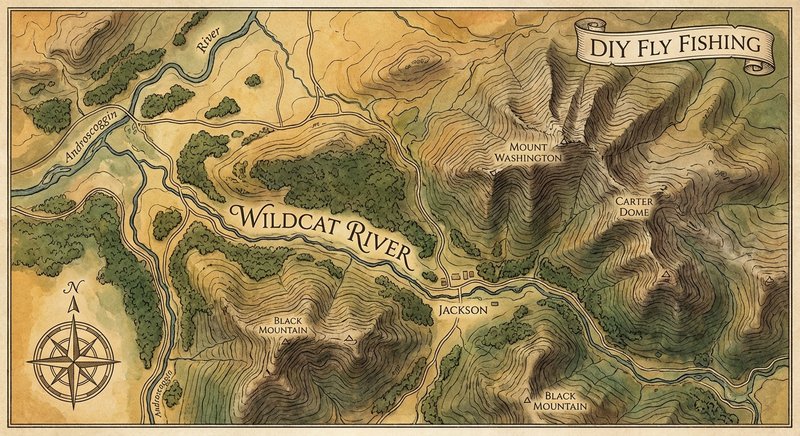
Wildcat River
Fly fishing in New Hampshire · Beginner · Best seasons: Summer, Fall
Target Species
Brook Trout
About This Water
Jackson area stream with wild brook trout. Popular covered bridge area.
Fishing Recommendations
The Wildcat River, specifically the stretch flowing through Jackson, New Hampshire, is one of the crown jewels of the White Mountains. It was the first river in New Hampshire to be designated a National Wild and Scenic River, and for good reason. It is the quintessential high-gradient mountain stream: crystal clear, boulder-strewn, and punctuated by dramatic waterfalls.
🎣 Location Overview
The Wildcat River is a high-elevation freestone stream that drains the eastern slopes of Carter Notch. What makes it special is its accessibility paired with its rugged beauty. While it flows right through the picturesque village of Jackson, the upper reaches offer a true wilderness experience.
The water characteristics are classic "pocket water." You’ll find plunges, deep emerald pools, and fast riffles. Because it is a freestone river, its flows are entirely dependent on snowmelt and rainfall. The water remains cold even in the heat of summer, making it a critical refuge for native fish. Anglers love it because it rewards stealth and precision rather than long-distance casting.
🐟 Target Species & Behavior
The primary draw here is the Wild Brook Trout. While the state does stock certain sections near the village, the Wildcat is famous for its "wild and woody" residents.
- Behavior: These fish are opportunistic but wary. In the fast-moving current, they don't have long to decide whether to eat, so they often strike aggressively. However, the water is so clear that they are easily spooked by a clumsy shadow or a heavy wading boot.
- Where they hold: Look for "pillows" of soft water in front of large boulders, the "tail-outs" of pools at dusk, and the bubbly "seams" where fast water meets slow water. In the summer, they hug the white water (highly oxygenated) and deep undercut banks.
- Feeding: They feed primarily on small stoneflies, caddis, and terrestrial insects (ants and beetles) that fall from the dense overhanging canopy.
📅 Best Times to Fish
Optimal Seasons
- Summer (Late June – August): This is the prime window. While other New Hampshire rivers might get too warm, the Wildcat stays cool. The terrestrial bite is at its peak.
- Fall (September – October): This is arguably the most beautiful time. The Brook Trout take on their vibrant spawning colors (deep oranges and reds). The fish become more aggressive as they prepare for winter.
Best Times of Day
- Morning: 8:00 AM to 11:00 AM before the sun gets too high and puts the fish down.
- Evening: The "Golden Hour" (6:00 PM to dark) is magical on the Wildcat, especially for dry fly action.
Prime Conditions
Look for "dropping and clearing" water after a summer rain. A slight stain in the water gives the angler a massive advantage by masking their presence.
🪰 Recommended Flies & Techniques
Top Fly Patterns
- Dry Flies:
- Royal Wulff or Royal Coachman (Size 12-16): The white wings are easy to see in the bubbles.
- Elk Hair Caddis (Tan or Olive, Size 14-18).
- Stimulators (Orange or Yellow, Size 12-14): Great for imitating large stoneflies or grasshoppers.
- Black Ants & Foam Beetles (Size 16-20): Essential for late summer.
- Nymphs:
- Bead-head Pheasant Tail (Size 16-20).
- Prince Nymph (Size 14-16).
- Streamers:
- Black Ghost or Mickey Finn: Classic New England patterns that work well in the deeper pools near Jackson Falls.
Effective Techniques
- Dry-Dropper: This is the most effective way to fish the Wildcat. Use a buoyant dry fly (like a Stimulator) and hang a small Pheasant Tail nymph 18-24 inches below it.
- Short-Line Nymphing: You rarely need to cast more than 15-20 feet. High-sticking through the pockets ensures you don't have line drag across multiple currents.
- Stealth Approach: Always fish upstream. Approach pools from behind and stay low. If you can see the fish, they have likely already seen you.
💡 Pro Tips & Local Knowledge
- The "Jackson Falls" Strategy: Most tourists stop at the falls to take photos. If you hike just a half-mile above or below the main falls area, the fishing pressure drops significantly.
- The Upper River: For a true wilderness experience, head up Carter Notch Road. The river narrows, the boulders get bigger, and the fish—while smaller—are entirely wild and incredibly beautiful.
- Light Tackle: Use a 2-weight or 3-weight rod. A 7.5-foot rod is better than a 9-foot rod here because of the tight overhead canopy.
- Watch the Shadows: Because the river is narrow and lined with trees, your shadow can easily "flicker" across a pool. Always keep the sun in your face when possible.
⚠️ Important Information
- Access: Much of the river follows Carter Notch Road and Route 16B. There are several pull-offs and public access points near the Jackson Grammar School and the falls. Always respect "Posted" signs on private property near the village.
- Regulations: New Hampshire fishing licenses are required (available online or at local shops like North Country Angler in North Conway). The Wildcat is generally under "General Law" for trout, but always check the current NH Fish & Game Digest for specific terminal tackle restrictions or bag limits, as these can change seasonally.
- Wading Safety: The rocks in the Wildcat are notoriously slippery (covered in "didymo" or rock snot at times). Studded wading boots and a staff are highly recommended. The current is stronger than it looks.
- Wildlife: This is bear and moose country. Be aware of your surroundings, especially if you are hiking into the upper reaches alone.
Bug Hatches & Matching Flies
| Hatch | Type | Peak months | Time of day | Hook sizes | Matching flies |
|---|---|---|---|---|---|
| Early Brown Stonefly Strophopteryx fasciata | stonefly | April, May | Midday | #12-16 | Early Brown Stone Nymph #12-14, Stimulator #14-16 |
| Blue-Winged Olive Baetis | mayfly | May, September, October | Midday/Afternoon | #18-22 | RS2 #18-22, BWO Parachute #18-20 |
| Hendrickson Ephemerella subvaria | mayfly | May | Afternoon | #12-14 | Hendrickson Dark #12-14, Pheasant Tail Nymph #12-14 |
| Grannom Caddis Brachycentrus | caddis | May | Morning/Afternoon | #14-16 | Peacock Caddis #14-16, Holy Grail Caddis #14-16 |
| March Brown Maccaffertium vicarium | mayfly | June | Afternoon/Evening | #10-12 | March Brown American #10-12, Hare's Ear Nymph #10-12 |
| Light Cahill Stenacron canadense | mayfly | June, July | Evening | #14-16 | Light Cahill #14-16, Gold Ribbed Hare's Ear #14-16 |
| Yellow Sally Isoperla | stonefly | June, July | Late Afternoon/Evening | #14-16 | Yellow Sally #14-16, Iron Lotus #16 |
| Slate Drake Isonychia bicolor | mayfly | July, August, September | Late Afternoon | #10-12 | Isonychia Parachute #10-12, Prince Nymph #10-12 |
| Black Ants Formicidae | terrestrial | July, August | All Day | #16-20 | Black Foam Ant #16-18, Flying Ant #18 |