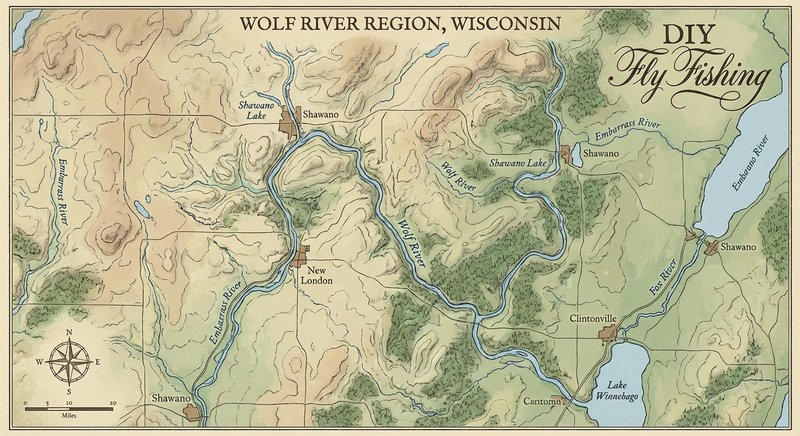
Wolf River
Fly fishing in Wisconsin · Beginner · Best seasons: Spring, Summer, Fall
Target Species
Brook Trout, Brown Trout, Smallmouth Bass
About This Water
Central Wisconsin river with diverse fishing. Trout, bass, and musky opportunities.
Fishing Recommendations
The Wolf River in Northeastern Wisconsin is a legend among Midwest fly anglers. Unlike the gentle, spring-fed creeks of the Driftless Area, the "Wolf" is a wild, rugged, and high-gradient river. It is often called the "White Water River of the North," characterized by granite boulders, heavy rapids, and classic pocket water.
Here is your comprehensive guide to fly fishing the Wolf River.
🎣 Location Overview
The Wolf River is one of the few rivers in the Midwest that offers a truly "Western" feel. The prime trout water is located primarily in Langlade County, stretching roughly from the village of Post Lake down to the Menominee County line.
What makes it special is its volatility and beauty. The riverbed is littered with massive boulders, creating endless seams, eddies, and plunge pools. It is a large river by Wisconsin standards, meaning you have room to cast, but the current is powerful. It is a freestone-style river, meaning its temperature and flow are heavily influenced by weather, making it a challenging but rewarding destination for the adventurous angler.
🐟 Target Species & Behavior
Brown Trout
The Wolf is famous for its wild, "buttery" Brown Trout. These fish are predators. They hold in the deep shadows of boulders or in the "cushion" of water just in front of rocks. During hatch cycles, they will move into the riffles, but generally, they prefer structure that breaks the heavy current.
Brook Trout
While the main stem holds some Brookies, they are more prevalent in the colder upper reaches and the numerous cold-water tributaries (like the Hunting River). They are opportunistic feeders but sensitive to water temperature; if the main stem hits 70°F, look for them at the mouth of feeder creeks.
Smallmouth Bass
As you move further downstream toward the Hollister and Langlade areas—and especially below the trout water—the Smallmouth Bass take over. These "Bronzebacks" are exceptionally strong due to living in constant heavy current. They behave much like trout, holding in eddies and darting out to grab streamers or large poppers.
📅 Best Times to Fish
Spring (May – June)
This is "Prime Time." The water is high but clearing.
- May: The Hendrickson (Ephemerella subvaria) hatch is the first major event of the year.
- Early June: The Caddis activity is intense. This is also when the water temperatures are most stable for trout.
Summer (Late June – August)
- The Hex: In late June and early July, the legendary Hexagenia limbata (Giant Mayfly) hatch occurs at dusk. This brings the largest trophy Browns to the surface.
- Dog Days: During the heat of August, trout fishing slows down in the afternoons. Switch to Smallmouth Bass or fish the "oxygenated" white water where trout retreat for cooler air.
Fall (September – October)
As water temperatures drop, Brown Trout become aggressive and territorial ahead of the spawn. This is the best time for streamer fishing. The fall colors on the Wolf are world-class.
🪰 Recommended Flies & Techniques
Dry Flies
- Hendricksons (Size 12-14): For May afternoons.
- Elk Hair Caddis (Size 14-18): A staple all summer.
- Hexagenia (Size 4-6): Large, yellow-bodied patterns for late-night summer July.
- Stimulators (Size 8-12): Great for "searching" the pocket water; they float high and are easy to see in the bubbles.
Nymphs
- Prince Nymph & Hare’s Ear (Size 12-16): Effective year-round.
- Rubber-Leg Stoneflies (Size 6-10): The Wolf has a massive population of Golden Stoneflies.
- Perdigons / Euro Nymphs: Because the water is so fast, heavy tungsten beads are necessary to get down into the strike zone.
Streamers
- Woolly Buggers (Black or Olive): The "go-to" for both Trout and Smallmouth.
- Sculpin Patterns: Mimic the natural forage found among the rocks.
- Clouser Minnows: Excellent for Smallmouth in the deeper runs.
Techniques
- Pocket Water Picking: Don't try to make 60-foot casts. Use a "high-stick" nymphing technique or short dry-fly drifts to target the small calm spots behind boulders.
- The "Swing": Swinging wet flies or small streamers through the riffles is a classic Wolf River technique that covers a lot of water.
💡 Pro Tips & Local Knowledge
- Wade with Caution: The Wolf River is notoriously difficult to wade. The rocks are incredibly slippery ("snotty") and often loose. Studded wading boots and a wading staff are mandatory. Do not attempt to wet-wade in sandals.
- The "Langlade Stretch": Focus on the area between Pearson and Hollister. This area has the best public access and the most consistent trout habitat.
- Temperature Watch: In mid-summer, carry a thermometer. If the water hits 70°F, stop fishing for trout to prevent mortality. Switch your focus to the Smallmouth stretches further south near Markton.
- Stealth vs. Power: While the water is loud and fast, the fish are still wary. Approach a pool from downstream and avoid casting your shadow over the holding water.
⚠️ Important Information
Access
Wisconsin has excellent "Stream Bank Protection" programs. Look for the yellow DNR signs at road crossings and designated parking lots along Highway 55. Popular access points include Ninemile Rapids, Sherry Rapids, and the Wolf River Landing.
Regulations
- Trout Stamp: An Wisconsin Inland Trout Stamp is required in addition to your fishing license.
- The Menominee Reservation: CRITICAL. The river flows into the Menominee Indian Reservation. Non-tribal members are generally prohibited from fishing within the reservation boundaries without specific tribal permits (which are rarely issued for the river portion). Always know your GPS location and stay north of the reservation line.
- Catch & Release: While some sections allow harvest, catch and release is highly encouraged to maintain the wild trout populations of this unique freestone river.
Gear Recommendation
- Rod: A 9-foot, 5-weight or 6-weight rod is ideal. The 6-weight helps handle the wind and the heavier streamers often needed for this river.
- Leader: 9-foot tapered leaders (3X or 4X for streamers/dries). Use fluorocarbon for nymphs.
Bug Hatches & Matching Flies
| Hatch | Type | Peak months | Time of day | Hook sizes | Matching flies |
|---|---|---|---|---|---|
| Hendrickson Ephemerella subvaria | mayfly | April, May | Afternoon | #12-14 | Red Quill #12-14, Hendrickson Emerger #12-14, Pheasant Tail #12-14 |
| Grannom Caddis Brachycentrus | caddis | April, May | Morning/Afternoon | #14-16 | Elk Hair Caddis (Olive) #14-16, LaFontaine's Deep Pupa #14-16, Pupa Sparkle Caddis #14-16 |
| Sulphur Ephemerella invaria/dorothea | mayfly | May, June | Evening | #14-18 | Sulphur Parachute #16-18, Pale Morning Dun Nymph #14-18, Rusty Spinner #16-18 |
| Giant Golden Stone Acroneuria lycorias | stonefly | June, July | Evening/Night | #6-10 | Golden Stone Nymph #6-10, Stimulator (Yellow) #8-10, Kaufmann's Stone #6-8 |
| Brown Drake Ephemera simulans | mayfly | June | Evening | #10-12 | Brown Drake Cripple #10-12, Brown Drake Dry #10-12, Hare's Ear Nymph #10-12 |
| Hex Hexagenia limbata | mayfly | June, July | Night | #4-8 | Hexagenia Dry #6-8, Hex Wiggle Nymph #6-8, Parachute Hex #6-8 |
| Light Cahill Stenacron interpunctatum | mayfly | June, July, August | Evening | #12-14 | Light Cahill #12-14, Gold Ribbed Hare's Ear #12-14 |
| Slate Drake Isonychia bicolor | mayfly | August, September | Afternoon | #10-12 | Isonychia Parachute #10-12, Zug Bug #10-12, Iso Nymph #10-12 |
| Blue-Winged Olive Baetis | mayfly | April, September, October | Afternoon | #18-22 | BWO Sparkle Dun #18-20, RS2 (Gray) #18-22, Micro Mayfly Nymph #18-22 |