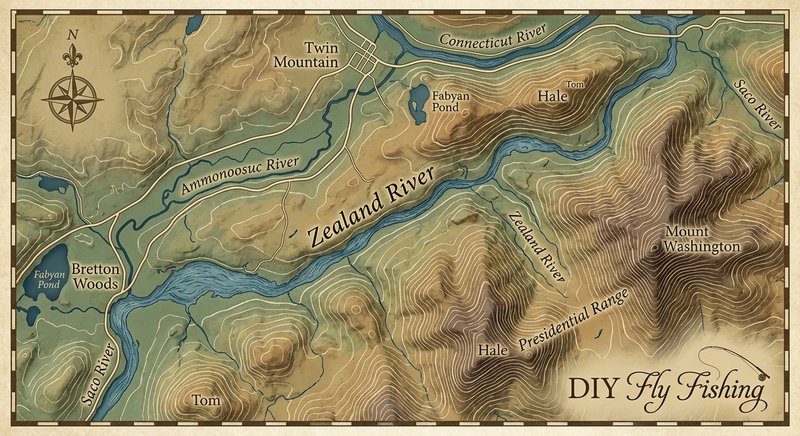
Zealand River
Fly fishing in New Hampshire · Intermediate · Best seasons: Summer, Fall
Target Species
Brook Trout
About This Water
White Mountain stream with native brook trout. Scenic wilderness area.
Fishing Recommendations
Welcome to the White Mountains of New Hampshire. As your guide, I’m excited to introduce you to the Zealand River, a quintessential high-gradient mountain stream located within the White Mountain National Forest (WMNF).
The Zealand is a "blueline" angler's dream: crystal-clear pools, tumbling pocket water, and wild, native brook trout that are as colorful as the autumn leaves.
🎣 Location Overview
The Zealand River is a tributary of the Ammonoosuc River, characterized by its classic "freestone" nature. It flows through a rugged landscape of granite boulders, dense forest, and mossy banks.
What makes it special is its accessibility combined with a wilderness feel. While the lower reaches are easily accessed via Zealand Road, the upper sections require a hike, which thins out the crowds. This is technical "pocket water" fishing—you won't find long, slow glides here. Instead, you’ll be picking apart small eddies, plunge pools, and runs. The water stays remarkably cold even in the heat of summer, making it a reliable refuge for trout when other lowland rivers become too warm to fish safely.
🐟 Target Species & Behavior
The primary (and usually only) target here is the Wild Eastern Brook Trout.
- Behavior: These are not the lethargic stocked fish found in bigger rivers. They are opportunistic predators. Because the Zealand is a nutrient-poor environment, these fish can't afford to be picky; if something looks like food and is presented naturally, they will smash it.
- Size: Expect fish in the 4-to-8-inch range. A 10-inch "Zealand Monster" is a trophy in these headwaters.
- Holding Spots: Look for "the soft in the hard." In this fast water, fish sit in the small cushions of slow water in front of or behind boulders, under undercut banks, and in the bubble lines of plunge pools.
📅 Best Times to Fish
While the river is open year-round under general NH rules, the Zealand is a seasonal gem.
- Summer (Late June – August): This is the prime window. While other rivers are overheating, the Zealand’s canopy and high elevation keep it cool. Dry fly fishing is at its peak.
- Fall (September – October): This is the most magical time. The Brook Trout enter their spawning colors (vibrant oranges and reds), and they become extra aggressive.
- Note: Be mindful of spawning beds (redds) in late October and try to avoid wading on them.
- Best Time of Day: Unlike tailwaters, you don't need to be there at the crack of dawn. In the mountains, the "banker’s hours" (10:00 AM to 4:00 PM) are often best, as the sun hitting the water activates insect life.
🪰 Recommended Flies & Techniques
Top Fly Patterns
In the Zealand, visibility and buoyancy are more important than exact imitation.
- Dry Flies:
- Royal Wulff or Royal Coachman (Size 12-16): The classic attractor.
- Elk Hair Caddis (Size 14-18): Great for skittering across fast ripples.
- Stimulators (Orange or Yellow, Size 12-16): High visibility and floats like a cork.
- Nymphs:
- Bead-head Pheasant Tail (Size 16-18): A staple for the deeper pools.
- Prince Nymph (Size 14-16): The "hot" white wings attract attention in dark water.
- Terrestrials:
- Black Ants or Foam Beetles (Size 16-18): Essential for late summer.
Techniques
- High-Sticking / Short-Line Nymphing: Because the currents are complex, keeping as much fly line off the water as possible is key to preventing drag.
- Dry-Dropper: This is the "pro move" here. Tie a buoyant dry fly (like a Stimulator) and hang a small unweighted nymph 12-18 inches below it. You’ll cover two water columns simultaneously.
- The "Stealth" Approach: The water is clear. If you can see the fish, they’ve likely already seen you. Stay low, wear earthy colors, and cast from downstream to upstream.
💡 Pro Tips & Local Knowledge
- Work Upstream: Always fish moving upstream. Brook trout face into the current; if you approach from behind, you’re less likely to spook them.
- The "One Cast" Rule: In small pocket water, your first cast is your best chance. If you botch the drift, move to the next pocket. These fish spook easily but reset quickly if you move on.
- Zealand Road Access: The first 3 miles of Zealand Road offer plenty of pull-offs. If you see a car, move half a mile up. There is plenty of water for everyone.
- The Upper Section: For a true wilderness experience, park at the end of Zealand Road and hike the Zealand Trail. About a mile in, the river pulls away from the road and sees significantly less pressure.
⚠️ Important Information
- Regulations: New Hampshire Fish & Game manages this as a general trout water. A standard NH Fishing License is required. Always check the current NH Open Seasons & Rules before heading out.
- Access: Zealand Road is a Forest Service road. It is closed in winter (usually late November to mid-May).
- Gear Recommendation: A 2-weight to 4-weight rod (7’ to 8’6”) is ideal. Anything heavier is overkill for these fish and difficult to cast under the tight tree canopy.
- Safety: This is bear country (Black Bears). Carry out what you carry in. Also, the granite rocks are incredibly slippery—studded wading boots or felt (where legal) are highly recommended.
- Cell Service: Expect zero cell service once you turn onto Zealand Road. Tell someone where you are going and when you expect to be back.
Enjoy the Zealand! It’s not about the size of the fish here; it’s about the wild places they take you. Tight lines!
Bug Hatches & Matching Flies
| Hatch | Type | Peak months | Time of day | Hook sizes | Matching flies |
|---|---|---|---|---|---|
| Blue Winged Olive Baetis | mayfly | May, September, October | Afternoon | #18-22 | BWO Sparkle Dun #18-20, Pheasant Tail Nymph #18-22 |
| Hendrickson Ephemerella subvaria | mayfly | May | Afternoon | #12-14 | Hendrickson Pink Lady #12-14, Red Quill #14 |
| Grannom Caddis Brachycentrus | caddis | May | Morning/Afternoon | #14-16 | Grannom Pupa #14-16, Elk Hair Caddis (Olive) #14-16 |
| March Brown Maccaffertium vicarium | mayfly | June | Afternoon | #10-14 | March Brown Dry #10-12, Gold Ribbed Hare's Ear #12-14 |
| Yellow Sally Isoperla | stonefly | June, July | Late Afternoon/Evening | #14-16 | Yellow Stimulator #14-16, Little Yellow Stone Nymph #14-16 |
| Light Cahill Stenacron interpunctatum | mayfly | June, July | Evening | #12-14 | Light Cahill #12-14, Cream Usual #14 |
| Cinnamon Caddis Hydropsyche | caddis | July, August | Evening | #14-18 | Tan Elk Hair Caddis #16-18, LaFontaine's Deep Sparkle Pupa #14-16 |
| Giant Black Stonefly Pteronarcys dorsata | stonefly | June | Night/Early Morning | #4-8 | Black Girdled Bugger #6-8, Pat's Rubber Legs #4-8 |
| Terrestrials (Ants and Beetles) Formicidae / Coleoptera | terrestrial | July, August, September | All Day | #12-18 | Black Foam Ant #14-18, Crowe Beetle #12-16 |