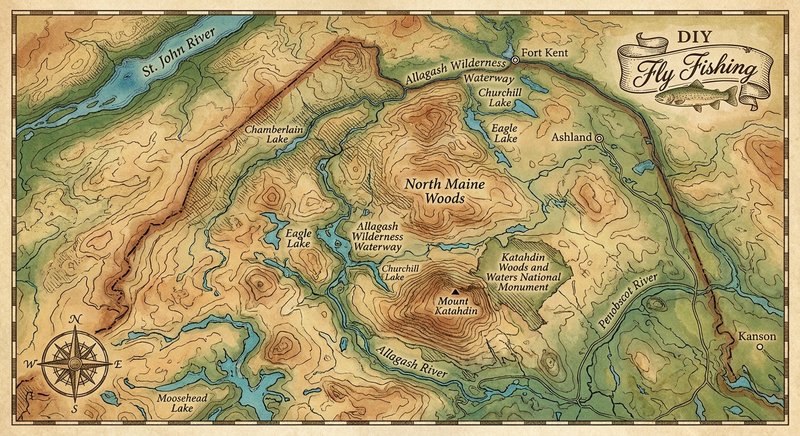
Allagash River
Fly fishing in Maine · Advanced · Best seasons: Summer, Fall
Target Species
Brook Trout
About This Water
Wild and scenic river with native brook trout. Multi-day canoe trip fishing.
Fishing Recommendations
The Allagash Wilderness Waterway (AWW) in Northern Maine is the "Crown Jewel" of the North Woods. Established by the state in 1966 and designated as a National Wild and Scenic River, it offers one of the most remote and authentic wilderness fly fishing experiences in the lower 48.
Here is your guide to targeting wild Brook Trout on the Allagash.
🎣 Location Overview
The Allagash is a 92-mile-long corridor of lakes, ponds, rivers, and streams. Unlike the fast-tumbling rivers of the Rockies, the Allagash is a classic "woods water"—characterized by dark, tannic-stained (tea-colored) flows, sprawling "deadwaters" (slow-moving deep sections), and technical rapids.
Anglers love the Allagash because it is a wild fishery. These are not stocked fish; these are native "Squaretails" (Brook Trout) that have inhabited these waters since the glaciers receded. Fishing here is as much about the environment—loons, moose, and old-growth pine—as it is about the fish.
🐟 Target Species & Behavior
Target Species: Wild Brook Trout (Salvelinus fontinalis). Note: You may also encounter Lake Trout (Togue) in the deeper lakes and Fallfish in the warmer stretches.
- Behavior: Allagash Brookies are highly temperature-sensitive. In the spring and early summer, they are spread throughout the river system. As temperatures rise, they become "thermally stressed" and congregate in massive numbers around cold-water refugia—spring holes and the mouths of cold tributary streams.
- Feeding: They are opportunistic. They feed heavily on Mayflies (notably the Hexagenia limbata), Caddis, and stoneflies. However, larger Allagash Brookies are highly piscivorous (fish-eaters), targeting smelt, dace, and even small frogs.
📅 Best Times to Fish
Summer (July – August)
- The Strategy: This is "Spring Hole" season. Because the main river can get warm, you must find where cold groundwater enters.
- Conditions: Low water levels make the river more technical to navigate by canoe.
- Time of Day: Early morning (dawn) and the final hour of light are the only times to fish the surface. During the day, fish deep in the coldest pockets.
Fall (September)
- The Strategy: This is the prime window. As water temperatures drop, trout leave the spring holes and move toward spawning gravel in the moving water sections.
- Conditions: The fish are in their spectacular spawning colors (bright orange bellies). They become aggressive and territorial.
- Prime Window: September 1st through the end of the season (Sept 30th on the river). The "Hex" hatch may be over, but the trout are looking for big meals to bulk up for winter.
🪰 Recommended Flies & Techniques
Dry Flies
- Hexagenia Limbata (Size 6-8): For the legendary "Hex hatch" in late June/early July.
- Elk Hair Caddis (Size 12-16): A staple for the evening rises in the riffles.
- Stimulators (Size 8-12): Great for "searching" the water in the faster sections like Chase Rapids.
- Usual or Haystack: Classic Maine patterns that float well in broken water.
Streamers (The Maine Tradition)
In the Allagash, streamers often out-produce everything else for trophy fish.
- Black Ghost: A classic Maine feather-wing pattern.
- Muddler Minnow: To mimic sculpins or grasshoppers.
- Wooly Buggers (Black or Olive): Essential for deep deadwaters.
- Mickey Finn: The bright colors work wonders in the tannic, tea-colored water.
Techniques
- The "Allagash Drift": Use a canoe to drift silently into the head of a pool. Anchoring (where permitted) or having a partner hold the boat is crucial.
- Streamer Stripping: Cast toward the banks or "dead-head" logs and use an erratic strip-strip-pause retrieve.
- Spring Hole Etiquette: If you find a spring hole where fish are stacked, stay back. Long casts are necessary to avoid spooking the school.
💡 Pro Tips & Local Knowledge
- Chase Rapids: If you want moving water and classic "pocket water" fishing, the section below Churchill Dam (Chase Rapids) is your best bet. It requires a high level of canoe skill or a "ranger shuttle."
- The "Cold Water" Secret: Carry a stream thermometer. If the main river is over 68°F, stop fishing the main channel and look for tributaries that feel significantly colder to the touch.
- Tannic Vision: Because the water is dark, high-contrast flies (black/white or bright orange) often perform better than subtle, natural shades.
- The Canoe is Your Platform: You cannot effectively fish the Allagash from the bank. A 17-20 foot canoe (traditionally a Scott or Old Town) with a small motor (within regulations) or a setting pole is the standard tool.
⚠️ Important Information
- Access: Access is via private logging roads (North Maine Woods gate system). Expect to pay gate fees and camping fees. The roads are gravel and rugged; a full-sized spare tire is mandatory.
- Regulations: The Allagash has specific "Special Fishing Laws." Many sections are FFO (Fly Fishing Only) or ALO (Artificial Lures Only). Always check the current Maine IF&W Open Water Regulations before your trip.
- Wilderness Ethics: This is a "leave no trace" area. Cell service is non-existent. Carry a Garmin inReach or similar satellite communicator.
- Lead Ban: Maine law prohibits the use of small lead sinkers and unpainted lead jigs to protect loons. Ensure your split shot is tin or tungsten.
Guide’s Final Word: The Allagash is not about "numbers" or "easy" fishing. It is about the grit of the North Woods. If you respect the water and time your trip with the cooling temperatures of September, you will find the most beautiful Brook Trout on the planet.
Bug Hatches & Matching Flies
| Hatch | Type | Peak months | Time of day | Hook sizes | Matching flies |
|---|---|---|---|---|---|
| Hendrickson Ephemerella subvaria | mayfly | May, June | Afternoon | #12-14 | Red Quill #12-14, Hendrickson Emerger #14, Pheasant Tail #12-14 |
| Grannom Caddis Brachycentrus | caddis | May | Morning/Afternoon | #14-16 | Peacock Caddis #14-16, Green Weenie #14-16, Deep Sparkle Pupa #16 |
| Blue-Winged Olive Baetis | mayfly | May, September, October | Afternoon | #18-22 | BWO Parachute #18-22, RS2 #20-22, WD-40 #20-22 |
| Eastern Green Drake Ephemera guttulata | mayfly | June | Evening | #8-12 | Green Drake Cripple #10-12, Coffin Fly #8-10, Green Drake Nymph #8-12 |
| Giant Stonefly Pteronarcys dorsata | stonefly | June | Night/Evening | #4-8 | Pats Rubber Legs #4-8, Stimulator (Orange) #6-10, Golden Stone Nymph #8-10 |
| Light Cahill Stenacron canadense | mayfly | June, July | Evening | #12-16 | Light Cahill Dry #12-16, Hare's Ear (Light) #14-16, Cahill Emerger #14 |
| Cinnamon Caddis Hydropsyche | caddis | June, July, August | Evening | #14-18 | Elk Hair Caddis (Tan) #14-18, Soft Hackle Hare's Ear #14-16, LaFontaine Sparkle Pupa #16 |
| Black Carpenter Ant Camponotus pennsylvanicus | terrestrial | July, August | All Day | #12-16 | Black Foam Ant #12-16, Chernobyl Ant #10-14, Flying Ant #14-16 |