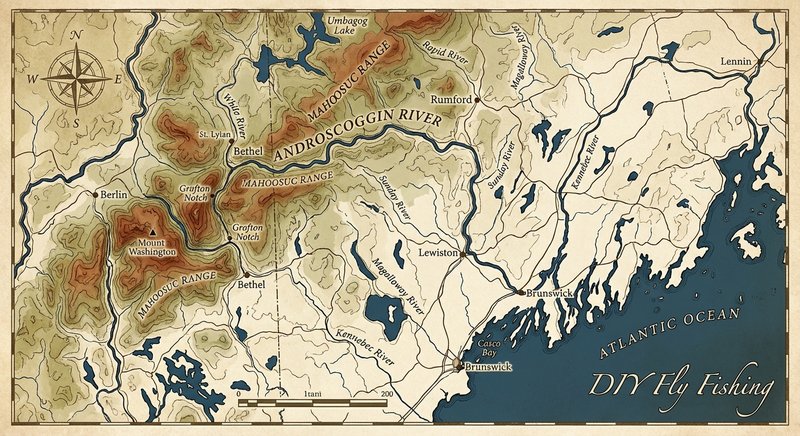
Androscoggin River
Fly fishing in Maine · Beginner · Best seasons: Spring, Summer, Fall
Target Species
Smallmouth Bass, Brown Trout, Brook Trout
About This Water
Western Maine river with smallmouth bass and trout. Good access throughout.
Fishing Recommendations
The Androscoggin River, or "The Andro" as locals call it, is one of the most diverse and productive fly fishing rivers in New England. Stretching from the mountains of New Hampshire through the heart of Maine to the Atlantic, it offers a "tale of two rivers": a premier cold-water trout fishery in its upper reaches and a world-class smallmouth bass fishery in its middle and lower sections.
🎣 Location Overview
The Androscoggin is a large, powerful river characterized by its impressive width, diverse bottom structure (from gravel runs to massive ledge outcroppings), and high nutrient load.
What makes it special is its recovery story. Once heavily polluted, it is now a thriving ecosystem. The stretch from Gilead to Bethel is the "Trout Capital" of the river, featuring classic freestone runs and cold-water oxygenation. As you move downstream past Rumford, the river warms and slows slightly, transforming into an elite Smallmouth Bass destination. It is a "big water" river that rewards both wading anglers and those in drift boats or rafts.
🐟 Target Species & Behavior
Brown Trout & Brook Trout
- Location: Primarily found from the NH border down to the Bethel/Dixfield area.
- Behavior: The Andro’s trout are known for being "caddis-focused." They hold in oxygenated riffles, behind large boulders (pocket water), and in deep runs during the heat of the day.
- Feeding: They are opportunistic but can become selective during the massive caddis hatches. They also key in on large Golden Stonefly nymphs and sculpin.
Smallmouth Bass
- Location: While found throughout, the highest concentrations are from Rumford down through Jay, Lewiston, and Auburn.
- Behavior: These are "river-run" smallies—extremely lean and powerful. They hold in "seams" where fast water meets slow water, in the eddies behind bridge pilings, and along the rocky ledges.
- Feeding: Aggressive predators. They feed heavily on crayfish, hellgrammites, and various minnows (shiners and dace).
📅 Best Times to Fish
- Spring (May – June): This is the "Golden Era" for trout. The Mother’s Day Caddis hatch is legendary, bringing every fish in the river to the surface. Water levels can be high, so heavy nymphs and streamers are often necessary early in the month.
- Summer (July – August):
- Trout: Focus on early mornings and late evenings. Target areas near cold-water tributaries.
- Smallmouth: This is prime time. The bass are active, aggressive, and will smash topwater flies during the heat of the day.
- Fall (September – October): The "Second Spring." Trout become aggressive again as temperatures drop. Brown trout begin to move and strike large streamers. Smallmouth feed heavily to bulk up for winter.
🪰 Recommended Flies & Techniques
Dry Flies (Trout)
- Elk Hair Caddis (Sizes 12-18): The bread and butter of the Andro. Tan, olive, and peacock bodies.
- Stimulators (Sizes 8-12): Great for the "skating caddis" technique or as a lead fly in a hopper-dropper rig.
- Goddard Caddis: High-floating and easy to see in heavy riffles.
Nymphs (Trout & Bass)
- Pat’s Rubber Legs (Coffee/Black): Imitates the large Golden Stoneflies found in the river.
- Pheasant Tail & Prince Nymphs (Sizes 14-16): Standard droppers that work year-round.
- Zebra Midges: Effective during the winter and early spring.
Streamers & Bass Flies
- Woolly Buggers (Olive, Black, White): Essential for both trout and bass.
- Clouser Minnows: Best for bass in the deeper runs.
- Boogle Bugs / Poppers: Nothing beats the surface strike of an Andro Smallmouth on a foam popper in August.
- Game Changers: For targeting trophy Brown Trout in the fall.
💡 Pro Tips & Local Knowledge
- The "Andro Twitch": When fishing the caddis hatch, don't just dead-drift. Androscoggin caddis are active; giving your fly a slight twitch or skating it across the surface often triggers a violent strike.
- Wading Safety: The Andro is a powerful river with a "greasy" bottom. Felt soles and studs are highly recommended. Be wary of sudden depth changes near ledge rock.
- The Bethel Stretch: For the best trout experience, focus on the water between the Gilead bridge and the Bethel boat launch. This stretch is best fished via drift boat or raft to access the mid-river islands.
- Check the Gauges: This is a dam-controlled river. Always check the USGS Gauge at Gilead (for trout) or Rumford (for bass). Ideal wading flows at Gilead are below 1,500 cfs; over 3,000 cfs is strictly boat-only water.
⚠️ Important Information
- Access: Much of the river follows Route 2, offering numerous pull-offs. Look for "Public Water Access" signs provided by Brookfield Power and the State of Maine.
- Regulations: Maine fishing laws are divided into North and South zones, and the Androscoggin has specific "Special Fishery Regulations."
- Many stretches are Catch and Release or have restricted bag limits for trout.
- Always consult the Maine IF&W Open Water Compliance Tool.
- Permits: A valid Maine Fishing License is required for anyone 16 years or older. You can purchase these online via the MDIFW website.
- Industrial Presence: Be aware that the river passes through industrial towns (Rumford, Jay). While the water is clean for fishing, always follow state consumption advisories if you plan to keep fish (though Catch & Release is highly encouraged for the trout population).
Bug Hatches & Matching Flies
| Hatch | Type | Peak months | Time of day | Hook sizes | Matching flies |
|---|---|---|---|---|---|
| Hendrickson Ephemerella subvaria | mayfly | May | Afternoon | #12-14 | Red Quill #12-14, Hendrickson Emerger #14, Pheasant Tail #12-16 |
| Grannom Caddis Brachycentrus | caddis | May | Morning/Afternoon | #14-16 | Elk Hair Caddis (Olive) #14-16, Peacock Caddis Larva #14-16, LaFontaine Sparkle Pupa #14-16 |
| Blue Winged Olive Baetis spp. | mayfly | April, May, September, October | Mid-day/Afternoon | #18-22 | BWO Parachute #18-22, RS2 #20-22, JujuBaetis #18-22 |
| Slate Drake Isonychia bicolor | mayfly | July, August, September | Afternoon/Evening | #10-12 | Iso Parachute #10-12, Isonychia Nymph #10-12, Zug Bug #10-14 |
| Golden Stonefly Acroneuria | stonefly | June, July | Morning/Evening | #6-10 | Pat's Rubber Legs #6-10, Stimulator (Yellow/Golden) #8-12, Golden Stone Nymph #8-10 |
| Light Cahill Stenacron / Stenonema | mayfly | June, July | Evening | #12-14 | Light Cahill #12-14, Cahill Emerger #14, Gold Ribbed Hare's Ear #12-14 |
| Tricos Tricorythodes | mayfly | July, August, September | Morning | #22-26 | Trico Spinner #22-24, Trico Duns #22-24 |
| Tan Caddis Hydropsyche | caddis | June, July, August | Evening | #14-18 | Elk Hair Caddis (Tan) #14-18, Pupa-Tan #16, Soft Hackle Hare's Ear #14-16 |
| March Brown Maccaffertium vicarium | mayfly | May, June | Afternoon | #10-12 | March Brown #10-12, March Brown Nymph #10-12 |
| Flying Ants Formicidae | terrestrial | August, September | Afternoon | #16-20 | Cinnamon Ant #16-18, Black Foam Ant #16-20 |