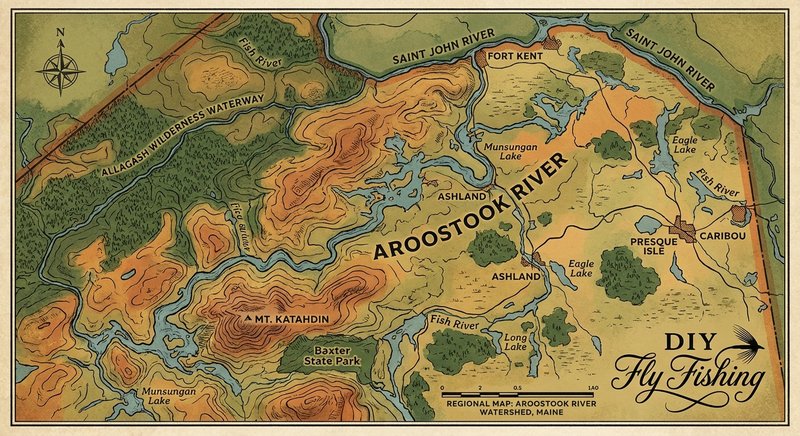
Aroostook River
Fly fishing in Maine · Beginner · Best seasons: Summer, Fall
Target Species
Brook Trout, Smallmouth Bass
About This Water
Northern Maine river with brook trout and smallmouth bass. Less pressured fishing.
Fishing Recommendations
The Aroostook River is the lifeblood of "The County" (Aroostook County), carving a path through the most remote and expansive region of Northern Maine. It is a river of dual personalities, offering world-class native Brook Trout fishing in its upper reaches and cool-water tributaries, and becoming a premier Smallmouth Bass destination as it widens and slows through the agricultural heartland.
For the angler seeking solitude, wild fish, and a true Northwoods experience, the "Big River" is a bucket-list destination.
🎣 Location Overview
The Aroostook flows roughly 112 miles from its headwaters in the Maine North Woods to the Canadian border. What makes it special is its scale and diversity. Unlike the tight, technical mountain streams of western Maine, the Aroostook is a broad, powerful river.
In the upper reaches (above Ashland), it is a freestone river characterized by gravel bars and deep pools, flanked by timberland. As it flows toward Presque Isle and Caribou, it becomes more fertile, influenced by the limestone-rich soils of the region's potato farms. This fertility leads to incredible insect life and high growth rates for fish. Anglers love it because it offers "big water" fly fishing where you can actually stretch out your backcast and hunt for trophy-sized wild fish.
🐟 Target Species & Behavior
Brook Trout (The Native King)
The Aroostook holds wild, native Brook Trout—not the small "blue-liners" found in mountain rills, but "logger" trout that can reach 18–20 inches.
- Behavior: In the summer, they are temperature-sensitive. They congregate near cold-water "refugia"—mouths of cold tributaries and underground springs.
- Feeding: They are opportunistic but keyed into hatches of Hexagenia (late June/July) and Caddis. In the fall, they become aggressive and territorial as they prepare for spawning.
Smallmouth Bass (The Bronze Back)
The middle and lower sections of the river are home to a massive population of Smallmouth Bass.
- Behavior: These are river-run fish, meaning they are lean, muscular, and fight harder than pond bass. They hold in the "seams" behind boulders and in the slower glides.
- Feeding: Their diet is heavy on crayfish and shiners. During summer evenings, they will look up for large terrestrial insects or damselflies.
📅 Best Times to Fish
Summer (July – August)
- Smallmouth Bass: This is the prime window. Low, stable water levels make the river easy to wade, and the bass are highly active.
- Brook Trout: Focus strictly on the early morning or late evening near cold-water inflows. Note: If water temps exceed 68°F, avoid targeting trout to prevent mortality.
Fall (September – September 30th/October)
- The "Golden Window": This is arguably the best time for Brook Trout. As the water cools, trout move out of the tributaries and back into the main stem. They are in their brilliant spawning colors and will strike streamers aggressively.
- Landlocked Salmon: You may also find Landlocked Salmon moving up from New Brunswick or down from the headwater lakes during the fall rains.
🪰 Recommended Flies & Techniques
For Brook Trout
- Dry Flies: Royal Wulff (size 12-14), Goddard Caddis, and the Ausable Wulff. In late summer, use large Terrestrials (Hoopers/Ants).
- Nymphs: Bead-head Pheasant Tails and Prince Nymphs. The Copper John is excellent for getting down in the faster riffles.
- Streamers: This is the Aroostook's bread and butter. Black Ghosts, Muddler Minnows, and Woolly Buggers (Olive or Black).
- Technique: "Swinging" a streamer across and down is the most effective way to cover water and find active trout in the big glides.
For Smallmouth Bass
- Topwater: Hard-body Poppers or Dahlberg Divers in chartreuse or white.
- Sub-surface: Clouser Minnows (Chartreuse/White) and crawfish patterns like the Near Nuff Crawdad.
- Technique: Cast toward the bank or into the eddies behind large rocks. Give the fly a "strip-strip-pause" rhythm to mimic a fleeing baitfish or wounded crawfish.
💡 Pro Tips & Local Knowledge
- The "Mouth" Rule: In the summer, if you aren't within 100 yards of a cold-water tributary (like the Machias River confluence or smaller unnamed brooks), you likely won't find many trout. Map out the feeder streams before you go.
- The Aroostook Ledge: The riverbed can be notoriously slippery with "ledge" rock and fine silt. Studded wading boots and a wading staff are not optional—they are essential for safety.
- Canoe is King: While there is great wade access, the best way to fish the Aroostook is by canoe or drift boat. A float from Oxbow to Ashland or Ashland to Castle Hill allows you to reach pockets that see zero fishing pressure.
⚠️ Important Information
Access
- Upper River: Access via the Realty Road (requires a gate fee for the North Woods) or through the town of Oxbow.
- Lower River: Excellent public access points at boat launches in Ashland, Presque Isle, and Caribou.
Regulations & Permits
- License: A valid Maine Fishing License is required.
- Special Regulations: The Aroostook has varying regulations depending on the section. Many stretches are Artificial Lures Only (S-33) or have specific bag limits for trout. Always check the Maine IF&W Open Water Fishing Laws (The "Lawbook") before your trip.
- Ethics: Because the Brook Trout are wild and native, Catch and Release is highly encouraged to preserve this northern treasure.
The "County" Factor
Be prepared for bugs (Black Flies in June, Mosquitoes in July) and limited cell service. Always carry a spare tire; the logging roads are gravel and can be unforgiving.
Bug Hatches & Matching Flies
| Hatch | Type | Peak months | Time of day | Hook sizes | Matching flies |
|---|---|---|---|---|---|
| Hendrickson Ephemerella subvaria | mayfly | May, June | Afternoon | #12-14 | Red Quill #12-14, Hendrickson Emerger #14, Pheasant Tail #12-16 |
| Blue-Winged Olive Baetis / Drunella | mayfly | May, September, October | Afternoon | #18-22 | RS2 #18-22, BWO Sparkle Dun #18-20, Barr's BWO Emerger #20 |
| Grannom Caddis Brachycentrus | caddis | May | Morning/Afternoon | #14-16 | Peacock Caddis #14-16, Deep Sparkle Pupa #14-16, Elk Hair Caddis (Olive) #14-16 |
| Eastern Green Drake Ephemera guttulata | mayfly | June | Evening | #8-10 | Coffin Fly #8-10, Green Drake Cripple #8-10, Green Drake Paradun #10 |
| Sulfur Ephemerella dorothea | mayfly | June, July | Evening | #16-18 | Pale Morning Dun #16-18, Sulfur Parachute #16-18, Sulfur CDC Emerger #16-18 |
| Golden Stonefly Acroneuria | stonefly | June, July | Morning/Evening | #8-12 | Golden Stone Nymph #8-12, Stimulator (Yellow/Orange) #8-12, Pat's Rubber Leg #8-12 |
| Cinnamon Caddis Hydropsyche | caddis | June, July, August | Evening | #14-18 | Tan Elk Hair Caddis #14-16, Iris Caddis #16, LaFontaine's Emergent Pupa #14-18 |
| White Miller Ephoron leukon | mayfly | August | Evening | #12-14 | White Wulff #12-14, Snowshoe Rabbit Foot Emerger #14, White Paradox #12 |
| Black Carpenter Ant Camponotus pennsylvanicus | terrestrial | July, August, September | Afternoon | #12-16 | Black Foam Ant #14-16, Chernobyl Ant #10-12, Fur Ant #16 |
| March Brown Maccaffertium vicarium | mayfly | June | Afternoon | #10-12 | March Brown American #10-12, Hare's Ear Nymph #10-12, March Brown Wet #12 |