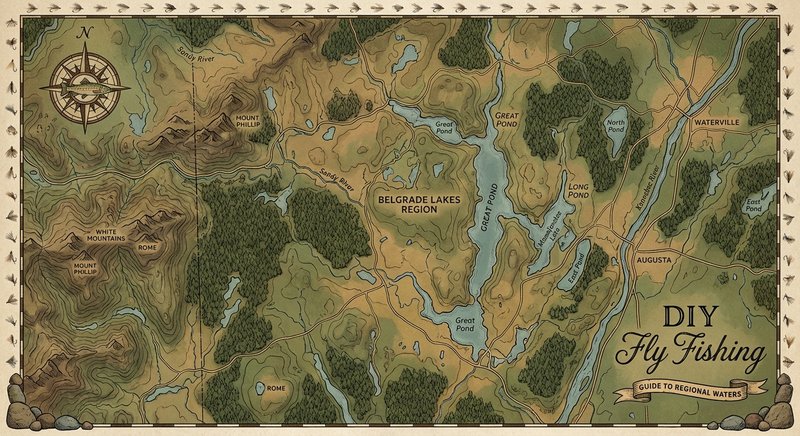
Belgrade Lakes
Fly fishing in Maine · Beginner · Best seasons: Spring, Summer, Fall
Target Species
Smallmouth Bass, Largemouth Bass, Brown Trout
About This Water
Central Maine lake chain with bass and panfish. Family-friendly fishing destination.
Fishing Recommendations
Welcome to the Belgrade Lakes region of Maine. As a guide, I consider this one of the premier freshwater fly fishing destinations in the Northeast. Located just north of Augusta, this chain of seven lakes—Great, Long, Messalonskee, North, East, Salmon, and McGrath—offers a diverse "choose your own adventure" experience ranging from rocky, smallmouth-choked points to lush, largemouth-filled lily pads and deep, cold haunts for trophy trout.
Here is your professional guide to fly fishing the Belgrades.
🎣 Location Overview
The Belgrade Lakes are a glacial masterpiece. What makes this area special is the diversity of habitat within a relatively small geographic footprint.
- Great Pond and Long Pond are the "crown jewels," featuring massive expanses of water with dramatic drop-offs, rocky shoals, and deep basins that hold cold-water species.
- East Pond and North Pond are shallower, warmer, and nutrient-rich, making them absolute factories for "bucketmouth" Largemouth Bass.
- The Connectors: The streams connecting the lakes (like Belgrade Stream and Messalonskee Stream) offer a more intimate, river-like experience for those who prefer to wade or fish from a canoe.
Anglers love the Belgrades because you can chase "Smallies" on topwater in the morning and hunt for a 5-pound Brown Trout or a heavy Largemouth in the afternoon, all while surrounded by the classic "On Golden Pond" Maine scenery.
🐟 Target Species & Behavior
Smallmouth Bass
The "bronzebacks" here are world-class. They are aggressive and highly mobile.
- Behavior: In spring, they move to shallow, rocky flats and points to spawn. In summer, they retreat to deeper "humps" (10–20 feet) but move into the shallows to feed during low-light periods.
- Feeding: Their diet is heavy on crayfish and "smelt" (landlocked rainbow smelt).
Largemouth Bass
Found primarily in the weedy bays of Great Pond and throughout East and North Ponds.
- Behavior: Structure-oriented. Look for them under docks, deep in lily pad fields, or tucked under downed timber. They are ambush predators.
- Feeding: Frogs, dragonflies, and sunfish.
Brown Trout
Primarily found in Long Pond and Great Pond, which have the depth and oxygen to support them year-round.
- Behavior: They are notorious "ghosts." In early spring and late fall, they can be found near the surface or around rocky points. In summer, they hold deep near the thermocline (25–40 feet).
- Feeding: Heavily focused on baitfish (smelt).
📅 Best Times to Fish
Spring (Mid-May to Late June) — Prime Time
This is the "Golden Window." As the water hits 55–60°F, Smallmouth move to the shallows. Sight fishing for spawning bass is possible (please practice catch and release immediately). This is also the best time to catch Brown Trout near the surface.
Summer (July to August)
- Bass: Best during the "magic hour" (dawn and dusk). Mid-day fishing requires sinking lines to reach fish on deeper structure.
- Trout: Very difficult on a fly rod during mid-summer unless you are fishing the tailwaters or using heavy full-sinking lines in the main lakes.
Fall (September to October)
The "Feeding Frenzy." As temperatures drop, bass move back to the shallows to gorge before winter. The foliage is world-class, and the boat traffic disappears. Brown Trout become more active near stream mouths as they prepare for their own spawning cycles.
🪰 Recommended Flies & Techniques
For Bass (Topwater)
- BoogleBugs (Size 4-6): The gold standard for durability and "pop."
- Dahlberg Divers: Perfect for mimicking frogs or injured baitfish near weeds.
- Murdsick Mini-Minnow: A "slider" style fly that is deadly for Smallmouth when they are chasing bait on the surface.
For Bass (Subsurface)
- The Game Changer: In white or olive. There is no better smelt/baitfish imitation.
- Near Nuff Craw: A fantastic crayfish pattern. Bounce this off rocky points for Smallmouth.
- Woolly Bugger (Black or Olive): Still the most versatile fly in Maine.
For Brown Trout
- Grey Ghost or Black Ghost: Classic Maine streamers. They represent the smelt perfectly.
- Muddler Minnow: Fish this on a sinking tip near rocky drop-offs.
Techniques
- The "Belgrade Twitch": When using topwater poppers, less is often more. Give it a pop, then let it sit until the rings disappear. Most strikes happen on the dead pause.
- Counting Down: When fishing subsurface, use a sinking-tip line. Cast, count to 10 or 15 to let the fly reach the "zone," and use erratic strips.
💡 Pro Tips & Local Knowledge
- Find the "Humps": Use a topographic map or GPS to find underwater islands (humps) in Great Pond. Smallmouth congregate here. A hump that rises from 30 feet up to 12 feet is a gold mine.
- The "Serpentine": The winding waterway between East Pond and North Pond is a hidden gem for fly anglers in kayaks. It is protected from the wind and full of aggressive Largemouth.
- Wind is your Friend (Sometimes): A "walleye chop" on the water often emboldens Smallmouth to feed in shallower water during the day. Don't be afraid of a little wind; just find a windward point where baitfish are being pushed.
- Fish the Docks: In the heat of summer, the shadow under a swimming dock is often 5 degrees cooler. A well-placed cast under a dock on Long Pond can yield a 4-pound Largemouth.
⚠️ Important Information
- Licensing: You must have a valid Maine Freshwater Fishing License. These can be purchased online at the Maine Department of Inland Fisheries & Wildlife (IFW) website.
- Invasive Species: Maine takes "Milfoil" and other invasive plants very seriously. Clean, Drain, Dry your boat and gear when moving between lakes.
- Safety: These lakes are large. Weather can move in fast, and the "Great Pond" can get very choppy. Always check the wind forecast before heading out in a small craft.
- Regulations: Note that some areas have "Artificial Lures Only" or specific "Catch and Release" windows. Always check the current Maine Open Water Fishing Laws (The "Green Book").
Guide's Final Word: The Belgrade Lakes are a place where you can truly find peace. Respect the water, watch for loons, and keep your rod tip down!
Bug Hatches & Matching Flies
| Hatch | Type | Peak months | Time of day | Hook sizes | Matching flies |
|---|---|---|---|---|---|
| Hexagenia (The Hex) Hexagenia limbata | mayfly | June, July | Dusk/Night | #6-10 | Hexagenia Dry #6-8, Hex Nymph #8-10, Hex Emerger #8 |
| Hendrickson Ephemerella invaria | mayfly | May | Afternoon | #12-14 | Red Quill #12-14, Hendrickson Nymph #12-14, Comparison Dun #14 |
| Light Cahill Stenacron interpunctatum | mayfly | June, July | Evening | #12-16 | Light Cahill Dry #12-16, Gold Ribbed Hare's Ear #14-16 |
| Spotted Sedge Hydropsyche | caddis | June, July, August | Evening/Dusk | #14-18 | Elk Hair Caddis (Tan) #14-16, LaFontaine's Deep Sparkle Pupa #14-18 |
| Damselfly Enallagma | terrestrial | June, July | Morning/Afternoon | #10-14 | Marabou Damselfly Nymph #10-12, Adult Damselfly #12 |
| Slate Drake Isonychia bicolor | mayfly | August, September | Afternoon/Evening | #10-12 | Isonychia Parachute #10-12, Zug Bug #10-12 |
| Trico Tricorythodes spp. | mayfly | July, August, September | Early Morning | #20-24 | Trico Spinner #20-24, RS2 (Black) #22 |
| Flying Ants Formicidae | terrestrial | August, September | Afternoon | #14-20 | Black Flying Ant #16-18, Cinnamon Ant #14-16 |
| Grannom Caddis Brachycentrus | caddis | May | Morning/Afternoon | #12-16 | Grannom Pupa #14-16, Peacock Caddis #14-16 |
| Chironomids (Midges) Chironomidae | midge | April, May, September | All Day | #18-24 | Zebra Midge #18-22, Griffith's Gnat #20-22 |