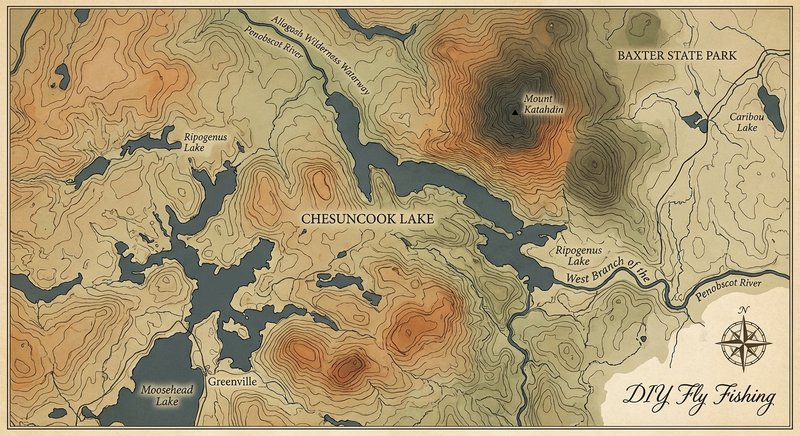
Chesuncook Lake
Fly fishing in Maine · Advanced · Best seasons: Spring, Summer, Fall
Target Species
Lake Trout, Landlocked Salmon, Brook Trout
About This Water
Remote Piscataquis County lake with lake trout and salmon. True wilderness experience.
Fishing Recommendations
Chesuncook Lake is the third-largest body of water in Maine and represents the true "wild heart" of the North Maine Woods. Located deep in the shadow of Mount Katahdin, this is a massive, undeveloped reservoir created by the damming of the West Branch of the Penobscot River.
As your guide, I can tell you that Chesuncook isn't just a lake; it’s a gateway to a bygone era of fly fishing. It is rugged, often windswept, and home to some of the most aggressive wild salmonids in the Northeast.
🎣 Location Overview
Chesuncook Lake is approximately 22 miles long and serves as a massive collection basin for the West Branch of the Penobscot. What makes it special is its isolation and its dual nature: it offers deep-water lake fishing while being fed by legendary moving waters like the West Branch and the Caucomgomoc Stream.
The water is tea-colored (tannic), common for Maine woods lakes, and stays relatively cool due to its depth and northern latitude. Anglers love it because it lacks the crowds of the Rangeley or Moosehead regions. It is a place where you are more likely to see a moose or a bald eagle than another drift boat.
🐟 Target Species & Behavior
- Landlocked Salmon: These are the "silver bullets" of Chesuncook. They are incredibly acrobatic and feed primarily on Rainbow Smelt. In the spring and fall, they cruise the surface and the mouths of tributaries. In summer, they drop deep into the thermocline.
- Lake Trout (Togue): The local name is "Togue." These are the giants of the deep. They are bottom-oriented predators that grow large by feasting on smelt and whitefish.
- Brook Trout: While the lake holds massive native brookies, they are most effectively targeted where the cool inlets and spring-fed streams enter the main body of water. They are opportunistic feeders but lean heavily on insect hatches (Mayflies and Caddis) and small baitfish.
📅 Best Times to Fish
- Spring (Ice-out to Mid-June): The Prime Window. When the ice clears (usually late April/early May), the smelt run into the tributaries to spawn. Salmon and trout follow them into the shallows. This is the only time you can consistently catch Togue on a fly rod near the surface.
- Summer (July - August): Fishing shifts to deep-water trolling or targeting the "cool water" refuge areas. Fly fishing becomes difficult on the main lake unless you are fishing the "Inlet" where the West Branch enters, as the moving water stays oxygenated.
- Fall (September - October): As temperatures drop, the Salmon and Brook Trout begin their spawning migrations. They congregate at the mouths of the West Branch and the Umbazooksus Stream. Their colors become brilliant, and their aggression levels spike.
🪰 Recommended Flies & Techniques
Top Fly Patterns
- Streamers (The Local Staple):
- Gray Ghost and Black Ghost (Classic Maine patterns)
- Joe’s Smelt or Magog Smelt (Size 2-6, long shank)
- Muddler Minnow (Greased for surface or weighted for depth)
- Dry Flies:
- Hexagenia Limbata (The "Mayfly" of the North – late June/July evenings)
- Elk Hair Caddis (Tan or Olive, size 12-16)
- Royal Wulff (Excellent attractor for Brookies)
- Nymphs:
- Pheasant Tail (Size 14-18)
- Prince Nymph (Bead head for the moving water sections)
Effective Techniques
- Trolling the Fly: This is a classic Maine technique. Using a sinking tip or full sinking line, let out 50–70 feet of line behind a motorized boat or canoe at a "brisk walk" pace. Twitch the rod tip to give the streamer a "wounded" action.
- "Stripping" Streamers: Near the rocky points or the dam, cast towards the structure and use fast, erratic strips to mimic a fleeing smelt.
- The "Hex" Hatch: In late June, be on the water at dusk. The giant Hexagenia mayflies hatch, and even the largest Lake Trout will come to the surface to gulp these "butterflies" of the North Woods.
💡 Pro Tips & Local Knowledge
- Focus on the "Inlet": The area where the West Branch of the Penobscot enters the north end of the lake is legendary. The current creates a conveyor belt of food. Target the seams where the river current meets the still lake water.
- Wind is Your Friend and Enemy: A light chop (the "Salmon chop") oxygenates the surface and hides your leader. However, Chesuncook can turn dangerous quickly. If the wind picks up from the Northwest, get off the main lake immediately.
- The "Smelt Follow": If you see gulls diving or bubbles on the surface, you’ve found the smelt. Use a fast-sinking line to get your fly under the school of bait, as that's where the big Landlocks are waiting for cripples.
- Think Small for Brookies: While the Salmon want a 4-inch streamer, the big Brookies in the late season often key in on tiny #18-20 midges or nymphs in the tributary pools.
⚠️ Important Information
- Access: This is remote. Most access is via the Golden Road (a private logging road) or through the town of Greenville. Ensure your spare tire is inflated; these roads are gravel and rough.
- North Maine Woods (NMW): You will have to pass through a checkpoint (like the Caribou Checkpoint) and pay a per-night/per-person fee to enter this managed wilderness area.
- Regulations: Maine fishing laws are specific. Chesuncook has specific bag limits and length requirements for Landlocked Salmon (usually 14 or 16 inches). Always check the current Maine Open Water Fishing Laws before your trip.
- Safety: There is no cell service. Carry a satellite messenger (InReach/Zoleo), a physical map (Delorme Maine Atlas), and plenty of bug spray—the black flies in June are the stuff of legend.
Guide's Final Word: Chesuncook is for the angler who values the experience as much as the catch. Respect the water, watch the weather, and keep your fly in the water—the next strike could be the fish of a lifetime.
Bug Hatches & Matching Flies
| Hatch | Type | Peak months | Time of day | Hook sizes | Matching flies |
|---|---|---|---|---|---|
| Hendrickson Ephemerella subvaria | mayfly | May | Afternoon | #12-14 | Red Quill #12-14, Hendrickson Emerger #14, Pheasant Tail #12-16 |
| Blue-Winged Olive Baetis spp. | mayfly | May, September, October | Mid-day/Afternoon | #18-22 | BWO Sparkle Dun #18-20, RS2 #20-22, Olive Parachute #18-22 |
| March Brown Maccaffertium vicarium | mayfly | June | Afternoon | #10-12 | March Brown Dry #10-12, Hare's Ear Nymph #10-12 |
| Grannom Caddis Brachycentrus | caddis | May | Morning/Evening | #14-16 | Grannom Pupa #14-16, Elk Hair Caddis (Olive) #14-16, Peacock Caddis #16 |
| Eastern Green Drake Ephemera guttulata | mayfly | June | Evening | #8-12 | Green Drake Parachute #8-10, Coffin Fly #8-10, Green Drake Nymph #8-12 |
| Hex Hexagenia limbata | mayfly | June, July | Late Evening/Dusk | #6-10 | Hexagenia Dry #6-8, Hex Wiggle Nymph #6-10, Hex Emerger #8 |
| Light Cahill Stenacron interpunctatum | mayfly | June, July | Evening | #12-16 | Light Cahill Dry #12-16, Gold Ribbed Hare's Ear #14-16 |
| Spotted Sedge Hydropsyche | caddis | June, July, August | Evening | #14-18 | Elk Hair Caddis (Tan) #14-18, LaFontaine's Deep Sparkle Pupa #14-16 |
| Trico Tricorythodes spp. | mayfly | August, September | Morning | #22-26 | Trico Spinner #22-24, Trico Parachute #22-26 |
| Black Flying Ant Formicidae | terrestrial | August, September | Afternoon | #14-18 | Black Foam Ant #14-18, Flying Ant (CDC) #16-18 |